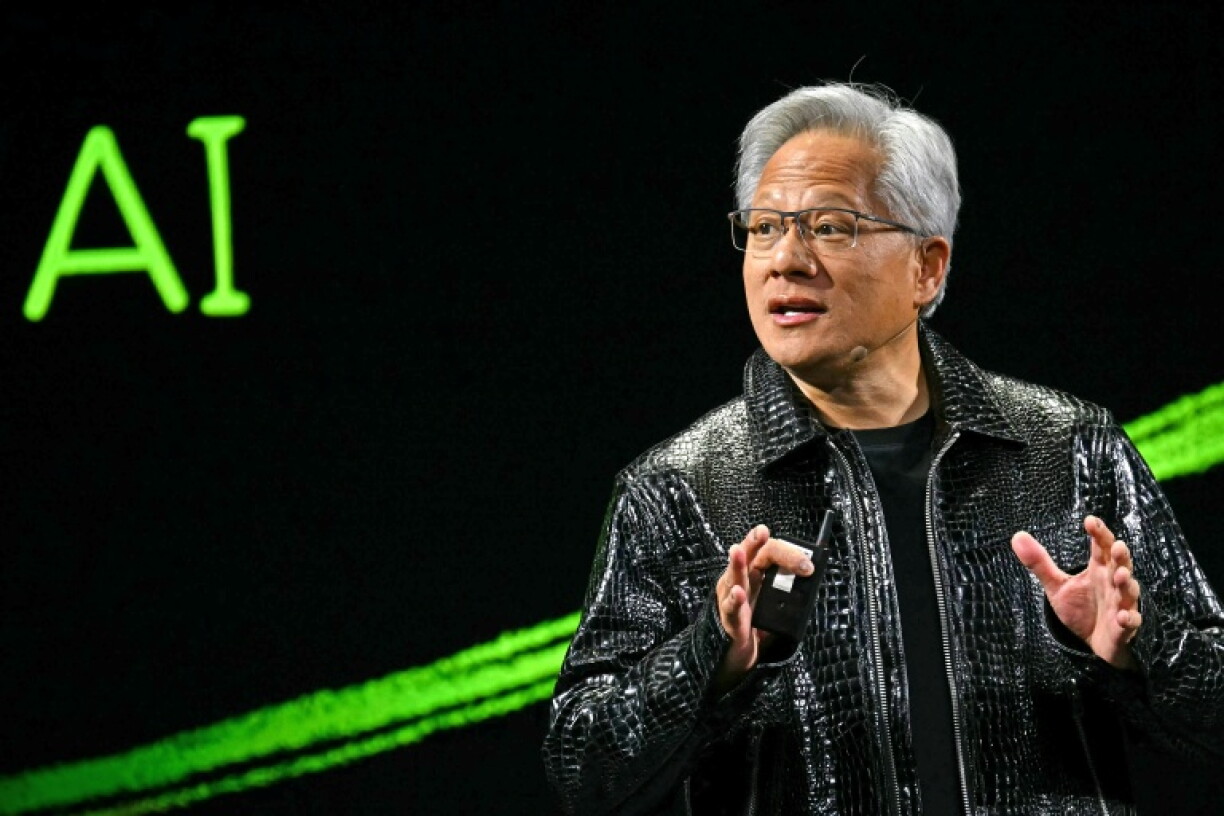
He had rockstar status, and now the artificial intelligence industry is weighing up how to move forward without Jensen Huang at the helm of American chips king Nvidia, which has become known as the "central bank of AI."
Before his resignation on Thursday after details emerged about multiple extramarital affairs, including with a suspected Chinese spy, Huang had positioned himself as a major booster for the AI industry across both political and financial lines.
He had built close ties to Donald Trump, accompanying him on Air Force One earlier this year when the US president traveled to Beijing for a summit with Chinese leader Xi Jinping.
And while other executives called for slowing down AI development over safety concerns, Huang pushed for plowing forward -- perhaps not surprising from the head of a company that has poured billions into the companies, data centers and chips deals that it stands to profit from.
Those efforts sparked questions about so-called circular dealmaking, highlighting the potentially fragile nature of Nvidia's financing activities.
Among those deals was a more than $100 billion financing guarantee for a new data center in Ohio for ChatGPT-maker OpenAI.
Nvidia has also committed to purchasing $10 billion-worth of shares in Anthropic's upcoming IPO next week.
The chip designer's own growth appears to be on solid footing, at least for now.
"The subsequent formal CEO transition and related organizational changes are expected to begin affecting Nvidia’s product development and competitiveness no earlier than 2028," Ming-Chi Kuo, an analyst at TF International Securities, wrote on X.
Nvidia CFO Colette Kress was named interim CEO on Thursday.
But expect "chaos," warned Gary Marcus, a longtime tech industry critic, who wrote on Substack that "things will clearly never be the same, neither for Nvidia, nor the AI industry as a whole. Congressional investigations will continue. The market may crash."
Huang persuaded Trump to allow sales of some of Nvidia’s high-end chips to China, despite the countries' rivalries and existing export controls.
Huang will now be absent when the US president meets with President Xi next week at the APEC summit in Shenzhen.
The ousted CEO has agreed to testify behind closed doors before Congress, according to Republican representative John Moolenaar.
In a note published Thursday, analyst Dan Ives called the whole sage a "black eye moment" for Huang.
However, the situation might prove to "sharpen the sword in the battle and arms race" between the US and China, the note continued.
Huang's resignation also presents an opportunity for the industry.
"Other US tech leaders are now going to have step in," Ives wrote in his note, highlighting Microsoft CEO Satya Nadella, Google CEO Sundar Pichai and Apple Chairman Tim Cook among others.
smb/bgs


