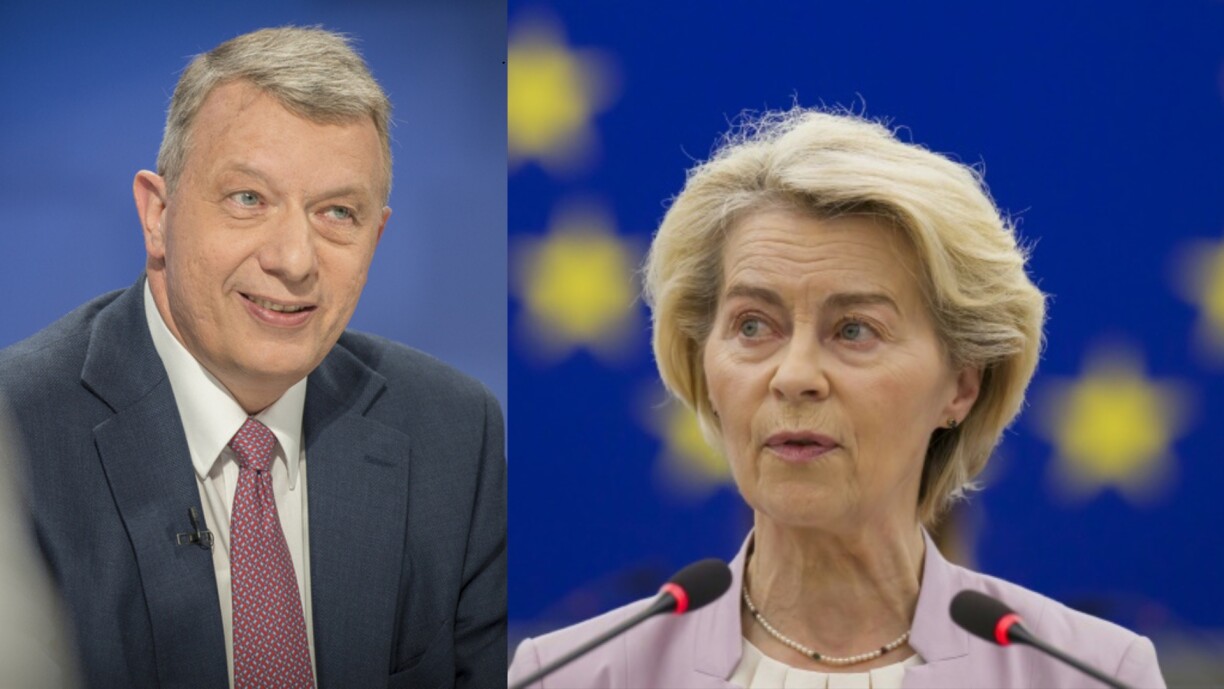
The president of the European Commission comfortably survived the vote by a wide margin, with 360 MEPs rejecting it and 175 backing the move. 18 MEPs abstained.
Amongst those voting to oust von der Leyen were Luxembourg's Fernand Kartheiser alongside 39 MEPs from the European Conservatives and Reformists (ECR), 75 from the Patriots for Europe (PfE), 24 from the European Sovereignists (ESN), 22-non attached members, and 13 from the European Left.
In a moment of global volatility and unpredictability, the EU needs strength, vision, and the capacity to act," von der Leyen, who wasn't at the parliament for the vote, wrote on X afterwards.
"As external forces seek to destabilize and divide us, it is our duty to respond in line with our values. Thank you, and long live Europe."
Addressing parliament earlier this week, von der Leyen had dismissed the initiative as a conspiracy theory-laden attempt to divide Europe, slamming its supporters as "anti-vaxxers" and "apologists" for Russian President Vladimir Putin.
She had urged lawmakers to renew confidence in her commission arguing it was critical for Europe to show unity in the face of an array of challenges, from US trade talks to Russia's war in Ukraine.
The no-confidence motion was initiated by Romanian far-right lawmaker Gheorghe Piperea.
He accused von der Leyen of a lack of transparency over text messages she sent to the head of the Pfizer pharmaceutical giant when negotiating Covid vaccines.
The commission's failure to release the messages -- the focus of multiple court cases -- has given weight to critics who accuse its boss of centralised and opaque decision-making.
That has also been a growing refrain from the commission chief's traditional allies on the left and centre, who largely backed von der Leyen, but used the vote to air their grievances.
One major complaint from her critics is that von der Leyen's centre-right camp has increasingly teamed up with the far-right to further its agenda -- most notably to roll back environmental rules.
Iratxe Garcia Perez, the head of the centre-left Socialists and Democrats, said the group's support did not "mean that we are not critical of the European Commission".
Its shift towards the far-right was "a major cause for alarm", she added.
"The motion of censure against the European Commission has been overwhelmingly rejected," centrist leader Valerie Hayer wrote on X. "But our support for von der Leyen is not unconditional."
"Pfizergate" aside, Romania's Piperea accused the commission of interfering in his country's recent presidential election, in which pro-European Nicusor Dan narrowly beat EU critic and nationalist George Simion.
That vote came after Romania's constitutional court scrapped an initial ballot over allegations of Russian interference and massive social media promotion of the far-right frontrunner, who was barred from standing again.
Piperea's challenge was supported by some groups on the left and part of the far right -- including the party of Hungary's nationalist Prime Minister Viktor Orban.
But Piperea's own group, the ECR, was split on the question.
Its largest faction, the party of Italian Prime Minister Giorgia Meloni that did not back the motion.





