On 12 August, the Moon will hide almost 90% of the Sun’s visible surface from Luxembourg, leaving a narrow solar crescent low in the evening sky. Only a few hours later, the same new Moon will create almost perfect conditions for the peak of the Perseids, offering one of the most promising meteor nights in years.
Then, on 28 August, the alignment will reverse and Earth’s shadow begins to cover the Moon during a partial lunar eclipse visible before dawn.
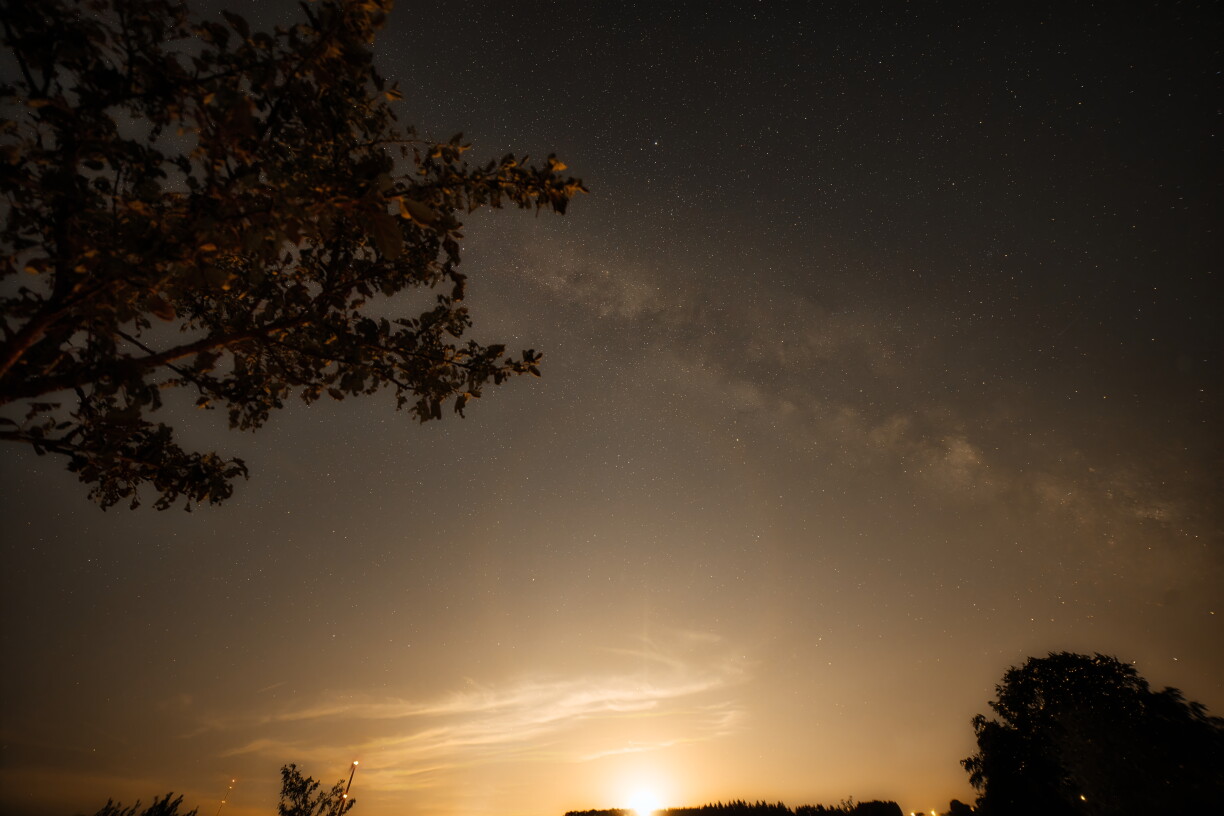
Meanwhile, the darkness that began to return in July continues to gain ground and as the Summer Triangle climbs higher, the Milky Way becomes easier to see.
Here is what to look for in the August night sky:
The first part of August begins with the Moon gradually retreating from the evening sky, leaving the early night increasingly free from lunar glare. True darkness arrives shortly before midnight at the beginning of the month, but by the end of August, the sky will be properly dark shortly after 10pm.
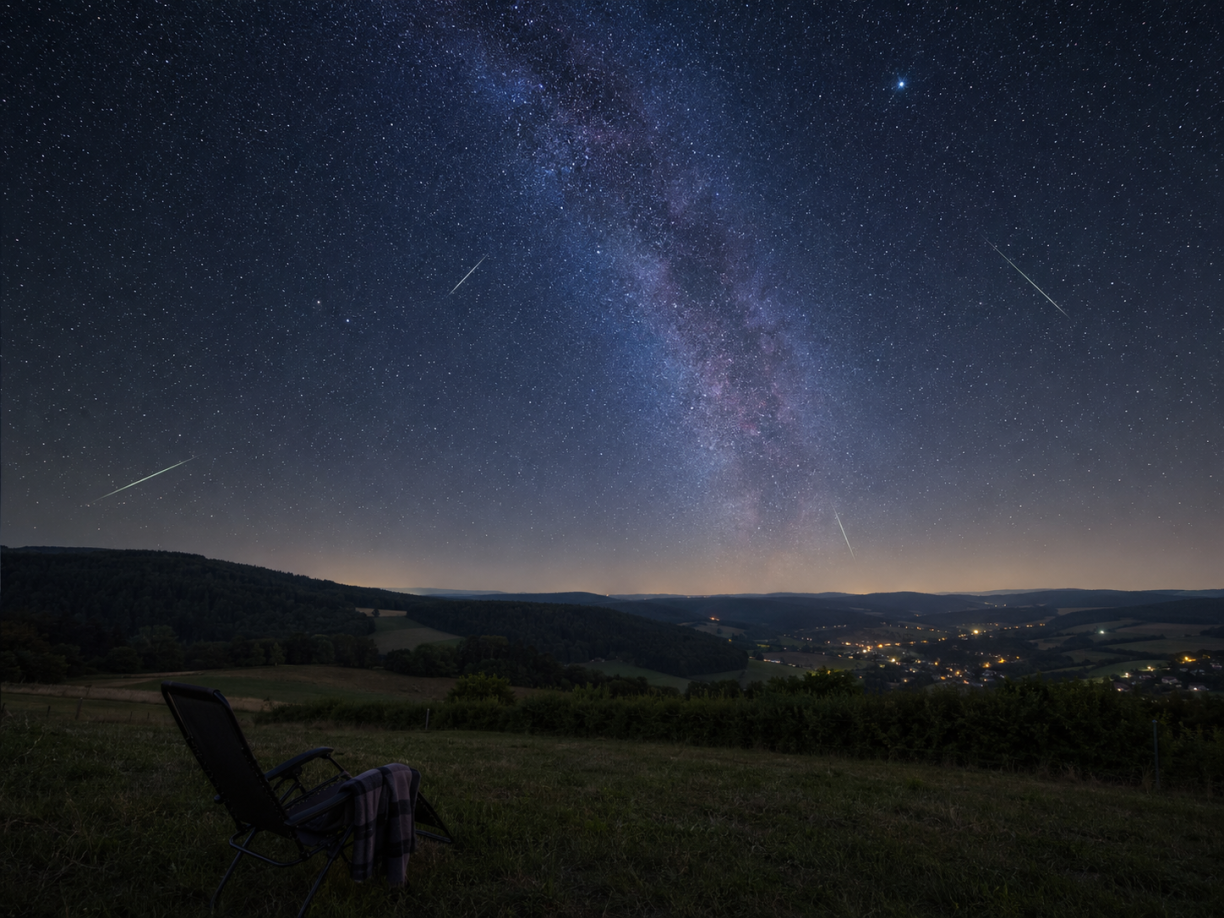
This is a good time to observe the summer Milky Way, using the Summer Triangle, formed by bright stars Vega, Deneb and Altair as the easiest guide. Spend a night in the Éislek region to see the Milky Way as a pale, irregular band running through the southern sky. Bring a blanket or a chair and just enjoy the show.
Set the alarm on 9 August to watch the waning crescent Moon passing close to Mars. The pair will be visible in the east before dawn, with Mars recognisable by its warm, reddish colour. It should be an elegant sight through binoculars and a rewarding subject for photographers awake early enough to catch it.
On 12 August, Luxembourg will experience a deep partial solar eclipse, with the Moon covering nearly 90% of the Sun; it begins at around 7.20pm, when the Moon takes its first small bite from the solar disc, to reach the peak at approximately 8.15pm.
Despite the very high coverage, the sky will not become dark as it does during totality: even a small part of the solar surface produces an extraordinary amount of light. The landscape may appear slightly dimmer, but daylight will remain.
This is nonetheless an unforgettable event that can’t be missed. That is why Nightwise and UniPop have organised a large public event, Solar Eclipse Day 2026, which will take place at the Däichhal in Ettelbruck. Here Nightwise and its partners will distribute free solar eclipse glasses to observe the event safely while also offering scientific workshops for the whole family.
All info about the event is available here:
Important: The eclipse must never be observed directly without suitable solar viewers, as ordinary sunglasses provide no protection.
Once the partially eclipsed Sun has disappeared, the same new Moon responsible for the eclipse will create perfect conditions to observe the Perseids. The most rewarding observing window for the meteor shower is between approximately 1am and 4am.
The central part of the month closes with Venus taking centre stage. The planet reaches its greatest eastern elongation on 15 August, and on 16 August it will appear close to a young crescent Moon, creating one of the month’s loveliest naked-eye conjunctions.
The final third of August begins under the growing Moon, which reaches first quarter on 20 August. On the evening of 21 August, it passes close to Antares, the reddish star in the heart of the constellation Scorpius. Antares is often mistaken for Mars because of its colour: its name comes in fact from an ancient expression meaning “rival of Mars”.
The main event, however, arrives during the early morning of 28 August, when the full Moon undergoes a partial lunar eclipse. It begins at approximately 4.33am, when Earth’s central shadow starts to cover the lunar surface.
From then on, the effect will become increasingly obvious as a curved darkness moves across the Moon. Maximum eclipse occurs at around 6.12am, when more than nine tenths of the Moon’s diameter will be inside Earth’s dark shadow.
At maximum, the Moon will be only about five degrees above the west-south-west horizon, with the morning sky already growing brighter. It sets at approximately 6.52am, before the eclipse has ended.
Saturn also becomes increasingly well placed towards the end of August, rising earlier each night and remaining visible through much of the second half of the night. Its best season is still approaching, but it is already the month’s most rewarding telescopic planet.
August 2026 is a remarkable month for astronomy: the Moon first moves between Earth and the Sun, Earth then crosses the dusty path of a comet, and two weeks later our planet passes between the Sun and the Moon.
The result is an eclipsed sunset, a moonless night of meteors and a second eclipse sinking into the dawn. All in the same month, under the best possible weather conditions. Hopefully.
9 August: Moon and Mars close encounter before dawn
12 August: Deep partial solar eclipse (start: 7.20pm, maximum: 8.15pm)
12–13 August: Perseids meteor shower
16 August: Moon and Venus conjunction after sunset
21 August: Moon and Antares conjunction
28 August: Partial lunar eclipse (start: 4.33am, maximum: 6.12am)





