On 26 September 2022, NASA’s Double Asteroid Redirection Test (DART) intentionally slammed into Dimorphos, a small body orbiting the larger asteroid Didymos. The high-speed collision served as a groundbreaking experiment to assess whether a targeted spacecraft could alter an asteroid’s path.
NASA declared the mission a major success when observations confirmed that Dimorphos took roughly 33 minutes less to complete an orbit around Didymos. While neither asteroid posed any threat to Earth, the experiment demonstrated that a spacecraft impact could change an asteroid’s motion, supporting its potential use in planetary defence.
Now, Europe’s own detective is approaching the crime scene: Hera, ESA’s pioneering planetary defence spacecraft, launched in October 2024 and will reach Dimorphos and Didymos in November 2026. Its mission is to examine the impact site, measure the changes caused by DART and gather data to help scientists refine future asteroid defence plans.
Successfully knocking one asteroid off course was a huge breakthrough, but using the same tactic on a future threat isn't a one-size-fits-all solution. Space rocks come in all shapes and sizes, with vastly different masses, compositions, and internal structures that dictate how they manage a hit.
When a spacecraft strikes an asteroid, it delivers a direct push, but debris thrown into space by the impact can provide an added push through recoil. This makes the asteroid’s structure an essential part of the experiment, as a solid body and a loose collection of boulders can respond very differently to the same impact.
Research published in March 2026 showed that DART also slightly altered the pair’s orbit around the Sun, changing its roughly 770-day orbital period by about 0.15 seconds. The impact therefore affected both Dimorphos’s orbit around Didymos and the pair’s orbit around the Sun.
By studying the pair directly, Hera will improve measurements of Dimorphos’s mass, shape and physical properties, helping researchers connect the observed change in motion with what happened to the material.
Hera will investigate whether DART left a recognisable crater and how extensively it reshaped Dimorphos. The asteroid appears to be a loose collection of rocks held together mainly by gravity, so the collision may have rearranged material across a much wider area.
Moving one asteroid was an achievement. Understanding the result will help us prepare for a future threat.
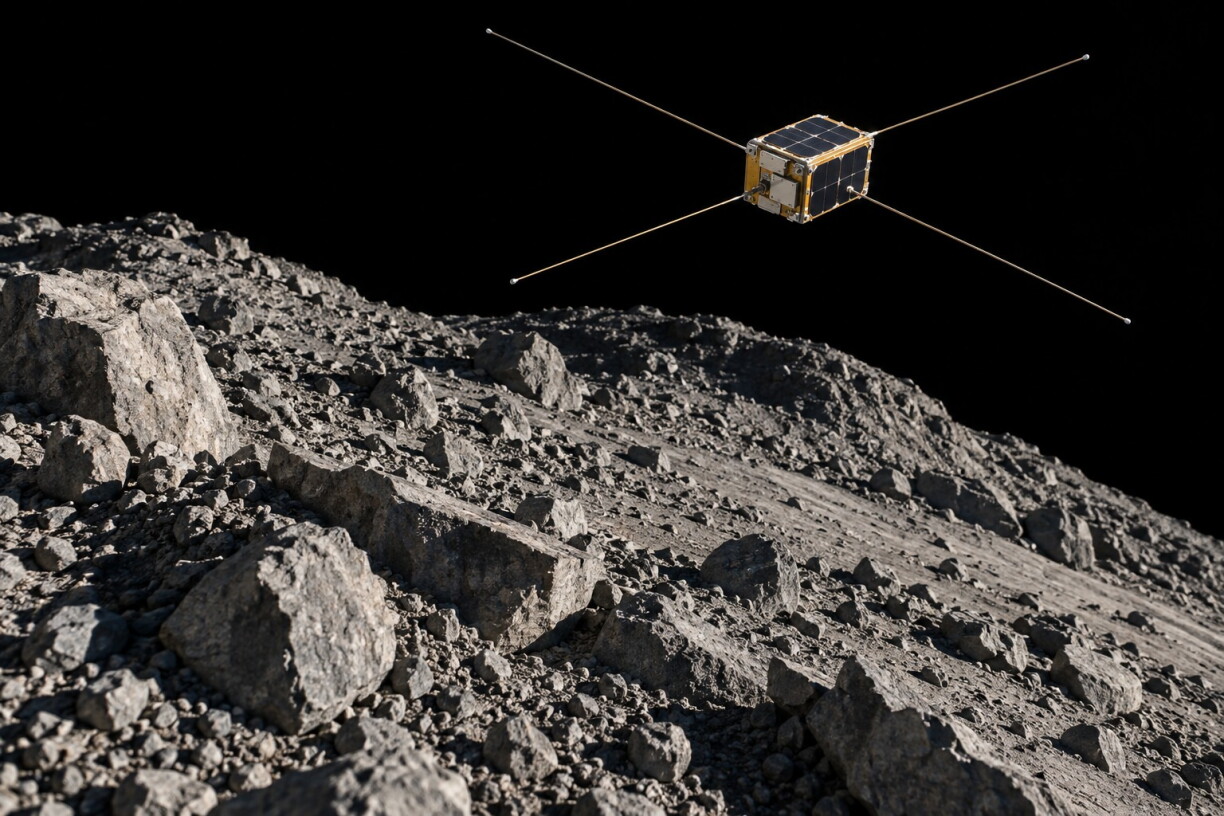
Hera also carries two small spacecraft, Juventas and Milani, which will separate from it near the asteroids and help study them, sharing their findings by radio.
Juventas has a direct Luxembourg connection: GomSpace Luxembourg oversaw its development, with assembly taking place in Denmark, while Luxembourg-based EmTroniX supplied electronics for its radar.
By sending radio signals into Dimorphos and analysing their reflections, Juventas will help reveal whether the asteroid has large empty spaces or a more tightly packed structure, something its rocky surface alone cannot tell us.
Milani will study the light reflected by both asteroids to identify the materials on their surfaces, while also examining the dust around them. Combined with Hera’s observations, these measurements will help scientists understand what the asteroids are made of and how Dimorphos responded to the impact.
By combining these findings, researchers will be able to evaluate and refine the models used to predict how different asteroids respond to an impact. Those predictions are essential when planning a future mission to deflect an asteroid that really does threaten Earth.
Time, however, remains crucial to planetary defence, because a minor change to an asteroid’s motion can be enough to prevent a collision if it is made far enough in advance. Waiting until the last moment leaves far fewer options, which is why finding and tracking asteroids is as important as developing ways to deflect them.
When Hera reaches its destination, scientists will finally be able to examine at close range the aftermath of an impact they have spent four years studying from afar. DART has already shown that a spacecraft can change an asteroid’s motion; Hera’s task is to explain how the target responded and help scientists predict what a similar collision might achieve elsewhere.
Hera could help us better protect our planet from future asteroid impacts, and Luxembourg is playing a part in that effort.


