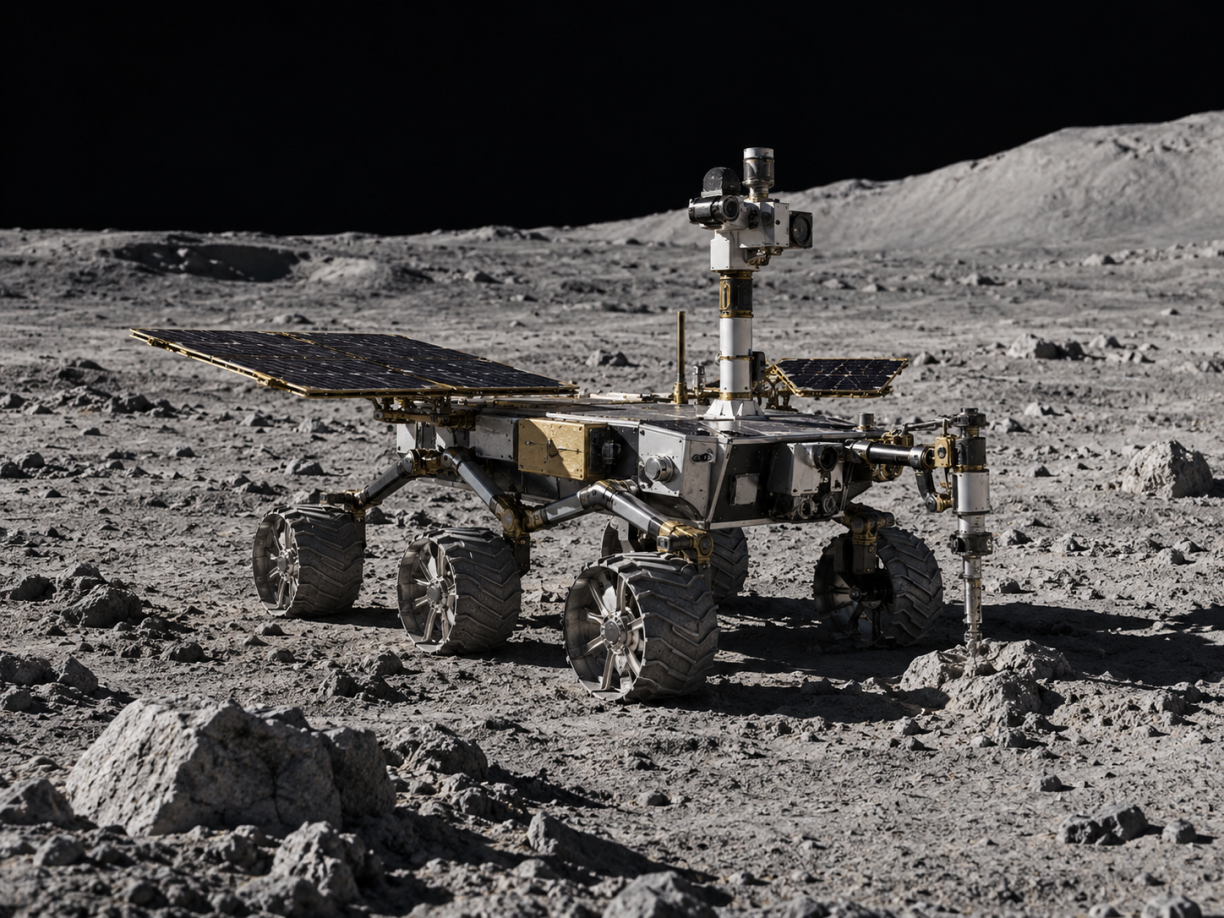
In a few years, a rover led from Luxembourg could be driving across one of the least understood regions of the Moon. Its destination is the lunar south pole, where deep shadows may preserve water ice that has remained hidden for immense periods of time.
Its name is MAGPIE, and if the mission succeeds, it will become the first European rover to operate on the Moon.
MAGPIE stands for Mission for Advanced Geophysics and Polar Ice Exploration. The European Space Agency (ESA) has officially signed a €65 million Phase 2 contract with Luxembourg-based ispace-EUROPE covering the mission’s remaining development, manufacture, testing, transportation to the lunar surface, operations, and delivery of scientific data.
The rover is planned to launch in 2029 aboard ispace's Mission 4 ULTRA lander and operate for roughly ten Earth days.
Scientists have known for years that water ice exists near the lunar poles. NASA's Lunar Crater Observation and Sensing Satellite (LCROSS) mission confirmed ice in material ejected from a permanently shadowed crater in 2009, while data from India's Chandrayaan-1 later provided direct evidence of surface ice in permanently shadowed polar regions.
Some practical questions, however, are still open: where is the water, how much is present, how deeply is it buried and how sharply does its concentration change from one place to another?
Equipped with a drill, volatile analyser, ground-penetrating radar and neutron detector, MAGPIE will examine both the surface and what lies beneath it. By drilling into the regolith, the Moon's layer of broken rock and dust, and analysing gases released from the material, it will allow scientists to compare samples from several locations.
The lunar south pole is a complicated mixture of illuminated ground, deep craters, and permanently shadowed areas with extreme temperatures. A measurement at one site cannot describe the entire region, so MAGPIE will move between different terrains to help scientists understand how variable these deposits really are.This is exactly the kind of mission that can help Europe build operational capability on the Moon.
MAGPIE is one of the clearest signs yet of Luxembourg's growing role in the space sector. As ESA's prime contractor, ispace-EUROPE is responsible for leading the mission from design and payload integration to surface operations and the delivery of scientific data to ESA.
Scientific instruments are being supplied by partners in Germany, the United Kingdom, Norway, and the Czech Republic, while transport involves cooperation between ESA and the Japan Aerospace Exploration Agency.
Luxembourg is becoming the point at which these different capabilities are assembled into one European mission.
The Grand Duchy's present role is the result of decades of sustained investment. The country entered the space sector through satellite communications with the creation of SES in 1985 and joined ESA in 2005.
In 2016, it launched the SpaceResources.lu initiative and, the following year, became the first European country to establish a legal framework recognising rights over resources extracted in space. In 2020, it helped establish the European Space Resources Innovation Centre (ESRIC).
The wider sector has also expanded significantly: according to the Luxembourg Space Agency (LSA), the national ecosystem grew from 16 companies and around 600 workers in 2012 to approximately 80 space-related companies employing 1,650 people by 2024. MAGPIE makes that growth unusually tangible: hardware, expertise, and mission responsibility directed towards the lunar surface.
When it comes to space, however, there is no guarantee of success. ispace-EUROPE previously built TENACIOUS, the first European-designed, manufactured, and assembled rover launched towards the Moon. It travelled aboard ispace's Mission 2 in 2025, but the RESILIENCE lander made a hard landing before the rover could be deployed.
MAGPIE will use the newer ULTRA lander, with high-precision polar landing technology supported through a Japanese programme, but reaching the Moon safely remains one of the mission's greatest challenges.
Engineers are now working towards the rover's Structural Thermal Model readiness review, followed by locomotion testing. The planned 2029 launch should therefore be understood as a target, not an appointment written permanently into the calendar.
Although MAGPIE is designed to operate for only about ten Earth days, it could leave a much longer legacy. Beyond the search for lunar water, it will give European teams practical experience in building, integrating, and operating a mobile laboratory on another world. For Luxembourg, that may be its greatest significance.
The country has spent a decade presenting itself as a centre for the future use of space resources; MAGPIE is the moment that strategy begins to acquire wheels.





