The benefits and limitations of electric and combustion engine cars have been widely debated for a long time. But what does the carbon balance actually look like? While electric cars don't use diesel or petrol, they do need electricity and a battery. Do they really allow CO2 savings?
For those who want the answer right away: Electric cars have a lower carbon footprint if their life cycle is long enough.

More specifically, it is important to assess from what mileage an electric car outperforms a combustion car. To that end, the vehicle's manufacturing process and its usage must be compared. By the way, and this is important: We must, of course, always compare models that are truly comparable, i.e. similar in terms of size, power, and year of manufacture.
And one more thing: this article is not meant to promote either type of vehicle. Our focus is solely on comparing their carbon footprints. There are, of course, other considerations both for and against each type of car – such as practicality, cost, and the availability of raw materials. But in this article, the focus is limited to the carbon footprint.
For this episode, we worked with researcher Thomas Gibon from the LIST, who is among other things responsible for the website climobil.lu, to carry out calculations and verify the data and statements.
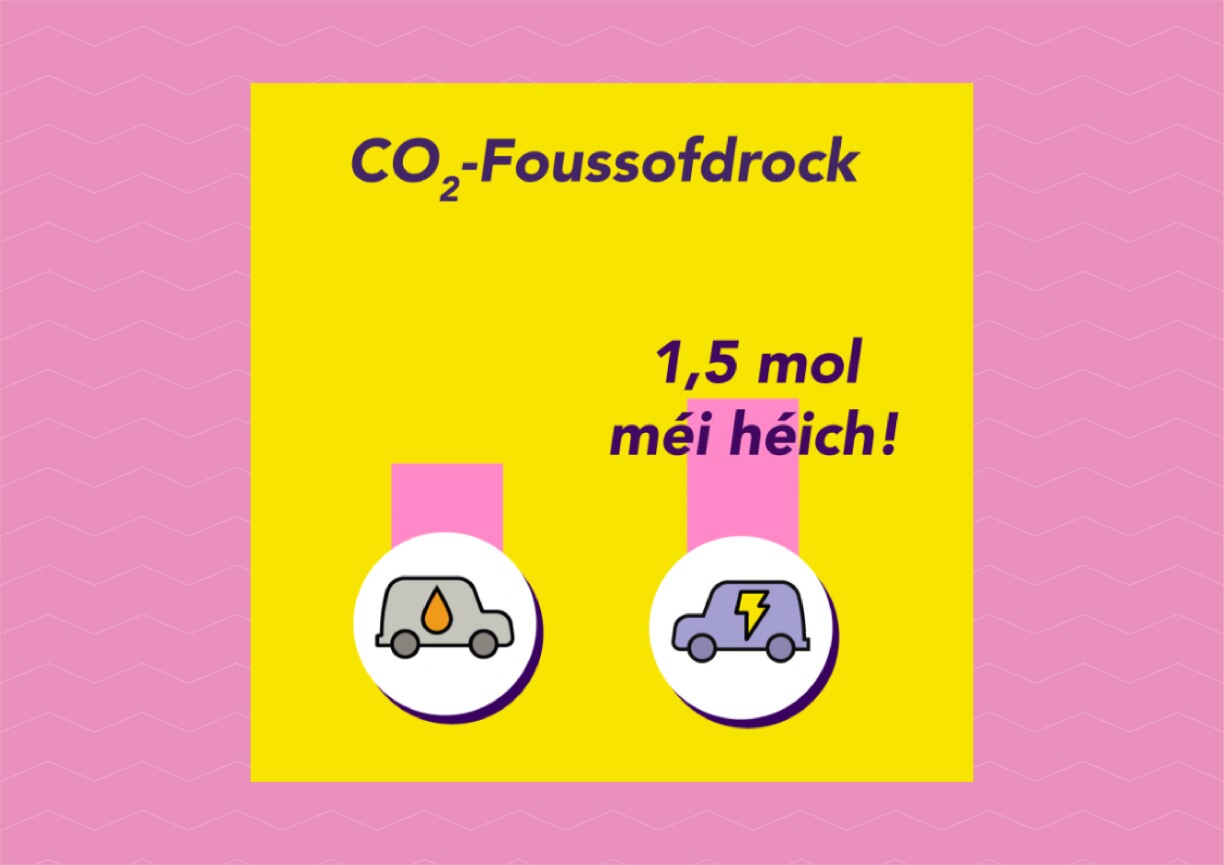
Let's start by examining the carbon footprint during production: the carbon footprint of an electric car is approximately one and a half times higher than that of a combustion car, provided comparable models are considered. The most significant difference lies in the energy-intensive production of the electric car battery.
That makes it a 1-0 win for the combustion engine!
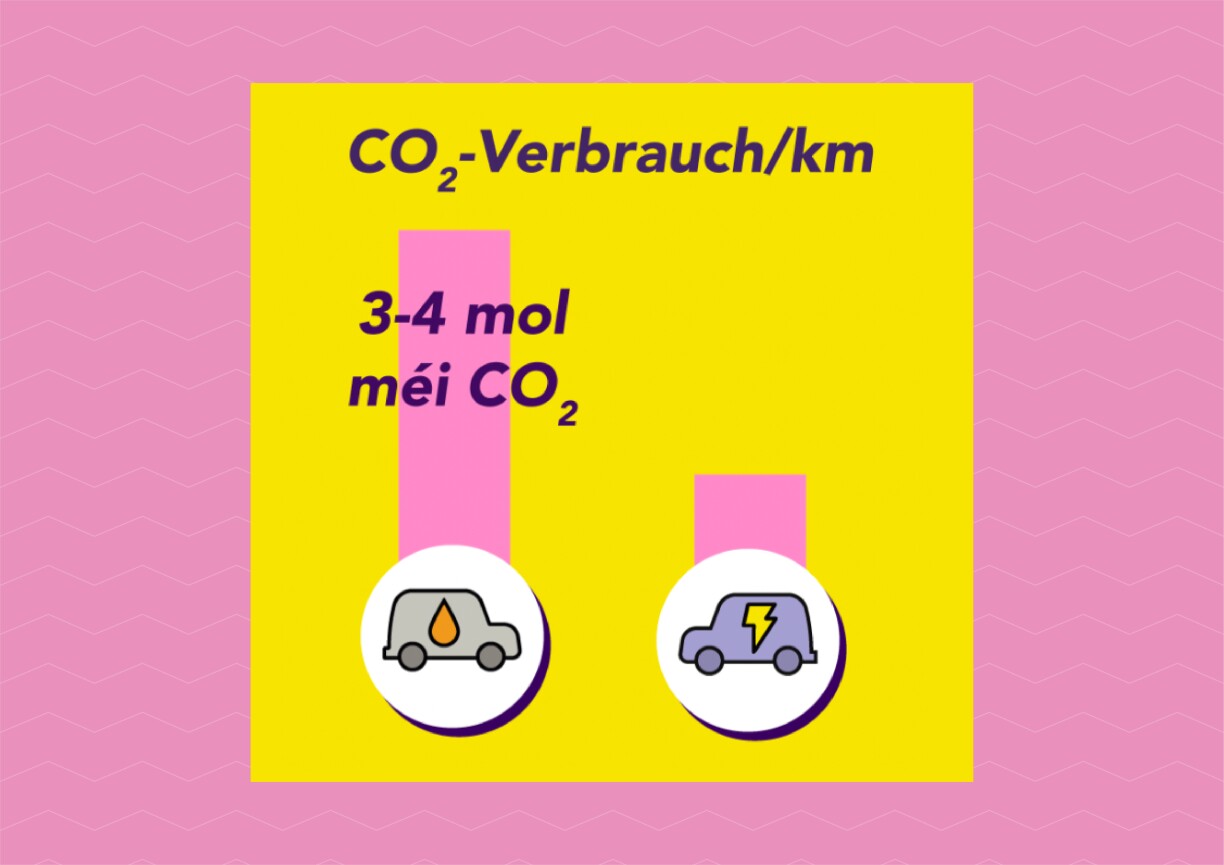
What about the carbon footprint during use? The combustion engine car generates around three to four times more CO2 than the electric car.
The carbon footprint in this scenario depends mainly on two factors:
Let's start with the energy efficiency of the engine: what proportion of the energy supplied to the car is actually used for driving and getting around ?
With electric cars, we achieve an overall energy efficiency of 80 to 90%.
So, 80 to 90% of the energy contained in the electricity used to charge the electric car is actually used for travelling. The rest is lost – primarily during battery charging and the conversion of electrical energy into mechanical energy.
In real-world conditions, the energy efficiency of a combustion car is often lower, especially in very cold or very hot weather when air conditioning or heating is needed...
Editor's note: in the video, we give a figure of 30%. In this article, we have replaced this figure with “30 to 40%” in order to provide a range and ensure greater consistency. There is always a gap between the values reported by manufacturers, which are based on optimal conditions and real-world conditions.
So only 30 to 40% of the energy contained in the diesel or petrol used to fuel a combustion car actually goes into moving it. Most of it is lost as heat during combustion.
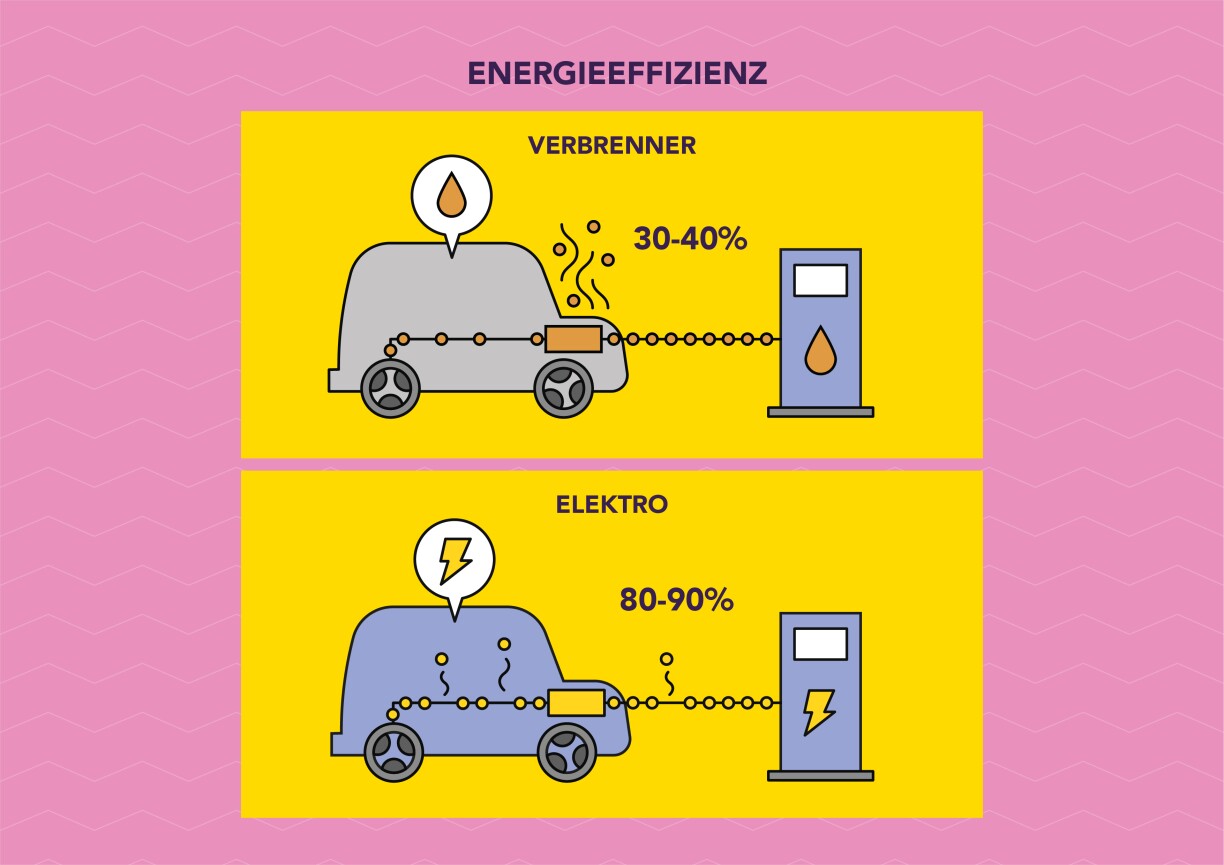
An electric engine is thus around two to three times more energy-efficient than a combustion engine.
But hold on... You also need energy to produce electricity. Doesn't that also emit CO2?
Yes, exactly! And that brings us to the second point: the carbon footprint of the energy source.
With diesel and petrol, the carbon footprint is always large. A lot of CO2 is produced during combustion.
By contrast, the carbon footprint of electricity largely depends on the energy sources used to produce it, whether it comes from renewable energy or from coal- or gas-fired power plants.
In the extreme scenario, with 100% of the electricity produced by burning fossil fuels, the electric car would offer no advantage in terms of CO2.* However, this scenario does not align with reality.
Comment by Thomas Gibon on this claim: "Current power plants have an average efficiency of 37%, which implies that the outcome would be virtually the same whether petrol or diesel is used directly by the car (30% efficiency) or first in a power plant and then by an electric car (37% × 80% = 30%). In Luxembourg, a relatively large share of the electricity mix comes from renewable energy with a low carbon footprint. "
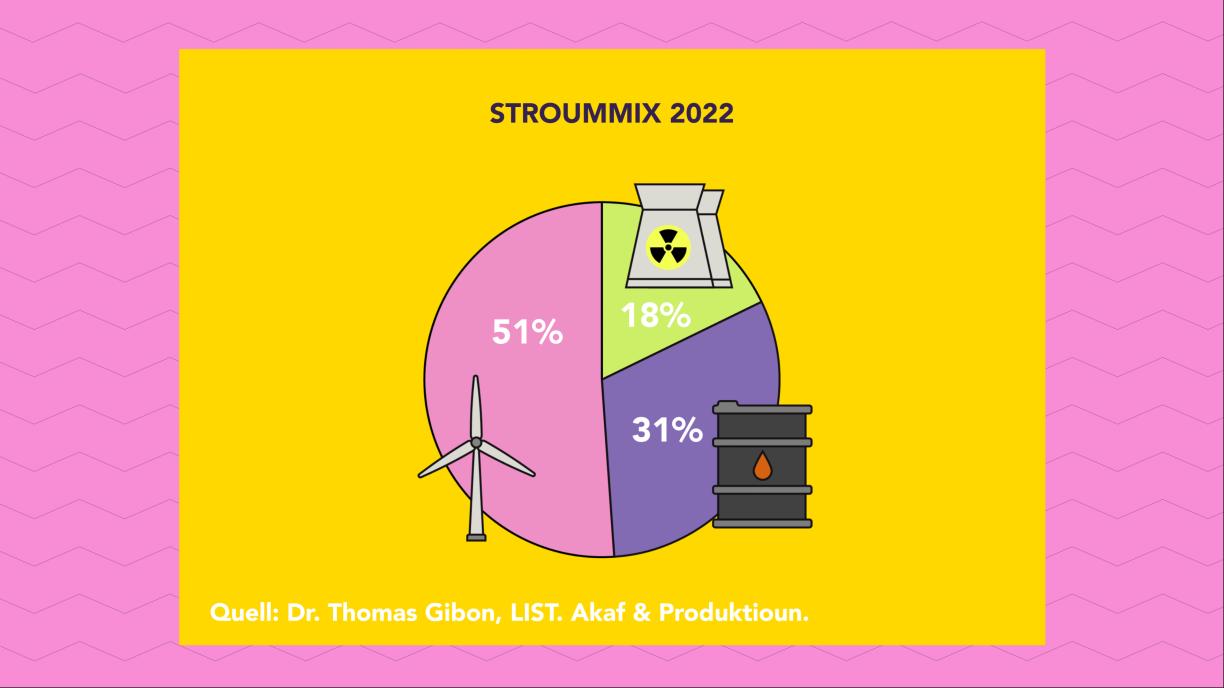
In 2022, 51% of the electricity mix was sourced from renewable energy, 18% from nuclear energy, and 31% from fossil fuels.
Luxembourg only produces a small share of its electricity, with most of it being imported.
This results in the following breakdown:
| Fossil fuel | 31.0% | |
| Nuclear energy | 18.5% | |
| Renewable energy | 50.6% | |
What does this mean for electric cars in Luxembourg? If we combine both factors – i.e. the better energy efficiency of the engine and the better carbon balance of the energy source, we can observe that
So the score is now 1:1!
It is worth noting in this context that the proportion of renewable energy is constantly increasing. The energy used to manufacture electric vehicles can therefore be generated in an increasingly climate-friendly way. This is not possible for combustion cars, where fossil fuels with a high carbon footprint are primarily used.
Carbon footprint over the life cycle
What it comes down to is how much CO2 the respective car model produces over its entire life cycle.
Let's now compare a few models. The LIST has developed a website to this end which allows you to do this easily.
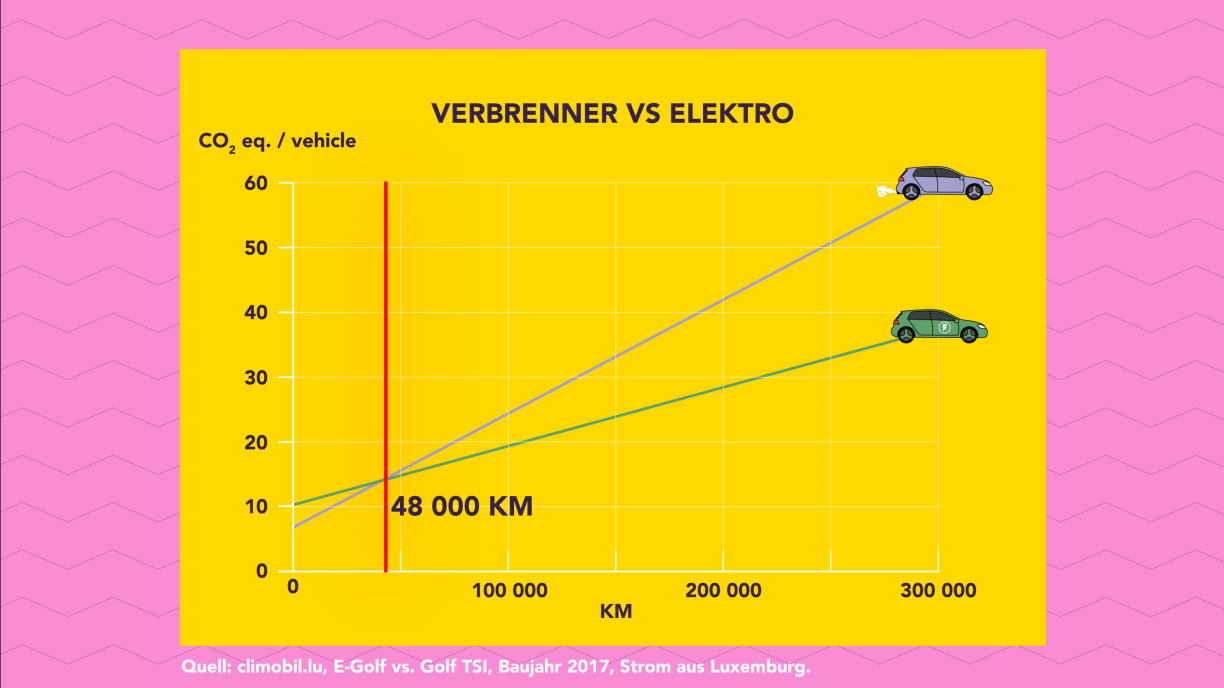
For example, if we compare a petrol Golf with an electric Golf, both built in 2017, with comparable power and based on the Luxembourg electricity mix, we can observe that the electric car, due to its more energy-intensive production, starts with a higher carbon balance.
However, because it generates less CO2 during use, it beats the combustion engine after around 48,000km. From then on, the electric car will have a lower overall CO2 footprint. If you assume that a car will travel over 250,000km, the difference at the end of its life cycle is quite considerable.
If we compare a BMW 3 Series with a Tesla Model 3, the Tesla outperforms the BMW in terms of carbon footprint from a mileage of 37,000km. Play around a bit with the site yourself at www.climobil.lu.
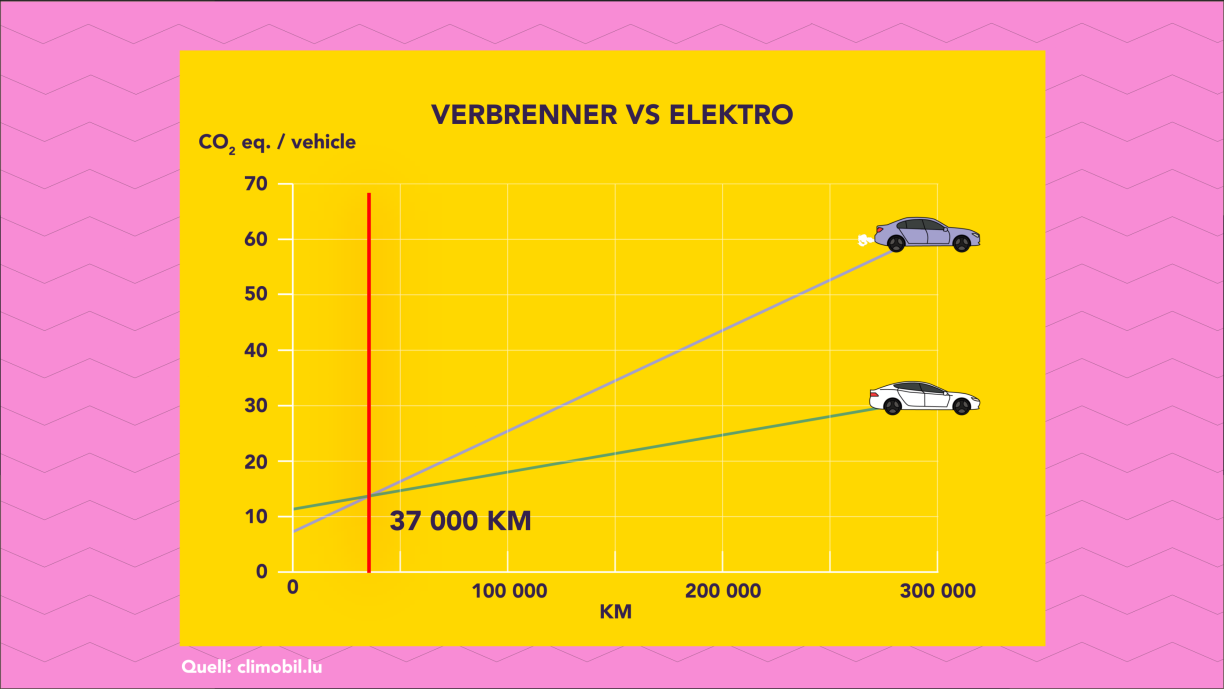
Conclusion: when the entire life cycle is taken into account, electric cars do generate less CO2 than combustion cars.
And as a rule, the carbon footprint of an electric car is better starting from 25,000 to 100,000km, depending on which cars you compare and the country in question.
*Sources: ADEME 2022 link: AVIS VE.pub (nextinpact.com) & climobil.lu.
Here is a chart from a 2022 study by ADEME comparing a compact diesel car with different types of electric vehicles (of varying power and size).
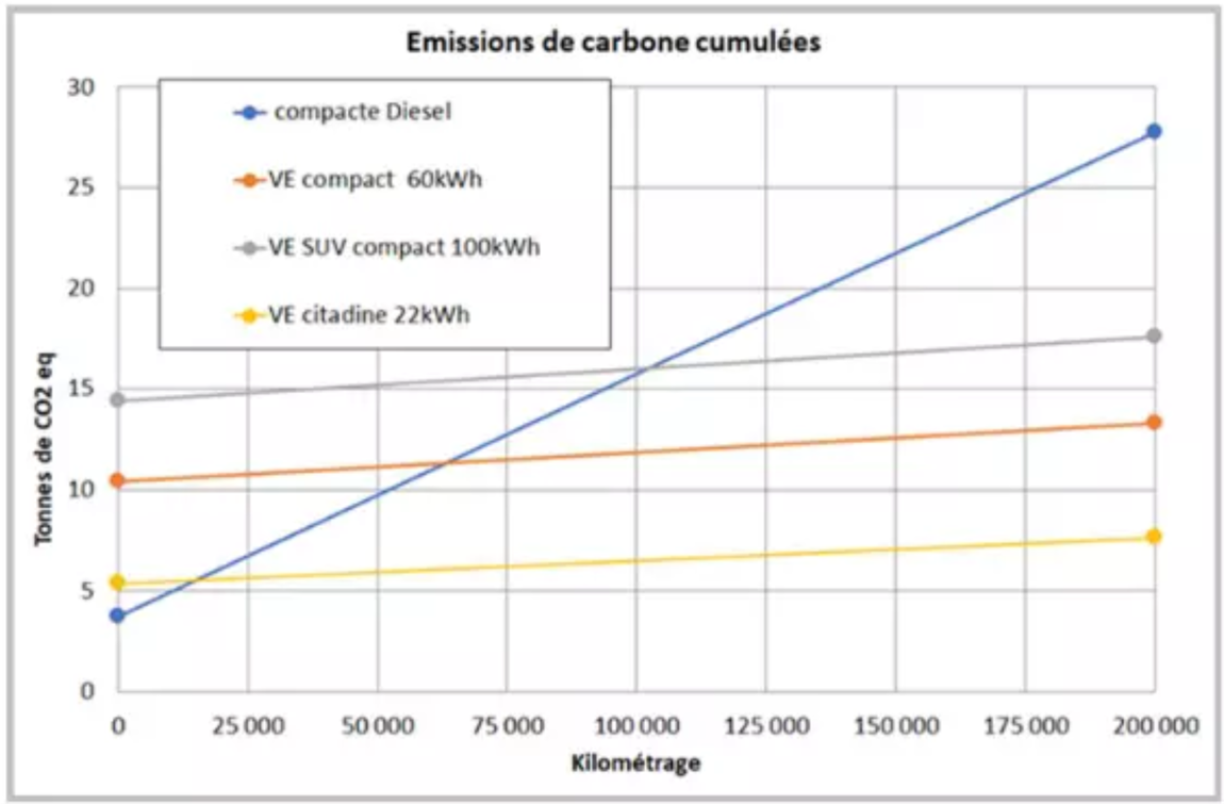
In Sweden, where the share of renewable energy in electricity production is higher, the electric car typically wins even earlier. In Poland, where the proportion of fossil fuels is higher, it wins later.
Over its entire life cycle, an electric car saves around 50% CO2.
This figure is valid for Luxembourg. For Europe, the figure ranges between roughly 25 and 75%, depending on the country and the electricity mix.
One more important final message: when making this comparison, it is extremely important not only to consider the current situation, but also to take future trends into account.
In fact, the LIST website does just that!
The electric engine will continue to evolve significantly, batteries will become more and more efficient, and the recycling market will develop.
Moreover, the share of renewable energy in the energy mix will increase.
As for the combustion engine, however, no further major technical efficiency improvements are to be expected. And fossil fuels... will always be fossil fuels.
Comment by Thomas Gibon: "Of course, you can also use renewable biodiesel as a fuel, but on a large scale, it will never be able to meet all fuel demand and will play only a minor role. Moreover, biofuels have potential climate impacts that depend on the raw material used (which crop? what harvesting frequency? which agricultural methods?) and, above all, on direct and indirect land-use changes."
To sum up, it can be said that electric cars are not a perfect solution. Of course, it would be better to rely less on cars in general. But that's another discussion 😊
Ziel mir keng! is broadcast on Sunday evenings after the programme Wëssensmagazin Pisa on RTL Tëlee and is a collaboration between RTL and the Luxembourg National Research Fund. You can also watch the episodes on RTL Play.
Author: Jean-Paul Bertemes (FNR)
Peer review, verification of sources and figures: Dr Thomas Gibon (LIST)
Editing: Michèle Weber, Lucie Zeches, Olivier Catani
Video: FNR & SKIN Charts: SKIN
Translation: Nadia Taouil (www.t9n.lu)





