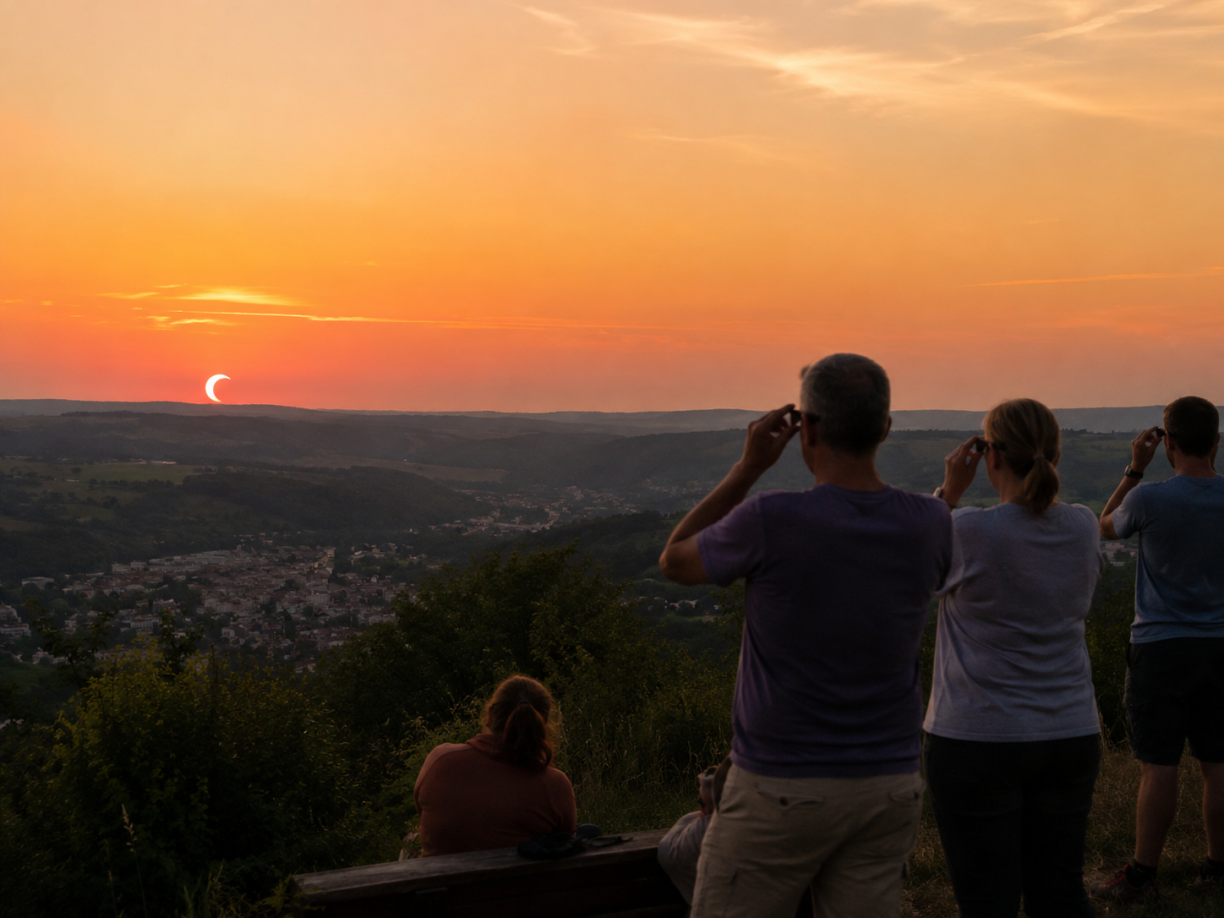
Luxembourg will be treated to a striking celestial spectacle on 12 August, when the Moon covers most of the Sun during a deep partial solar eclipse.
A solar eclipse occurs when the Moon passes between Earth and the Sun, casting its shadow across part of our planet. From our perspective on Earth, the Sun can appear partly or completely covered, depending on where the observer is located.
This is possible because of a remarkable coincidence of scale and distance. The Sun is about 400 times wider than the Moon, but it is also about 400 times farther away. As a result, the two appear almost the same size in our sky, and when the alignment is just right, the Moon can temporarily block the Sun from our point of view.
Although the Moon passes between Earth and the Sun every month at New Moon, a solar eclipse does not happen every month. The reason is simple: the Moon's orbit is slightly tilted compared with Earth's orbit around the Sun.
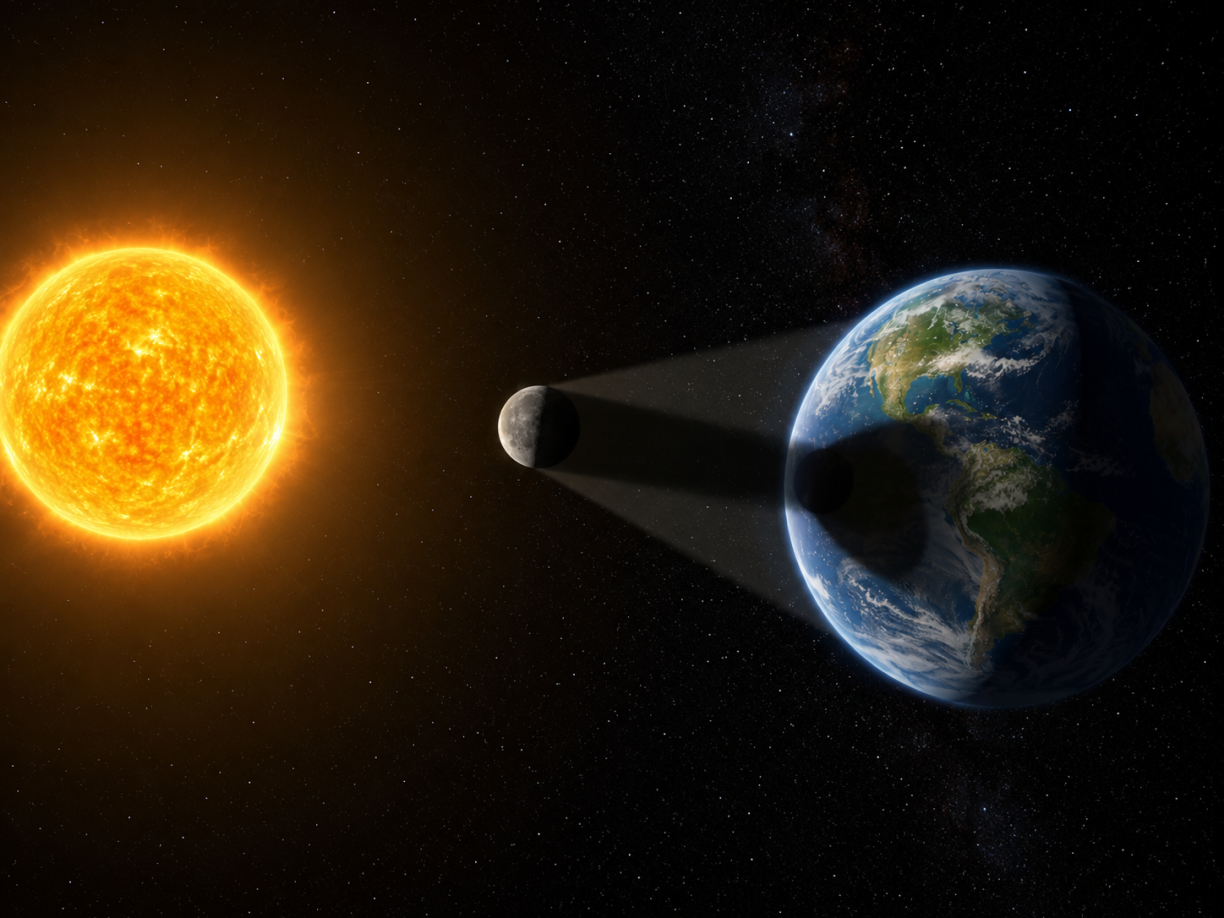
Most of the time, the Moon passes just above or below the Sun from our point of view, so its shadow misses Earth and no eclipse occurs.
Luxembourg has lived through memorable eclipses before. Many people still remember 11 August 1999, when a total solar eclipse crossed parts of Europe. Schools, offices, and families paused to watch the sky change, and for those who experienced it, the strange light and sudden quiet remain difficult to forget.
More recently, on 29 March 2025, Luxembourg saw a much smaller partial solar eclipse, with only a small part of the Sun covered. The 2026 eclipse will be very different.
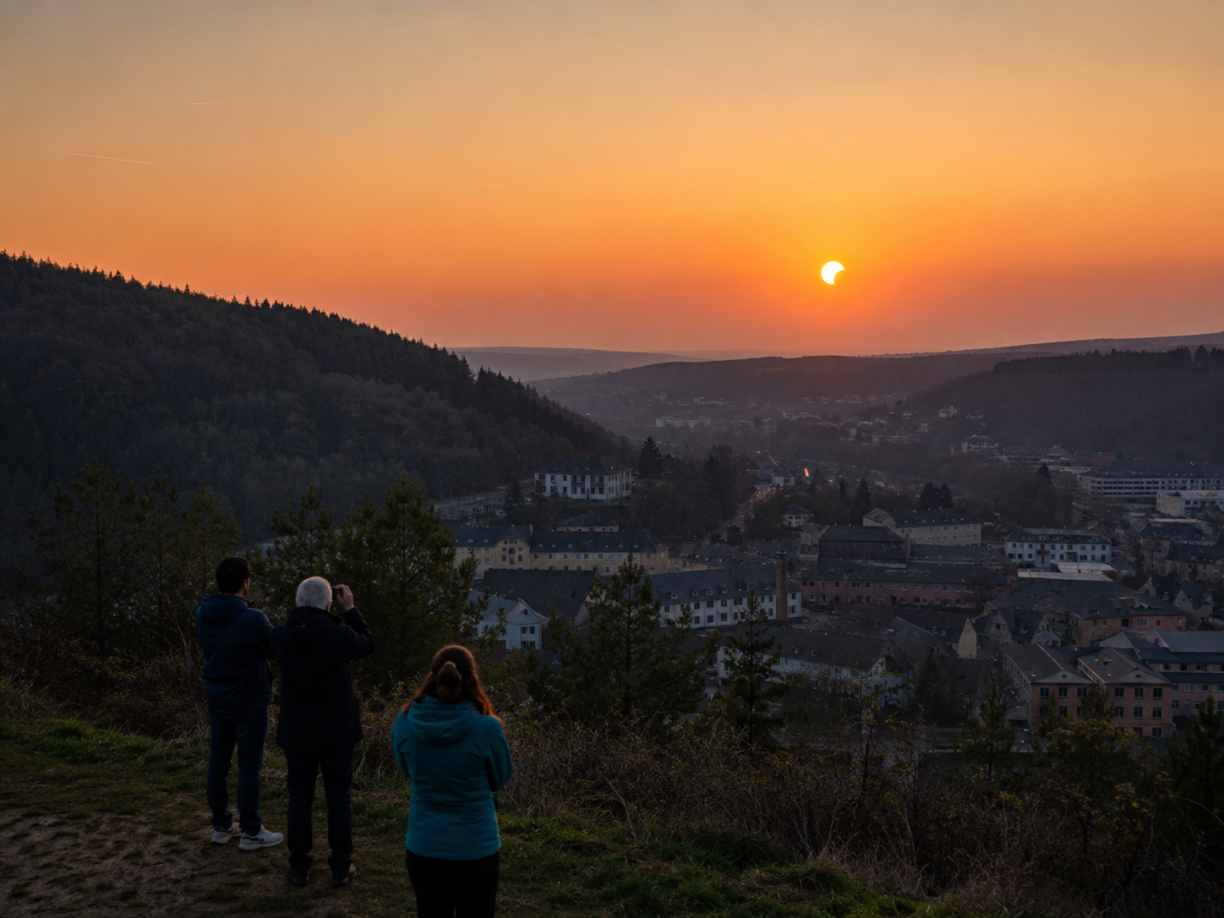
While observers across Greenland, Iceland, northern Spain, and a small area of Portugal will see the Sun disappear completely for a short time, Luxembourg will be outside the path of totality. Here, the same event will appear as a deep partial solar eclipse, with the Moon covering most of the solar disc.
It will not bring total darkness to the Grand Duchy, but it will still be one of the most impressive eclipses visible from Luxembourg in recent memory.
The eclipse will begin at around 7.20pm. The peak will occur around 8.15pm, when roughly 90% of the Sun will be covered. At that moment, the Sun will sit only about 6 degrees above the western horizon.
This will make the peak tricky to observe, as hills, trees, buildings, or the local skyline may hide the Sun before the deepest part of the eclipse is reached.
In Ettelbruck, a large, free public event will take place at Hall du Deich. Organised by Nightwise with the support of UniPop and the Luxembourg Science Centre, Solar Eclipse Day 2026 will include safe solar observation, family-friendly activities, explanations throughout the day, and a live broadcast of the eclipse from different locations along the path of totality.
The event will be more than an observing session. It will be a shared encounter with one of the most precise and beautiful alignments in nature: the Moon crossing the face of the Sun, seen from Luxembourg, followed on screen from the path of totality, and explained in a way that everyone can enjoy.
On 12 August 2026, Luxembourg will not stand in the Moon's darkest shadow. But for one evening, the country will still be part of a rare celestial event stretching across the planet.
The eclipse will not bring total darkness here, but it will offer something quieter and still powerful: a visible reminder that the sky above us is not static. It moves, changes, aligns, and occasionally asks for our full attention.
For a short time, the familiar evening Sun will look unfamiliar. And perhaps that is the real beauty of the event: not only the shadow itself, but the simple fact that many of us will stop, look up safely, and share the same moment from different places under the same sky.
Further details on the event are available here: https://nightwise.lu/solar-eclipse-2026/.
Date: Wednesday, 12 August 2026.
Time: starts around 7.20pm, with the peak around 8.15pm.
What to expect: roughly 90% of the Sun covered, very low in the west-north-west.
Public event: Solar Eclipse Day 2026, Hall du Deich, Ettelbruck.
Safety: never look directly at the Sun without certified eclipse protection.





