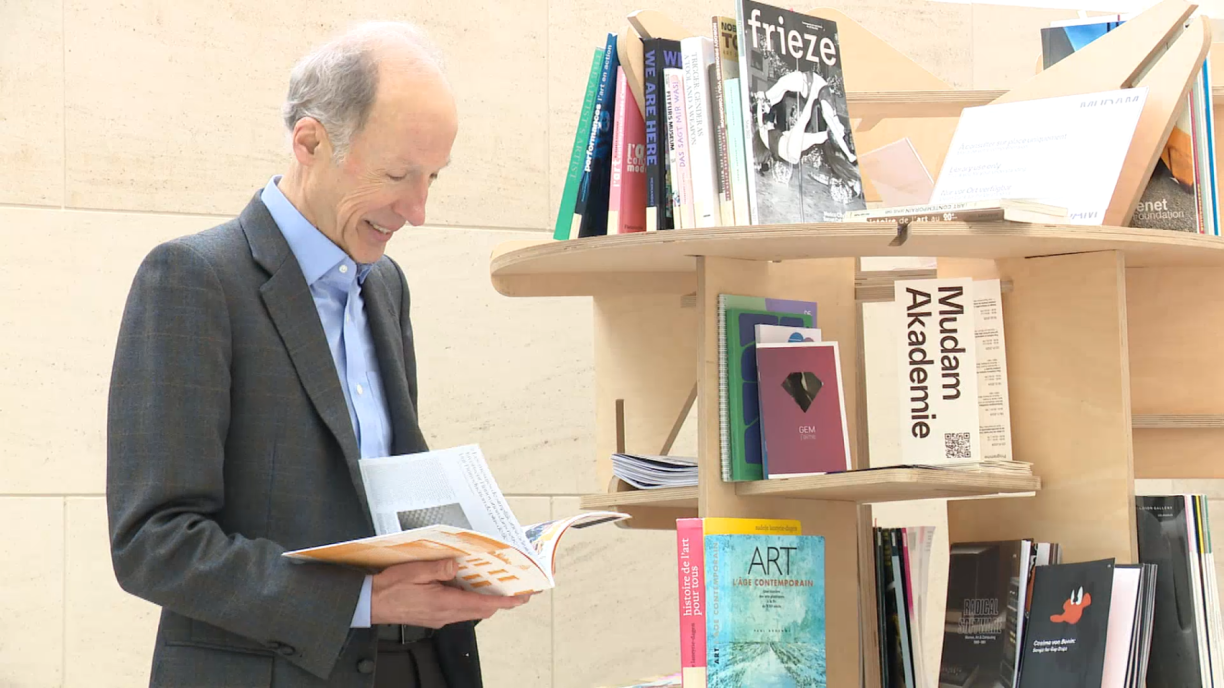
Meeting Dr Schockmel at a surprisingly bright café in Mudam on a rainy January day, RTL's Sarah Cames found the renowned infectiologist in a new role. Dr Schockmel swapped his doctor's coat for a seat in the Chamber with the Democratic Party (DP) in October 2023.
Nonetheless, the expert continues to nurture a strong connection with the medical environment, keeping his office at Kirchberg hospital.
"I usually have meals in the hospital canteen, talk to my colleagues there and stay informed about pressing issues. I can often pass this on directly to the responsible ministers or commissions," he explains.
Dr Schockmel's seat on the Health Commission comes as no surprise. During the Covid-19 crisis, he played a key role in raising awareness around the virus. This wasn't his first experience with a global health emergency, however, having trained as a medical student at the height of the HIV pandemic in the 1980s.
The politician reflects on his time as a fourth-year medical student, when he encountered a very special patient:
"At the time, we had an AIDS patient, a young American ballet dancer. He had AIDS–the final stage of HIV infection–and we stood around his bed to see a young man full of fear. At the time, nobody dared to touch him properly. At some point, I couldn't stand it any longer, and then I put my hand on him. It was then that I, as a young student, realised the sense of urgency."
This encounter shaped his career, leading him to HIV research at Oxford University, where he worked with highly concentrated HIV viruses at a time when no treatment was available yet.
"My career started with a pandemic, AIDS, and in a way, it ended with another, the Covid-19 pandemic." Both are RNA viruses, he continues, "so you can see how I have come full-circle."
The key difference between the two pandemics was the speed of response. With HIV, it took years to even identify the virus, or understand that AIDS was a consequence of HIV. "In contrast, Covid-19 was an explosion. The virus was identified quickly, and vaccines and tests were developed in record time because everyone collaborated in an unprecedented way."
Reflecting on the pandemic, Dr Schockmel sees both successes and areas for improvement in Luxembourg's pandemic response. Schools, for instance, were a success story. Unlike many neighbouring countries, children were able to still attend in-person classes. Similarly, hospitals were well-equipped and well-staffed.
What could have been better, on the other hand, was communication. "Public authorities should have provided more information, especially before vaccinations were made available. Many people relied on social media which is of course not objective."
He also criticised the debate around mandatory vaccination. "There was a reluctance to discuss it openly, and when the debate finally took place under intense pressure from all sides, the moment had already passed. Omicron and the increasing collective immunity had changed the situation by then."
From a human rights perspective, Dr Schockmel describes the isolation of elderly residents in nursing homes as an 'absolute catastrophe.' "After a lifetime, people should have the right to decide for themselves. If someone wants to see their family or loved ones, and everyone agrees, that should be respected and made possible."
As someone who worked tirelessly to counter misinformation during the pandemic via educational work, Dr Schockmel finds recent developments in the US and elsewhere deeply concerning.
"We may have reached the age of obscurantism again. If arguments, facts, data, statistics, and established knowledge no longer hold weight, but personal feelings do, then that leads to total arbitrariness."
Since Donald Trump's re-election, the country has seen drastic policy shifts: Covid expert Dr Anthony Fauci's personal security detail has been removed, the US has withdrawn from the World Health Organisation (WHO), and vaccine skeptic Robert F. Kennedy Jr. has been appointed Secretary of Health and Human Services.
"Watching this unfold feels like you're seeing the wrong film. Cutting back on health and international cooperation will have serious consequences sooner or later."
He also warns that climate change, the biggest challenge facing humanity, is being ignored. "How many more wildfires need to devastate Californian homes before some politicians acknowledge their part in it? There's a complete denial."
Equally, Dr Schockmel fears the rise of a new oligarchy in the US, with the judiciary branch and press coming increasingly under pressure. "Europe must now focus on its strengths: We remain an essential trading partner and have certain benefits we need to take into account."
Over the years, Dr Schockmel's political involvement has grown. Since joining the Chamber in 2023, he has taken on memberships in various committees, including health, research, digitalisation, justice, media, and culture.
While he remains cautious about outlining personal priorities, he is clear on one issue: "We have to be vigilant to protect our democracy now."
External threats like misinformation or foreign interference in elections are well recognised, but the bigger danger comes from within. "Democracy's freedoms can be exploited to democratically dismantle democracy itself."





