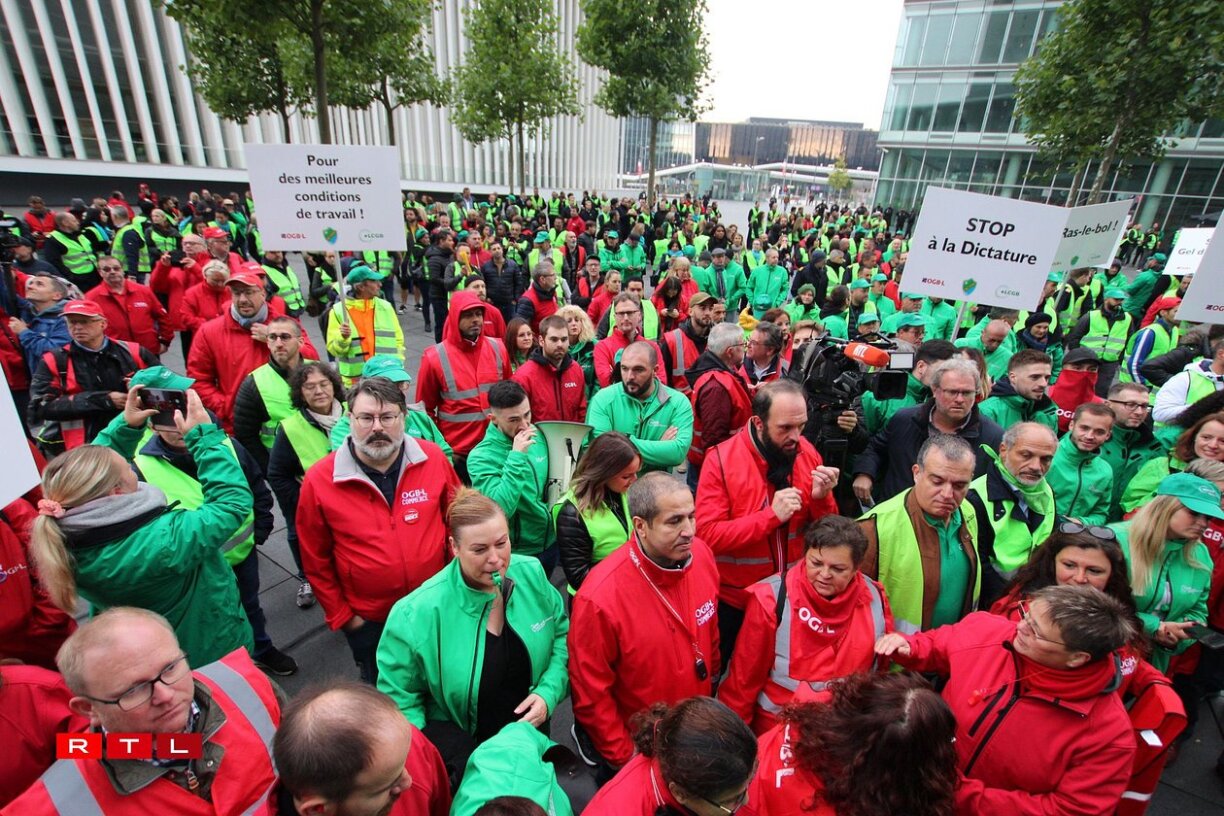
Less popular in appearance and less personified by faces plastered on every street corner, the social elections on 12 March are nonetheless crucial for Luxembourg in more ways than one.
Companies with more than 15 employees will have to post the results of the election, including the new composition of the Chamber of Employees' plenary assembly, for three days. Trade unions will thus derive a large part of their legitimacy from the results for the next five years, but it also plays a crucial role for the government and for employers' representatives.
It took Prime Minister Luc Frieden more than 110 days to have a first exchange of views with Luxembourg's major trade unions, who complained about not to having been invited to the recent housing roundtable. Nevertheless, Frieden assured parliament that his government "attaches great importance to social dialogue".
The elections are aimed at more than 600,000 potential voters, including 479,000 working people, pensioners, and, for the first time, apprentices and jobseekers. Also eligible are the 224,000 cross-border commuters from France, Belgium, and Germany.
That is twice as many people as the 286,700 who vote in Luxembourg's general elections. The social elections will thereby make it possible to assess the unions' ability to mobilise those they defend.
In March 2022, the National Institute of Statistics and Economic Studies (STATEC), based on OECD figures, reported a decline of trade union size, which had lost 5.4% of their membership between 2017 and 2019.
At the beginning of 2024, the Independent Luxembourg Trade Union Confederation (OGBL), remains by far the biggest player with more than 76,000 members. Its main competitor, the Luxembourg Confederation of Independent Trade Unions (LCGB), had 46,800 members, according to the statements of their respective presidents.
In the last social elections in 2019, the OGBL won 23.04% of the effective delegates in the country's companies (i.e. 2,042 effective delegates), the LCGB 13.66% (i.e. 1,211 effective delegates), and the Luxembourg Association of Bank and Insurance Employees (ALEBA) 3.86% (342 effective delegates).
Figures from the Inspectorate of Labour and Mines (ITM) show that unaffiliated union members are the largest union force with 58.65%, or 5,197 effective delegates.
According to OGBL president Nora Back, who also presides over the Chamber of Employees, voting for representatives gives employees greater weight "in all political discussions, but also in dealings with employers. An employee who works for a salary is always in a subordinate relationship to his hierarchical superior, and they need a strong player to defend their interests, and that is the Chamber of Employees."
Another major issue at stake in these elections is whether or not the credibility of the Chamber of Employees will be strengthened. The greater the mobilisation of voters, the more weight it will carry in all political discussions.
In 2019, the 60 employee representatives who sit on the plenary assembly of the Chamber of Employees were elected with just 32.2% of the votes cast by employees and retirees.
To make their voices heard at the highest level, the unions aim to achieve "national representativeness", which means receiving 20% of the votes. It should be noted that national representativeness is the "key" that enables trade unions to sit on the tripartite, but also on the decision-making bodies of the National Health Fund (CNS), the Pension Fund, the Fund for the Future of Children, and similar representative bodies.





