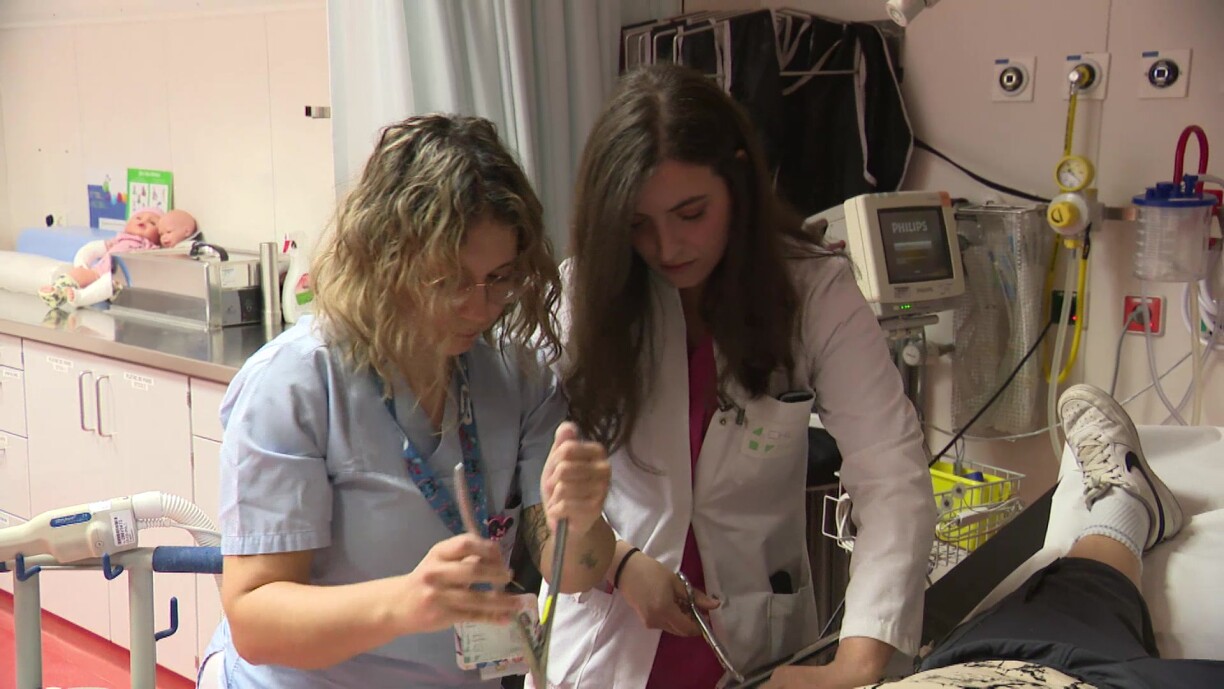
At the Centre Hospitalier de Luxembourg (CHL), between 160 and 180 doctors in training are welcomed each year. These young doctors, known as Médecins en Voie de Spécialisation (MEVS, or doctors in specialist training), have already completed six years of medical school and are now working toward becoming fully specialised. Under the supervision of experienced senior physicians, they gain practical, hands-on experience in various clinical departments.
RTL spoke with two young physician trainees at the CHL to understand how appealing Luxembourg’s hospital landscape is for young professionals starting their careers.
One of them, Sabrin Zaghbouni, began her journey in medicine after completing secondary education in Saarbrücken. She started her first year of medical studies in Luxembourg, then continued her training in Nancy, France. During her time there, she gained extensive practical experience working in hospitals, which sparked her interest in paediatric surgery. She now has over two years of specialisation completed at the paediatric clinic (also known as the Kannerklinik) in Luxembourg.
“I wanted to start in Luxembourg to gain a broader perspective on paediatric surgery,” Dr. Zaghbouni explains. “I wanted to observe how my senior colleagues from France, Belgium, and Germany approach patient care.”
She is fully aware of the demands of the profession and is currently learning the day-to-day realities of the job as an MEVS.
“We divide the tasks between daily consultations in paediatric surgery, where we see patients admitted through the emergency department with fractures, and follow them through their recovery,” she says. “We also care for hospitalised patients, have 24-hour shifts and, of course, we assist in surgeries that take place almost every day.”
Michael Dang is equally committed. After studying medicine in Paris for six years, he is now in his fifth year of specialisation in oncology. Except for a year abroad in Heidelberg, he has completed his entire specialist training in Luxembourg.
“You have your family here, your friends, and if you already know you want to work here later, then training here is a great option. We’re lucky to be exposed to different systems. I did my basic medical studies in Paris. Of course, the working conditions are different, it’s a different environment. Things operate on a smaller scale here compared to a big city like Paris or Heidelberg. But personally, I find the working atmosphere at the CHL especially positive, particularly the collaboration with other doctors. In oncology, that kind of teamwork across specialties is very important.”
Satisfaction and praise, then, from the MEVS – at least among those who have gained experience in Belgium or France, where working conditions and salaries are often viewed as less favorable than in Luxembourg.
“This might be different for MEVS coming from German-speaking countries, where working conditions vary, and where they might find things here to be more demanding or challenging,” explains Dr. Jean Reuter, President of the Medical Council at CHL.
Overall, however, conversations at CHL made it clear that MEVS generally feel well supported and welcomed within the hospital environment.
Dr. Zaghbouni continues: "I think our seniors are really great mentors. I think they're there to support us. They don't hesitate to give us advice, correct us, and help us."
“On the one hand, the MEVS benefit from having a solid training environment here, where they can learn directly from senior doctors. At the same time, it’s also enriching for the seniors because by training newcomers fresh from university, they have to stay constantly up to date and really master their craft. From that perspective, it’s essentially an added value,” explains Dr. Reuter.
To preserve this added value and avoid the risk that other countries might eventually want to retain their MEVS for themselves, potentially leading to a shortage of doctors, Dr. Reuter believes that, in the long term, Luxembourg should offer a full medical curriculum. This would go well beyond a bachelor’s degree and include specialisation programs. However, such an initiative would require a comprehensive infrastructure, including a professional university hospital and research facilities.





