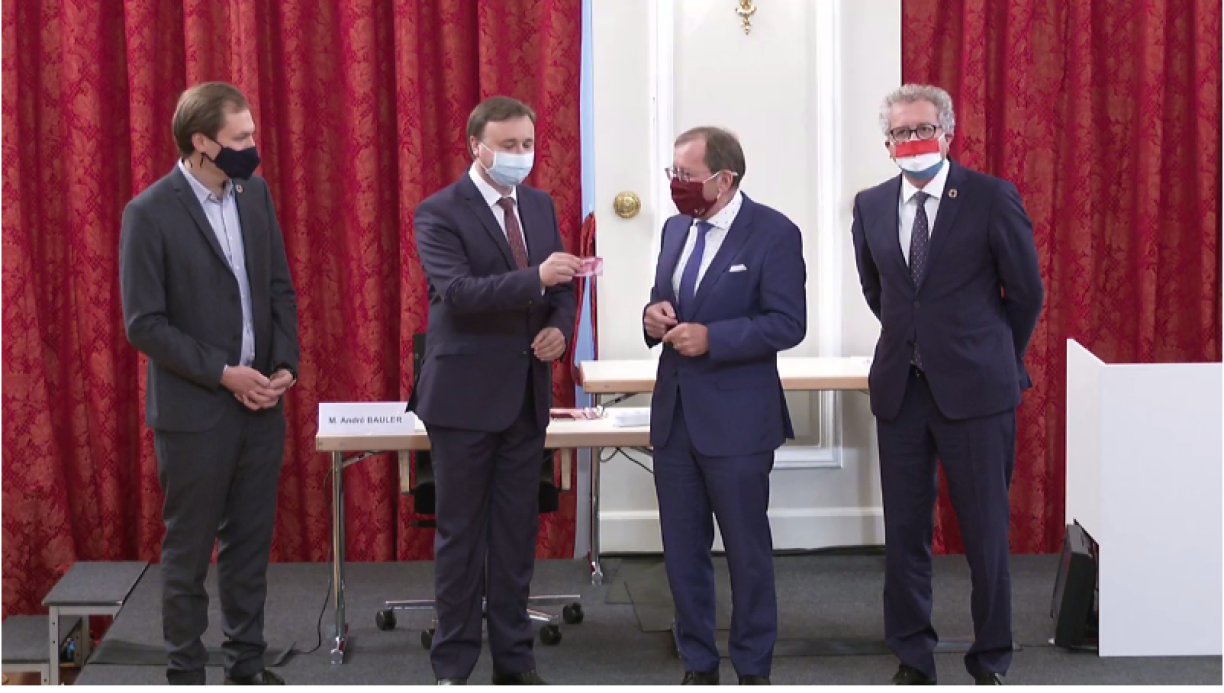
The health and social protection of the population on one hand, and the easing of the economic burden of the crisis on enterprises and employees on the other: the 2021 budget will be "in line with these ambitious measures to combat the Covid-19 pandemic and accompany a sustainable recovery".
According to government officials, the budget focuses on five priority areas:
An ambitious investment programme forms the backbone of the 2021 budget. To foster a sustainable recovery, the investment rate will be 4.3% of the GDP in 2021, or €2.7 billion, an all-time record (excluding additional investments related to the pandemic in 2020). In fact, this level far exceeds that of the pre-crisis period, which hovered around 3.7% of the GDP.
Almost half of the expenditure (48%) of the 2021 budget is dedicated to social benefits, subsidies, and grants in the social field. In particular, the funds needed to strengthen the public health system and care services will be substantially increased in 2021. Similarly, the "Employment Fund" and the "Fund for socio-family investments" will be given the necessary means to enable them to support the labour market and help the most disadvantaged to face the challenges related to the crisis.
In the same spirit, the budget introduces a series of fiscal measures in favour of social equity. In particular, to counter abuses arising from the use of the tax regime applicable to so-called Specialised Investment Funds (SIFs) and other funds for investments in the real estate sector in Luxembourg, a real estate levy will be introduced as of 1 January 2021. Income from real estate (rents and real estate capital gains) realised by investment funds in Luxembourg will thus be taxed at a rate of 20%, without the possibility of claiming deductions.
The Ministry of Housing's budget will be considerably increased (+11%) and the new "Special Support Fund for Housing Development" will receive a budget of €150 million to create and finance affordable housing.
On a fiscal level, the budget proposes several measures to combat property speculation and to provide incentives for energy renovation, including a reduction in the accelerated depreciation rate for investment in new rental housing and the introduction of the 6% depreciation rate for energy renovation for buildings used for rental housing.
The 2021 budget provides €547 million for investments in the field of mobility and climate. Particular emphasis is placed on the further development of the railway and tram network, as well as on soft mobility.
The introduction of a reduced subscription tax for sustainable investment funds will further stimulate green and social investments and consolidate the financial centre's leading position in sustainable finance.
The polluter pays principle in the area of climate change is put into practice by the introduction of a CO2 tax of €20 per tonne in 2021, which will be gradually increased to €30 per tonne by 2023. The budget does, however, ensure social equity by providing for social compensation measures, including an increase in tax credits of around €96 per year, as well as a 10% increase in the cost-of-living allowance from 2021.
The 2021 Budget includes many measures to further strengthen the country's competitiveness. In particular, a total amount of €1 billion euros is earmarked over the period 2021-2024 to advance the digitalisation of the Luxembourg economy.
In order to attract and retain the talent needed for Luxembourg's continued economic development, two innovative tax instruments are planned: a participation bonus, which employers will be able to grant to their deserving employees, and an updated scheme for "impatriates", including the possibility for the employer to grant an "impatriation bonus" which will benefit from a 50% tax exemption.
In 2020, the nominal balance of the Public Administration is expected to be -7.4% of the GDP (i.e. -€4.4 billion), a significant drop compared to the positive balance of 2.4% of the GDP (i.e. €1.543 billion) in 2019 and 3.8% of the GDP (i.e. €1.841 billion) in 2018.
In 2021, the balance will improve significantly compared to 2020. The deficit will be reduced by more than half and will reach -€1.7 billion, i.e. -2.7% of the GDP.
On the central government expenditure side, the year 2020 shows significant growth of +16.4% compared to 2019. This increase is mainly due to the measures taken by the government in the context of the health crisis.
Thus, the balance of the central government alone will fall to -€5.1 billion or -8.6% of the GDP in 2020. Although the balance will remain negative in 2021, it would show a significant improvement of €2.6 billion to €2.5 billion or -3.9% of the GDP.
The public debt will rise from 22% in 2019 to 27.4% in 2020 and could reach 29.4% by the end of 2021, due to the deficit of the central government and the financing of support measures linked to the pandemic. Excluding the financing of these measures, the public debt would be only 22.3% in 2020 and 24.7% in 2021.
Minister of Finance Pierre Gramegna commented that the 2021 budget was "an exceptional budget for an exceptional time". The government had put together a package that could rival the challenges that this unprecedented crisis represented for Luxembourg, the minister explained. Gramegna stated that the 2021 budget emphasised "solidarity with employees and businesses, the strengthening of infrastructure, housing and sustainable recovery, all thanks to record investments".





