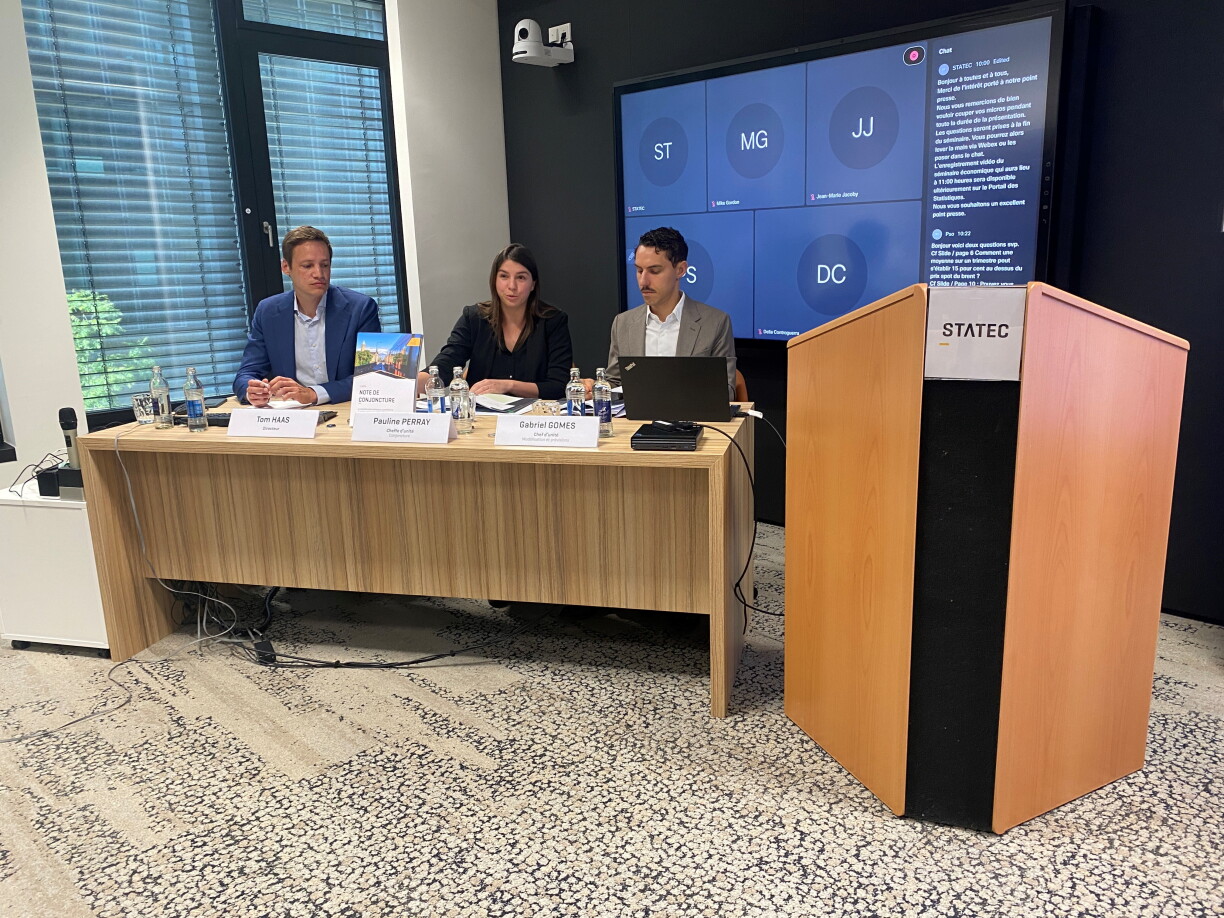
Uncertainty continues to dominate both the global and national economic outlook, making accurate forecasts increasingly difficult. This was the central message from Tom Haas, director of the National Institute of Statistics and Economic Studies (STATEC), during the presentation of the institute’s latest economic briefing on Tuesday morning.
The analysis comes just ahead of the Tripartite meeting on Tuesday afternoon. According to Haas, while the general economic situation has remained relatively stable in recent weeks, financial markets have, somewhat surprisingly, retained a degree of optimism, despite the fact that hopes for a reopening of the Strait of Hormuz by the end of May have not materialised.
Haas noted that prices remain low, which indicates markets still expect a swift resolution to the current energy crisis, mitigating the impact of the crisis even if circumstances could shift at any moment. For now, he argues, Luxembourg finds itself somewhere between stability and the more severe scenarios, such as soaring prices and the threat of a recession.
However, the crisis is already leaving a mark on public finances. Haas described the situation as one requiring constant, day-to-day evaluation. Recent calculations show that the consequences of the crisis extend beyond the broader economy and are now clearly affecting public finances.
For many years, Luxembourg benefited from high state revenues, a positive legacy from previous periods of economic growth, especially from exceptional corporate tax receipts. Haas explained that the situation has now changed and that people are feeling the effects of the economic slowdown from recent years. This downturn is reflected in lower revenues, both from businesses and other tax sources, with the impact compounded by recent tax cuts.


The outlook for wage indexation remains uncertain following the most recent adjustment on 1 June.
Haas explained that if prices remain low, it could be another year before the next wage index tranche is triggered. However, he cautioned that STATEC had already highlighted at the Tripartite's preparatory meeting that the risk of another indexation being triggered in the second half of the year is "significant" if prices begin to climb. He admitted that "at this point, anything is possible, whether that means an indexation this summer, towards the end of the year, or even next year."
Turning to the labour market, Haas noted that there were positive signs at the end of last year regarding unemployment levels.
Now, much depends on the strength of the economic shock. Haas explains that the real question is how much the labour market will slow down, and to what extent unemployment will rise. In this sense, the labour market finds itself in a similar situation to the price levels as there is "nothing dramatic at the moment, but potential indirect effects in the coming weeks are cause for concern".
Comparing the current situation with the 2022 energy crisis, Haas noted that the impact has so far been more moderate: gas prices have barely been affected, and oil prices have retreated from their peak. Ahead of the Tripartite, Statec has also prepared fresh analyses on public finances, emissions, and household purchasing power.
Regarding emissions, the director explained that, unless political measures change, Luxembourg remains on track to meet its reduction targets for 2026 and 2027.





