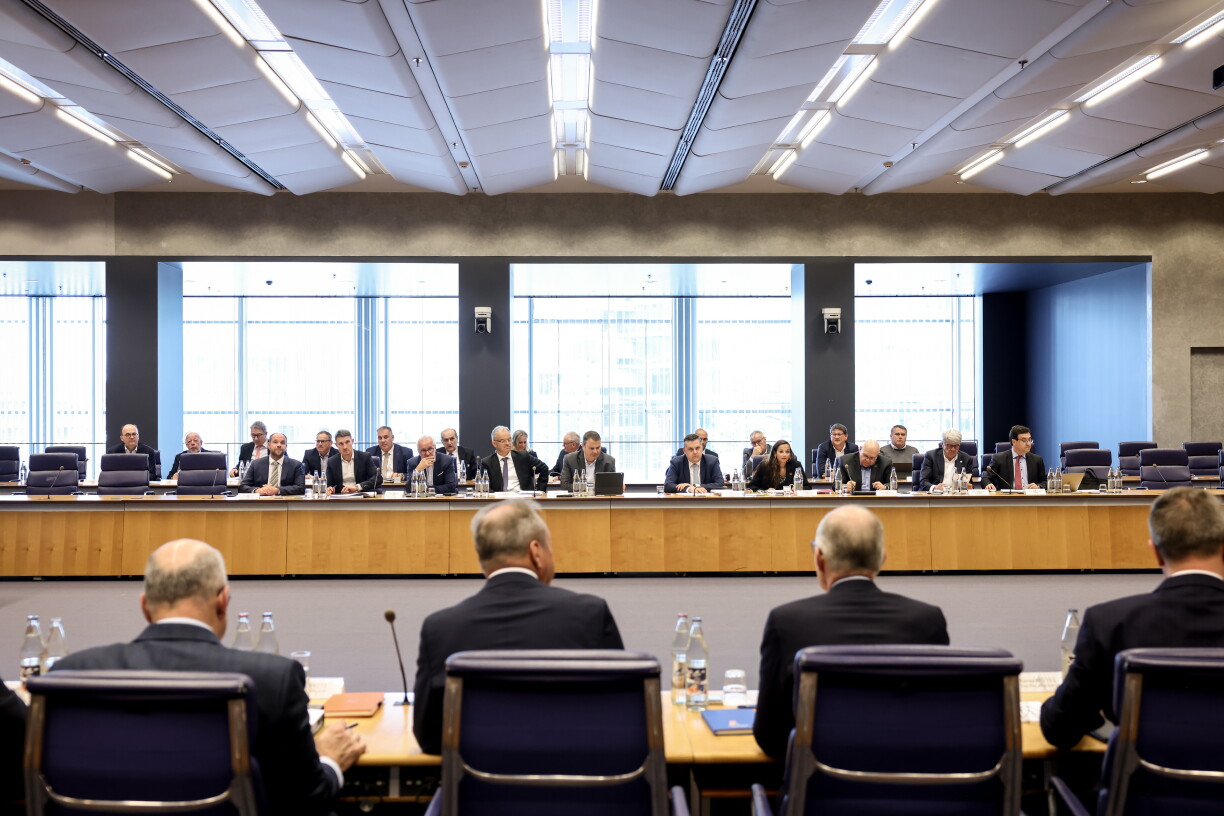
The social partners did not receive answers to all of their questions during the information round held ahead of the Tripartite meeting two weeks ago. Prime Minister Luc Frieden said after the session that participants should now "digest the figures first."
The data presented at that meeting by the National Institute of Statistics and Economic Studies (STATEC) have since been made public. However, STATEC did not have ready answers to all of the social partners' queries. Meanwhile, some of the data may raise more questions than they resolve.
The trade union alliance between the Independent Luxembourg Trade Union Confederation (OGBL) and the Luxembourg Confederation of Christian Trade Unions (LCGB) had already announced its intention to discuss the minimum wage at the Tripartite. Now, a fresh controversy over the figures risks emerging. STATEC presented a graph indicating that the average standard of living rose by 50% over the ten years leading up to 2015, reaching just under €5,000 per month.
So is Luxembourg the land of milk and honey? Dylan Theis, an economist at the Chamber of Employees, urgently cautioned against taking the indicator at face value. "In 2025, the average income of a household was 50% higher than in 2015," he said, "However, this absolutely does not mean that their actual standard of living has become 50% higher, because between 2015 and 2025, the cost of living has also risen significantly."
In other words, the figures have not been adjusted for inflation.
"We know that everything is getting more expensive, and people also have more money in their pockets," Theis continued, "So it is simply important to see what is actually left over at the end of the month when you also take those living costs into account."
Adding to the complexity, the methodology for the indicator has been changed four times in the last five years. The same applies to the poverty risk rate. As a result, the data now suggest that the risk of poverty has decreased considerably between 2024 and 2025.
Theis explicitly welcomed the fact that the quality of the data is improving. However, he noted that the figures are now simply no longer comparable with previous years. This, he argued, makes it very difficult to carry out any analysis – particularly a political analysis – to assess where the country has come from and where it currently stands.
Given the changes in measurement, Theis raised the question of whether it would be important to recalculate older data using the new methodology. "Even if that is of course time-consuming, it would still be important in order to be able to conduct a serious debate on the development of these indicators," he argued.
Otherwise, the economist warned, it would not be possible to properly evaluate the country's first national anti-poverty plan.
The government's decision not to increase the minimum wage, taken in part with an eye on the EU minimum wage directive, is based on Eurostat figures showing that the minimum wage already equates to nearly 60% of the median income. However, the unions dispute these figures, arguing that the median income does not take into account premiums, bonuses, or the 13th-month salary.
The numerous methodological breaks in calculating the poverty risk further complicate discussions within the Tripartite, particularly regarding who would need support should energy prices rise due to the conflict in Iran.
Prime Minister Luc Frieden had already pledged that wage indexation is non-negotiable. But for the trade unions, other mechanisms could also help preserve purchasing power – in particular, the various tax credits, whose income thresholds have not been adjusted over time.
Theis pointed to the employee tax credit as an example. When it was introduced in 2017, he said, everyone received the full amount – €50 per month for those with an annual income of less than €40,000. "Today it is still just €50 per month," he noted.
With successive wage indexations, nominal wages have risen without necessarily translating into real-terms gains. As a result, workers fall into degressive tranches and eventually lose eligibility for these tax credits, Theis stressed. He argued that accurate data is needed to determine how many people should theoretically receive the credit today but do not, because the income thresholds have never been adjusted.
Other questions remain unanswered. The unions had asked what impact the reduction in corporate taxes would have on growth, the labour market, state finances, and the creation of new businesses. In essence, they sought to verify whether Prime Minister Luc Frieden's neo-liberal promise holds – namely, that tax cuts for businesses bring positive effects for everyone.
According to the documents, STATEC has no answer to this question, as such a detailed analysis does not exist at this stage.
The figures also show that margins in the real economy – i.e., outside the financial sector – have declined over the past two years. Activity in business services, commerce, and information technology has fallen, while staffing levels have not.
Despite lower margins, shareholders paid themselves substantial dividends in 2025, amounting to 30% of the gross result – a significantly higher rate than in France or Belgium. At the same time, companies in Luxembourg invested less than their counterparts in any neighbouring country or the Eurozone as a whole.





