Snowfall continues to grip large parts of Europe, causing widespread disruption. In the Netherlands, over 700 flights were cancelled at Schiphol Airport in Amsterdam, while in Belgium, flights to Luxembourg were also cancelled in Brussels. In France, thirty-eight of the 101 departments have been placed under an orange alert – the country’s second-highest weather warning.
Here in Luxembourg, snow began falling around midday on Wednesday. Meteolux issued a yellow alert for the entire country, and the National Roads Administration has been working since the early hours to keep roads clear.
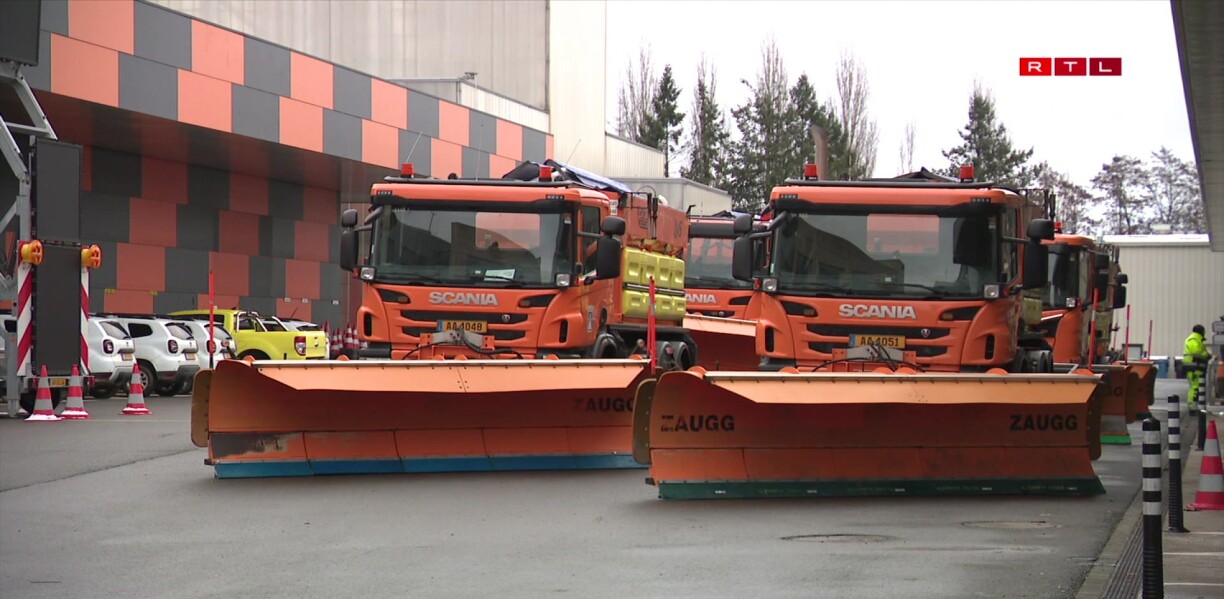
Around 400 agents and 300 vehicles have been deployed as part of the salting service. The work is spread across three shifts, and the administration covers some 3,000km of state roads – including national roads, motorways and so-called CRs (Chemins Repris). Municipalities take care of the rest.
On Thursday morning, RTL reporter Annick Goerens joined one of the teams in Bertrange. Around ten lorries set off at 10am from the motorway network (CITA) depot. Among them was Joé Bausch, a long-time employee of the National Roads Administration, who drove a tipper lorry along the 'Contournement 1' route.
"We head out of Helfent towards Bridel, doing the two roundabouts and the bridge. Then we go straight on to the Kirchberg and the Serra roundabout, and from there we head back. Then we turn onto roads towards Leudelange and do two more loops. And be careful not to run people over with the plough", he said.
The operation requires a hefty amount of salt. Ralph di Marco, Director of Communications at the National Roads Administration, explained: "We have a stock of around 20,000 tonnes. We spread an average of 17,000 tonnes each year. Last season, we were at 17,000 tonnes. The year before, 19,000. It really depends. At the moment, we are already at 10,000 tonnes that have been spread this season".

In an emergency, Luxembourg could reorder salt at any time. The country’s salt supply is sourced from two Luxembourg-based companies that import it from France and Germany.
While grit is often used abroad – particularly in Alpine countries – as a more environmentally friendly alternative, it is not considered viable in Luxembourg.
"To achieve the same results with grit as with salt, we would have to spread four times as much", explained a representative of the National Roads Administration. "Then there's the problem of drainage. The grit would block the system. On motorways, this would prevent water from draining properly, leading to potentially dangerous conditions".
The climate also plays a role. "In Austria or Switzerland, winter lasts much longer, with consistent snowfall. There, grit is spread and left on the roads. Once the snow melts, it is then removed. Here in Luxembourg, snowfalls are less predictable and often short-lived. If we used grit, we would have to clear and re-grit roads repeatedly, which is not optimal".
Grit also requires significantly more storage space and personnel, as it needs to be spread more frequently. These logistical factors further justify the continued use of salt on Luxembourg's roads.
Road users are reminded that the salting lorries can spread salt across a width of at least 12m. Drivers should avoid overtaking these vehicles, especially on country roads or in motorway construction zones, as the lorries often carry side ploughs and require extra space to operate safely.
The National Roads Administration also appeals to all drivers to ensure their vehicles are fitted with winter tyres. While they are legally required in Luxembourg during winter conditions, officials warn that not all motorists are complying with the rule.





