Maria Eduarda de Macedo was born in 1960 in Lisbon. She was 14 years-old when the Carnation Revolution took place, and she vividly remembers it. As the daughter of the famous Portuguese singer Simone de Oliveira, who represented her country twice at Eurovision, Maria has been living in Luxembourg for the past 38 years.
In 1986, she was one of the very first translators from Portugal to come to Luxembourg to work for the European Institutions. The Carnation Revolution changed her life: "Without the 25th of April, I wouldn't be who I am today."
This Thursday, Portugal celebrates the fiftieth anniversary of the Carnation Revolution, a bloodless coup d'état led by young officers to put an end to 48 years of dictatorship and 13 years of colonial wars.
This year's commemoration of Portugal's transition to democracy is overshadowed by a notable rise of the far-right "Chega" ("Enough") party, solidifying its position as the country's third political force with 18% of the vote.
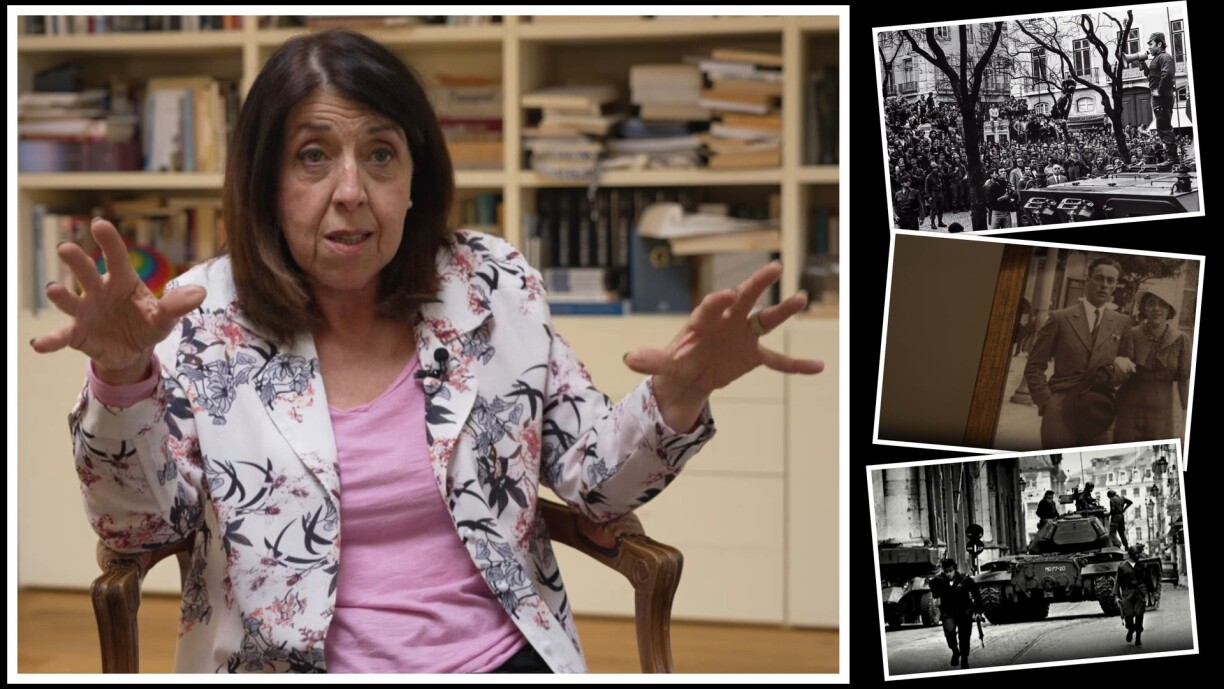
"I'm deeply saddened by this outcome; it pains me to see that a majority of Portuguese expatriates in Luxembourg supported this party," Maria expresses with a tinge of bitterness.
In a recent survey conducted just last week, the majority of respondents viewed the authoritarian regime that was overthrown in 1974 as predominantly negative. However, one-fifth of the people said the opposite.
Nevertheless, a resounding 65% of those surveyed deemed the April 25th Revolution to be the most pivotal event in Portugal's history, surpassing milestones such as joining the precursor to the European Union in 1986 and the end of the monarchy in 1910.
The overthrow of the Portuguese dictatorship is the focus of a significant exhibition at the National Museum of Fëschmaart. It recently opened on 25 April 2024, precisely fifty years after the historic Carnation Revolution.
To read on the same subject: De Lisbonne à Luxembourg, un vent de révolution (FR)





