Calls for reforming Luxembourg's electoral system have grown louder in recent years. In response, Claude Wiseler, President of the Chamber of Deputies, recently invited political parties represented in parliament to submit their proposals for change.
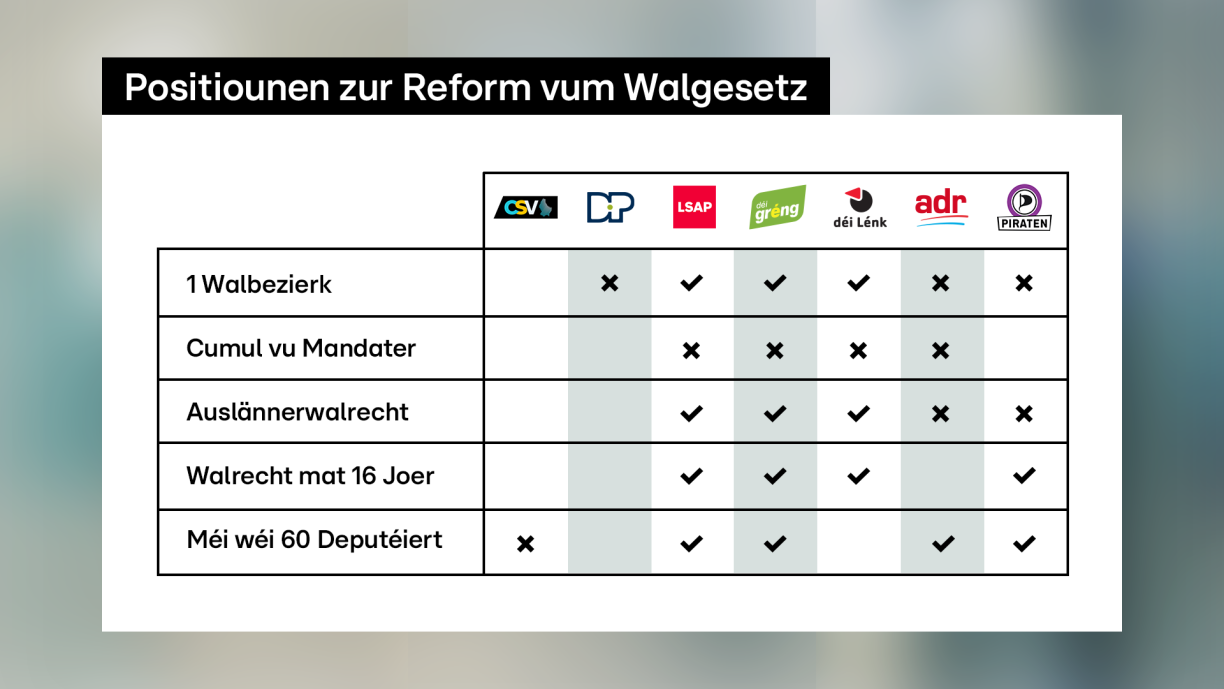
Our colleagues from RTL Radio compared their positions on several key issues, revealing differing views on the future of the electoral system.
The Christian Social People's Party (CSV) and the Democratic Party (DP) oppose abolishing the four constituencies. The CSV argues that this issue was already addressed during the constitutional reform and does not warrant further debate. The DP, meanwhile, believes the current system ensures representation from all regions of the country. Gilles Baum, head of the DP parliamentary group, pointed out the demographic imbalance between the more populous, electorally influential south and centre, and the less populated north and east. He warned that a single constituency could make it harder for candidates from smaller regions to secure seats in the Chamber of Deputies.
The Alternative Democratic Reform Party (ADR) shares a similar view.
In contrast, the Left Party (Déi Lénk) rejects this argument. MP Marc Baum pointed out that regional differences, which may have been significant a century ago, have largely disappeared. "The distinctions between Echternach, Wiltz, and Mersch – theoretically in three different constituencies – are now so minimal that maintaining separate constituencies no longer makes sense," he said.
The Left Party, alongside the Luxembourg Socialist Workers' Party (LSAP) and the Green Party (Déi Gréng), also criticises the current system for giving votes in smaller constituencies less weight than those in larger ones.
LSAP MP Paulette Lenert emphasised that modern mobility has rendered the current system outdated. "The right to vote is a fundamental political right, and it should be applied equally to every voter," she said. Lenert argued that the current system unfairly ties a voter's influence to their place of residence, a practice she described as incompatible with a modern democracy.
The Pirate Party echoed this sentiment, criticising the underrepresentation of northern and eastern Luxembourg in the Chamber of Deputies.
The LSAP, the Green Party, and the ADR support increasing the number of MPs beyond the current limit of 60. They argue that the Chamber of Deputies should reflect societal changes, including the country's demographic growth.
In contrast, the CSV sees no need for expansion. MP Alex Donnersbach stated that the party conducted an analysis and concluded that the current number of MPs is not "extremely out of proportion".
To prevent an influx of smaller parties in the Chamber, both the LSAP and the ADR advocate for introducing an electoral threshold – a minimum percentage of votes required for a party to secure representation in parliament.
Can mayors effectively serve as MPs while managing municipal responsibilities? The LSAP, the Green Party, the Left Party, the ADR, and the Pirate Party all oppose this practice, arguing that holding both roles simultaneously is unsustainable.
Green Party MP Sam Tanson emphasised the need for strong, focused leadership at both local and national levels. "We want strong mayors and strong MPs, which is why we believe the roles should be separated," she said. Tanson noted that combining the two positions would require 80-hour workweeks, which is neither realistic nor conducive to effective governance. Separating the roles, she argued, would strengthen Luxembourg's democratic institutions.
Left Party MP Marc Baum raised concerns about the separation of powers and potential conflicts of interest. He stressed the importance of empowering local authorities while ensuring MPs can dedicate their full attention to parliamentary duties. Baum also warned against the risk of mayors using their parliamentary mandates to prioritise municipal interests, or MPs leveraging their positions to influence local decision-making.
The DP has refrained from providing a detailed response, suggesting instead that the issue warrants broader debate to find consensus. The CSV, which in 2018 supported the separation of mandates under certain conditions, has grown quieter on the matter. According to MP Alex Donnersbach, several questions surrounding MPs' "political leave, obligations, rights, duties, and social security" must first be addressed before any discussion on mandate separation can proceed.
In parallel, both the LSAP and the Green Party advocate for establishing a legal framework to address scenarios where an MP is unable to fulfill their parliamentary duties over an extended period.
Ten years ago, Luxembourg held a referendum asking whether the voting age should be lowered to 16, and whether non-Luxembourg residents should gain the right to vote in legislative elections. At the time, voters rejected both proposals. However, critics now argue that the current system – where only a portion of the population can elect the Chamber of Deputies – has become increasingly problematic. As a result, the Green Party, the LSAP, and the Left Party believe it is time to revisit this issue.
Green Party MP Sam Tanson described the limited voting rights as a societal challenge, drawing parallels to historical contexts. Over a century ago, voting rights were similarly restricted, with only a fraction of the population eligible to participate, she noted. This imbalance was resolved in 1919 through the introduction of universal suffrage. "Today, we face a similar situation: fewer than half of the country's residents hold voting rights," emphasised. Tanson.
LSAP MP Paulette Lenert highlighted the unique circumstances in Luxembourg, noting how reliant the nation is on cross-border workers, which became particularly evident during the Covid-19 pandemic. She proposed extending voting rights to long-term residents who have integrated into society and participated in local elections. "They contribute to our prosperity and deserve a say in shaping the future of our country," she stated.
Nevertheless, the LSAP acknowledges the need for thorough public discussion before potentially revisiting the issue via another referendum.
The ADR remains, unsurprisingly, opposed to such changes, while the DP has not taken a stance. The CSV, pointing to recent constitutional reforms, does not see a pressing need for further debate on the matter.
The DP once again refrained from taking a position on whether the voting age should be lowered to 16. The CSV maintains that this issue was addressed during the recent constitutional reform.
The LSAP suggests that Luxembourg could draw inspiration from neighbouring countries that have already extended voting rights to 16-year-olds. The Green Party agrees but emphasises the importance of ensuring young people are adequately prepared through education in schools if such a change were implemented. The Left Party proposes introducing the option at the local level first, with plans to expand it to national elections later.
Left Party MP Marc Baum highlighted that 16-year-olds are already permitted to engage in various adult responsibilities, such as joining the military, taking driving exams, working, and paying taxes. "I think that someone who pays taxes also has the right to vote," Baum argued.
There is consensus across party lines that the rules regarding incompatibilities for running in elections should be reviewed. Currently, certain professional groups are prohibited from participating in elections, and couples are not allowed to both run in the same election.
Both the DP and the ADR have emphasised their commitment to preserving the "panachage" system, which allows voters to split their votes between individual candidates from different party lists.
Practically all parties support maintaining compulsory voting in Luxembourg. However, the LSAP expresses concern about the rising number of non-voters and advocates for prioritising incentives over penalties to address the issue. The Green Party believes that penalties for non-compliance with compulsory voting should be simplified. Meanwhile, the Pirate Party proposes social service hours as an alternative penalty for those who refuse to vote.
Electoral reform: Pirate Party advocates for lowering voting age to 16





