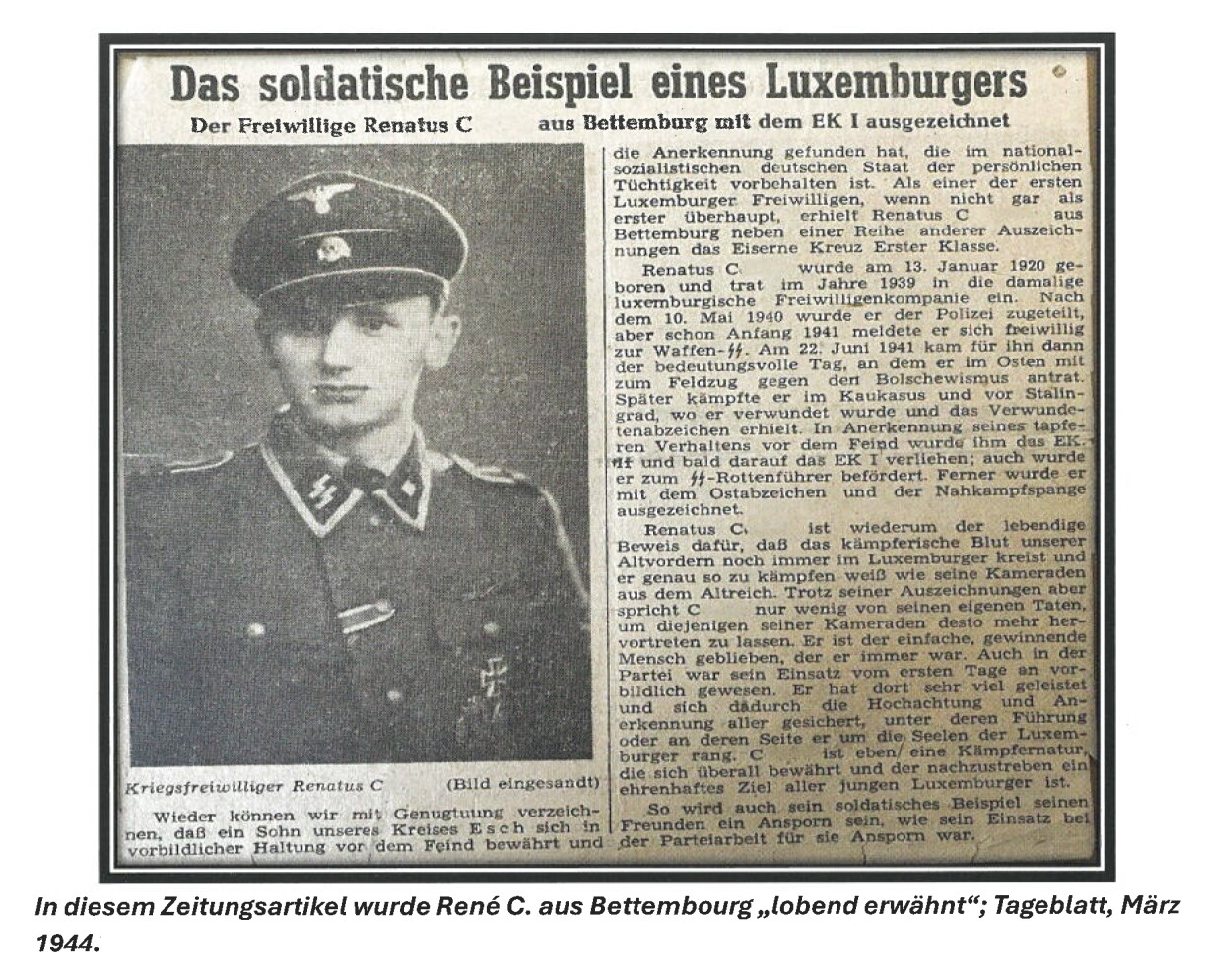
It remains one of the darker chapters of the Second World War: over 100 Luxembourg nationals were members of the Waffen-SS, the combat branch of the Nazi Party's paramilitary Schutzstaffel (SS) organisation. However, the men's origins and motivations varied widely, and only a minority can be considered ardent Nazis.
81 years have passed since the end of the war. Luxembourg was under German occupation between May 1940 and September 1944, and during the Battle of the Bulge – from December 1944 to February 1945 – large parts of northern Luxembourg were destroyed. Nearly 4,000 Jews who lived in Luxembourg were almost all either coerced into emigration or deported.
Over 10,000 young Luxembourgers were forcibly recruited into the Wehrmacht. At the same time, however, a significant number of Luxembourgers collaborated with the Nazis, with more than 100 men even joining the Waffen-SS.


This chapter of Luxembourg's history was not discussed publicly for a long time in the Grand Duchy, and even today it remains a sensitive topic. Part of Luxembourg's population welcomed the German invasion and actively denounced Jews or members of the resistance.
In Luxembourgish, collaborators are known as "Gielemännercher", or "yellow men", a reference to the brownish-yellow uniforms worn by Nazi supporters. While their existence is well known, what is less widely known is that over 100 Luxembourg nationals were members of the Waffen-SS.
Hobby historian Georges Even estimates the number at around 150. He was able to prove membership in 100 cases, which he documented in his book "Waffen-SS 1940–1945: Luxemburg". However, Even stresses that these 100 cases are not all comparable and should not all be dismissed as Nazis.
According to Even, 20 of the 100 embraced what they were doing, and of these 20, perhaps a dozen can be considered actual Nazis. The hobby historian cites three men who served as guards at a concentration camp. Some of the letters they wrote suggest they were fully behind the entire ideology.
As for the other 80, several were coerced into joining the Waffen-SS. For instance, 27 were members of a volunteer company that was sent to Weimar for re-education. Some of them were forced to become members of the Waffen-SS, while others volunteered.
One reason for joining was a desire for adventure, according to Even, who cites the case of an individual who, before the war, had wanted to join the French Foreign Legion but was rejected because at 17 he was still underage (the legal age at the time being 21). When the Germans invaded Luxembourg, the same individual applied for the Waffen-SS because the Germans did not care about his age, Even explained.
As for the family and social backgrounds of these 100 men, 79 were born in Luxembourg. The others were born in Germany, Belgium, France, and one in Croatia – though their families had long been settled in Luxembourg before the start of the war.
In terms of professional backgrounds, workers formed the majority, but the group also included farmers, students, civil servants, and one architect. Many came from modest circumstances, and several had lost at least one parent at a young age.
For the Nazis, racial characteristics were initially more important, although that changed over time. Hobby historian Even notes that candidates had to submit an application. He added that they were required to be unmarried, meet a certain height requirement, and have blue eyes and blonde hair.
Even explained further that they also had to provide a family tree as proof that they had no Jewish roots and had predominantly German or Luxembourgish ancestry – since the Nazis considered Luxembourgers to be Germans – going back three generations. In the later years of the war, however, most of these criteria were dropped.
The first Luxembourgers joined the Waffen-SS in 1941 – one year before the start of forced recruitment.





