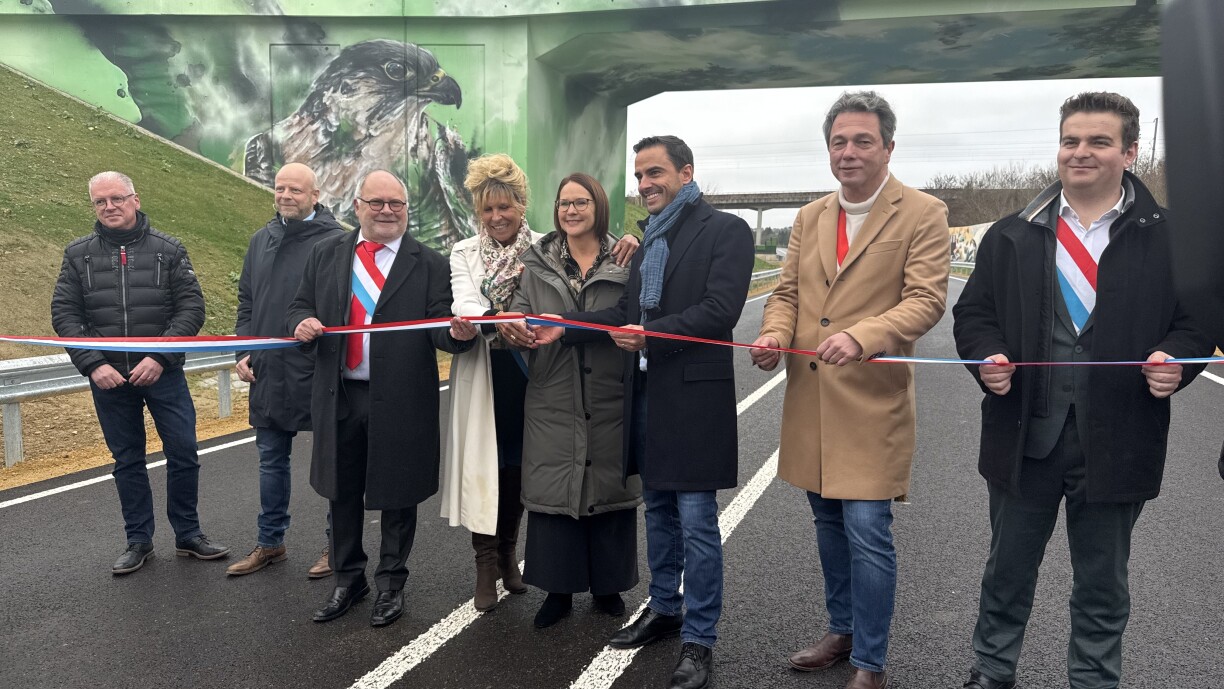
After years of planning, the Dippach-Gare bypass will open to its first vehicles on Friday, 12 December, at 12.12pm.
The road was officially inaugurated on Thursday by Minister for Mobility and Public Works Yuriko Backes. The ceremony was attended by Manon Bei-Roller, Mayor of Dippach, Carlo Muller, Mayor of Reckange-sur-Mess, officials from the National Roads Authority and the Luxembourg National Railway Company (CFL), as well as Minister for Family Affairs, Solidarity, Living Together and Reception of Refugees Max Hahn.
While the opening was met with satisfaction, officials acknowledged the new route does not solve all traffic issues in the Dippach area. Politicians stated repeatedly that the bypass's completion was urgently needed. The existing Route des Trois Cantons, used by over 8,000 vehicles daily, had reached its capacity limit, exacerbated by a level crossing that can remain closed for up to 40 minutes per hour.
The 2.2-kilometre bypass features a 125-metre covered trench and an 85-metre footbridge for pedestrians and cyclists. The project cost nearly €30 million and was completed in a relatively short construction period of two and a half years for Luxembourg.
When asked how this timeline was achieved and if it could serve as a model, the Director of the National Roads Authority, Roland Fox, offered an explanation. He stated that the authority "normally" faces fewer delays during the construction phase itself. For this project, all major works were bundled into a single contract tender, which helped keep the build on schedule.
"Where it sometimes gets stuck is in the authorisation and planning phases," Fox explained, "but efforts are underway to improve that."


A significant factor impacting both timelines and budgets is the requirement for ecological compensation measures, mandated to offset the environmental impact of construction. In a departure from past issues – such as with the A7 motorway, where some compensatory work remains incomplete – new regulations now require these measures to be in place before construction can begin. For the Dippach-Gare bypass, this involved developing approximately 10 hectares of compensatory land.
Minister Backes offered a critical view of the current regulations, noting they affect "a great many projects." She stated her ministry is "in dialogue" with the Ministry of the Environment to find solutions. "It is indeed a major challenge, as we have seen here, but which we also encounter in many other places, and we must find constructive solutions," Backes said.
For Dippach Mayor Manon Bei-Roller, the bypass's opening restores a quality of life long absent for local residents. However, she stressed that major traffic challenges persist in other parts of the municipality. Mayor Bei-Roller highlighted the N5, a primary route running from the south to the centre, as a particular concern. She noted that local authorities are in consultation with relevant ministries and pointed to increased pressure from neighbouring Käerjeng, where the closure of local roads is diverting more traffic onto the N5. "This naturally means a lot more traffic for Dippach," she stated.
A meeting between local representatives and the Ministry of Mobility is scheduled for early January. Minister Backes offered few details, stating only that all aspects would be discussed to identify necessary solutions.
Regarding the railway crossing at Dippach-Gare, it will be permanently closed to through traffic starting Tuesday, 16 December. If the municipality's plans proceed, the Route des Trois Cantons will be redeveloped for local access between the two new bypass junctions.






