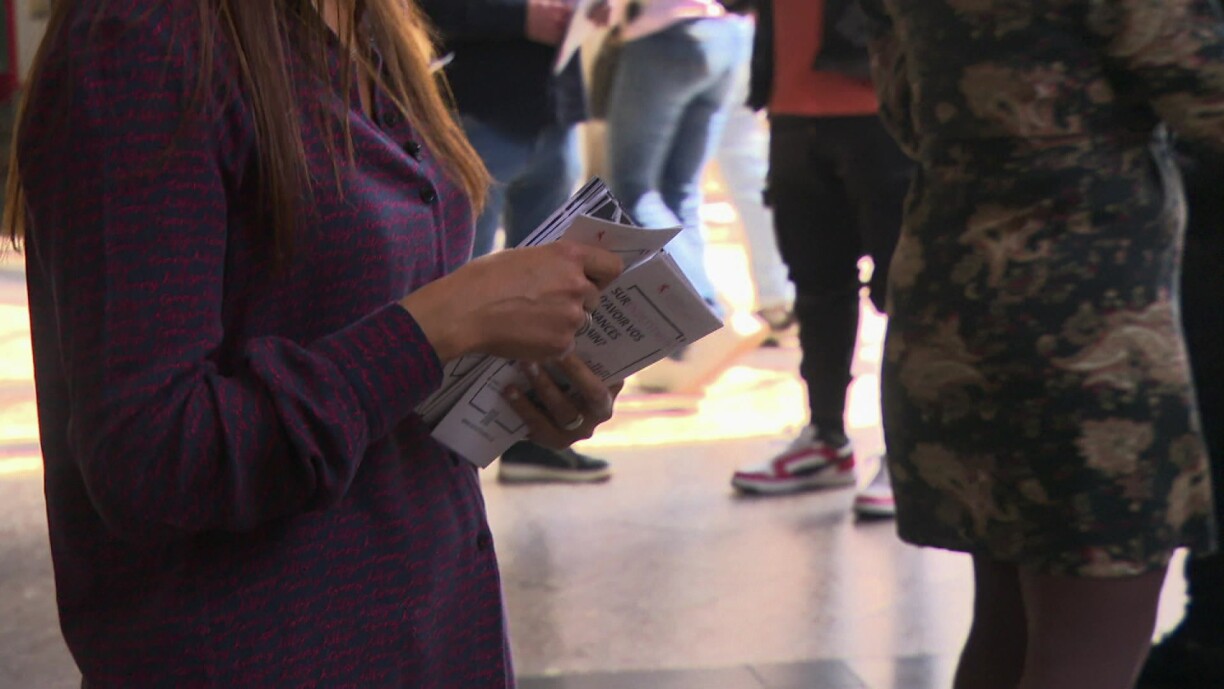
Over-indebtedness refers to the situation in which a person no longer has sufficient financial means to cover debts and bills. Announced last week, outreach teams from the Health and Social Welfare League (LMS) over-indebtedness service were stationed at Luxembourg City’s central train station on Monday afternoon to engage with the public, asking whether people understood what over-indebtedness means or knew someone who might need help.
Talking about money remains taboo, noted Helena Matos, coordinator at the LMS, who explained that many people rarely discuss finances at home, even less so when facing difficulties.
Few are comfortable speaking openly about financial problems. One young woman who approached the information stand shared how quickly manageable debt can spiral out of control. Small consumer loans, taken out to make life easier, suddenly became overwhelming when she lost her job during the COVID-19 pandemic. With bills piling up and no income, she found herself unable to respond to letters from creditors – until one day, the bailiff came to her door.
Data from last year highlights that over-indebtedness can affect anyone. Of those who entered the official procedure in 2023, 49% were aged between 31 and 50, and 45% were over 50. Most were salaried workers, while others included retirees (20%), people without employment status (13%), jobseekers (11%), and recipients of social assistance (9%). Only 3% were self-employed.
Job loss, illness, divorce – often it's not one event but a combination of factors that push individuals into financial crisis.
Ideally, people should contact the over-indebtedness service before reaching breaking point. The service offers free, personalised support: financial situations are assessed, budgets are drafted, and creditors are approached to explore possible agreements.
If no arrangement can be reached, individuals can apply for entry into Luxembourg’s formal over-indebtedness procedure, which is regulated by law. The aim in the first phase is still to find a mutually acceptable repayment plan.
Family Minister Max Hahn explained that when agreements are reached, people are protected – interest charges can be waived, asset seizures suspended, and a structured plan set up, with the goal of becoming debt-free within seven years.
Christian Schumacher, head of the over-indebtedness service of the LMS, described the procedure as a form of out-of-court assistance, one designed to help people regain control before matters escalate to judicial consequences. He stressed that the ultimate aim of the law is to give people a path back to living with dignity. In stark terms, he noted that the legislation exists, in part, to prevent someone from taking their own life because they see no way out of debt.
The number of people entering the official procedure has remained relatively stable in recent years: between 50 and 60 cases annually. However, Schumacher warned that the true impact of economic crises often appears only two or three years later in their office.
Further details about the National Prevention Week and its programme in English can be found at endettement.lu.





