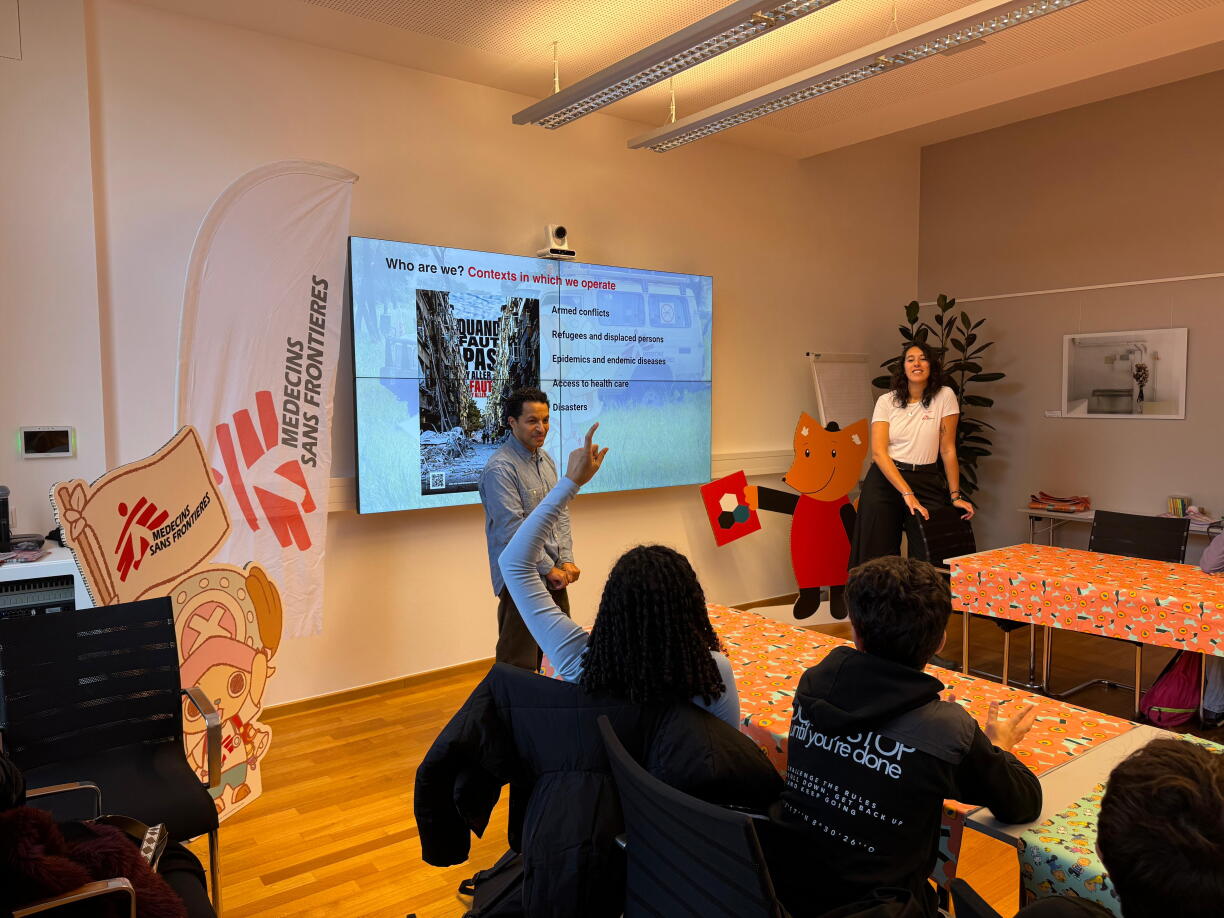
What can a manga character teach a Luxembourg school class about humanitarian medicine? For Dr Javid Abdelmoneim, international president of Doctors Without Borders (MSF), the answer goes to the heart of the organisation's work: helping people because they need help, whoever they are.
Visiting Luxembourg in the context of MSF Luxembourg's 40th anniversary, Dr Abdelmoneim joined a school workshop at Cercle Cité on Thursday. The 'All aboard the Humanity Ship' programme used photographs, geography games, and One Piece character Dr Tony Tony Chopper to explore humanity and solidarity.
Speaking to RTL, Abdelmoneim moved from the generosity of Luxembourg's donors to the increasingly difficult choices facing humanitarian organisations.
For a small country, Luxembourg makes a substantial contribution, he said.
Its fundraising stands out within MSF's international network for the amount raised per inhabitant: "I think it holds actually a record, in that it raises the most per capita of our fundraising sections, so what that tells us is the generosity of the Luxembourgers is immense."
That support represents more than money. To Abdelmoneim, donating also expresses a belief in humanity, solidarity, and the dignity of people living far away.
Luxembourg's contribution is scientific, too. Its operational research unit, LuxOR, is one of MSF's three main research hubs globally, he explained.
By studying humanitarian projects, it helps teams improve care, measure results, and understand outbreaks and populations' health needs. For an organisation delivering medical assistance in difficult conditions, that research translates into better decisions about how to reach and treat patients.
Asked about shrinking international humanitarian funding, Abdelmoneim drew a distinction between MSF's finances and the wider system around it. MSF's reliance on private donors largely shields it from government aid cuts; in Luxembourg, he put the privately funded share of income at 99.9%.
But financial independence cannot protect patients from the disappearance of other services, he warned: "Multiple actors, including the UN, are cutting services as a result, and there is absolutely no way MSF or any one organisation can fill the gap left behind."
He described shortages affecting food provision, sexual and reproductive healthcare, maternal and child health services, and treatment for HIV, tuberculosis, and malaria. Progress made over decades in reducing illness and death is being reversed, he warned.
Maintaining donors' confidence is another challenge. Abdelmoneim pointed to published annual accounts, anti-fraud systems, and accountability measures, while acknowledging that humanitarian organisations operate amid a broader erosion of trust in institutions.
Trust also has to be earned from the communities receiving assistance. He cited people in the Democratic Republic of Congo, who see an intensive international response to Ebola but feel abandoned during years of violence and inadequate healthcare between outbreaks:
'You only care about us when Ebola's here because you think you'll be affected. When it's not here, you don't care about us.' That's a trust deficit. And it's understandable.
MSF works in approximately 70 countries, Abdelmoneim said, responding both to emergencies and to crises that persist for years.
Sudan deserves far greater attention, he argued: "Sudan doesn't hit the headlines as much as it should. It's an enormous, enormous crisis when you look at the number of people affected."
He also highlighted the western Sahel, where armed violence, drought, poor harvests, and food insecurity compound one another. These overlapping pressures drive malnutrition and deepen poverty, yet receive insufficient public attention.
Across such settings, MSF's purpose remains delivering care. Conflict, however, creates particular frustrations and dangers.
"Conflict is a human choice. We're supposed to be better than that", he said.
Rules intended to protect civilians, medical workers, and healthcare facilities are increasingly being abandoned, he said, making assistance more dangerous, complex, and also costly.
That raises a difficult question: when should humanitarians turn their focus from hands-on assistance to speaking out about the causes of suffering?
Acknowledging that this question keeps him up at night, Abdelmoneim described a tension between treating immediate needs and challenging the decisions that perpetuate them.
In Gaza, he argued, speaking out about obstruction is inseparable from trying to deliver medical care. He accused Israel of impeding the humanitarian response required by the destruction of the healthcare system, and challenged the description of the situation as a ceasefire.
"Someone has to be the grown up in the room", he underlined. "We will say what needs to be said."
Back in the world of One Piece and Thursday's children's workshop, the message becomes more accessible.
Dr Chopper's ambition to cure people regardless of their identity mirrors MSF's principle of impartiality, Abdelmoneim explained: "It means that the human being who has a health need is treated as a human being who has a health need, regardless."
The collaboration began with an MSF staff member who had grown up in Japan and recognised that shared outlook. Abdelmoneim admitted he had not previously known the manga, but quickly understood the connection.
For the children attending the workshop, he hoped the lasting lesson would be simple: solidarity is something everyone can practise, and helping others can bring happiness to those offering it, too.
"We're all human beings living together and it's a joyful thing to do something for others", he said.


