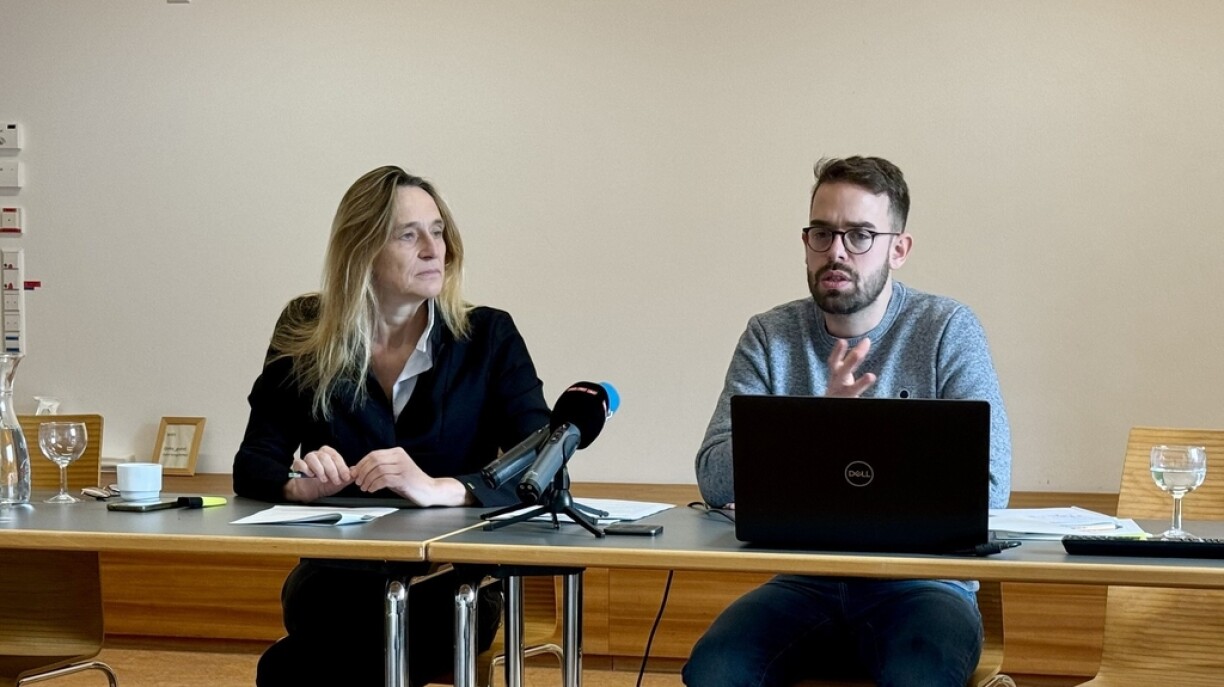
Blanche Weber, president of environment and sustainable development NGO Mouvement Écologique, underlined "the need for a wholistic strategy, which we cannot recognise in this instance". It should be a priority to set a framework which reinforces the trustworthiness of political decision processes, so that people still want to join the energy transition. It is important that consumers remain interested in investing into heat pumps and electric mobility.
For the time being, renewable energy is still more affordable than fossil fuels, yet consumers' uncertainty is big. The charging prices at public electric terminals have increased by 50%, the energy price cap is expected to rise in 2026, therefore electricity will become more expensive. The risk that the financial advantages of renewable energies over fossil fuels might disappear has surfaced. Blanche Weber emphasises that a difference between the prices must be kept up.
One of the key elements of the energy transition is the steady development of electrification. According to Creos, the electricity network and gas pipeline company in Luxembourg, they would need to invest €350 million into the expansion of high voltage networks until 2034. Afterwards, €100 to €145 million have to be invested into the distribution networks yearly. These are costs which will feed into the network costs.
Mouvement Écologique calls for a higher investment participation of the state in the expansion of electricity networks. Marc Krier, in charge of climate and energy questions at the organisation, insists "on a stronger public participation in network costs". Should that be implemented, the increase in electricity prices could be reduced and the strain on the final consumer would be eased, resulting in a more sustainable and useful strategy than another price cap, which does not change the structure of how networks function.
Another discussion point is the CO2 tax. From 2030 onwards, the European Union will introduce a new EU-emission trading system (ETS2) which also affects buildings and mobility. The European CO2 price is estimated at €200 to €300 per tonne.
Marc Krier adds: "It's a fact, fossil fuels are going to become more expensive". If Luxembourg does not gradually raise their CO2 tax until then, they are in for a price shock. In four years, we can expect an increase of €45 to €200 or €300 per tonne of CO2. A fact which the population might not seamlessly accept, according to Mouvement Écologique.
To give consumers more security, and the chance to plan ahead, it is crucial to settle on a national rise of the CO2 tax until 2030. "For us it is a decision which should not be procrastinated any longer, it should be clear to everyone as soon as possible, so that they can adapt themselves", reinforces Marc Krier.
Households with lower financial means have to be included. "A couple of conditions have been instated, yet there is still a lot of work to do", claims 'MECO' president Blanche Weber. For instance, not everyone is a property owner. Tenants are exposed to the price changes and cannot benefit from all subsidies, for example regarding the installation of solar panels. "It's a common issue", states Weber, "though we don't get the impression that the efforts to include everyone are what they should be".
The government and the communes should participate more in price calculations, in order to set the frameworks for the energy transition. Besides measures such as the support for renovations or the simplification of procedures concerning the expansion of renewable energies, more supporting conditions should be implemented.
"For example, it's not always useful for every person to install their own heat pump", highlights the president. However, the organisation of the heating network in the communes has to be pushed further, so that it can be connected to the public network. Luxembourg is supposedly running behind in development. The heating grid should become one of the priorities of the Ministry of Energy as well as of the municipalities, according to Mouvement Écologique.
In addition, a unification of norms regarding the construction of heating pumps and solar panels would simplify the processes.
At the end of the press conference on Friday, the general consensus was that in order to motivate people to take part in the energy transition, they need to stay informed. Therefore, Mouvement Écologique has requested an informative campaign to be carried out over a certain period of time. The campaign should clarify the network needs of each individual.





