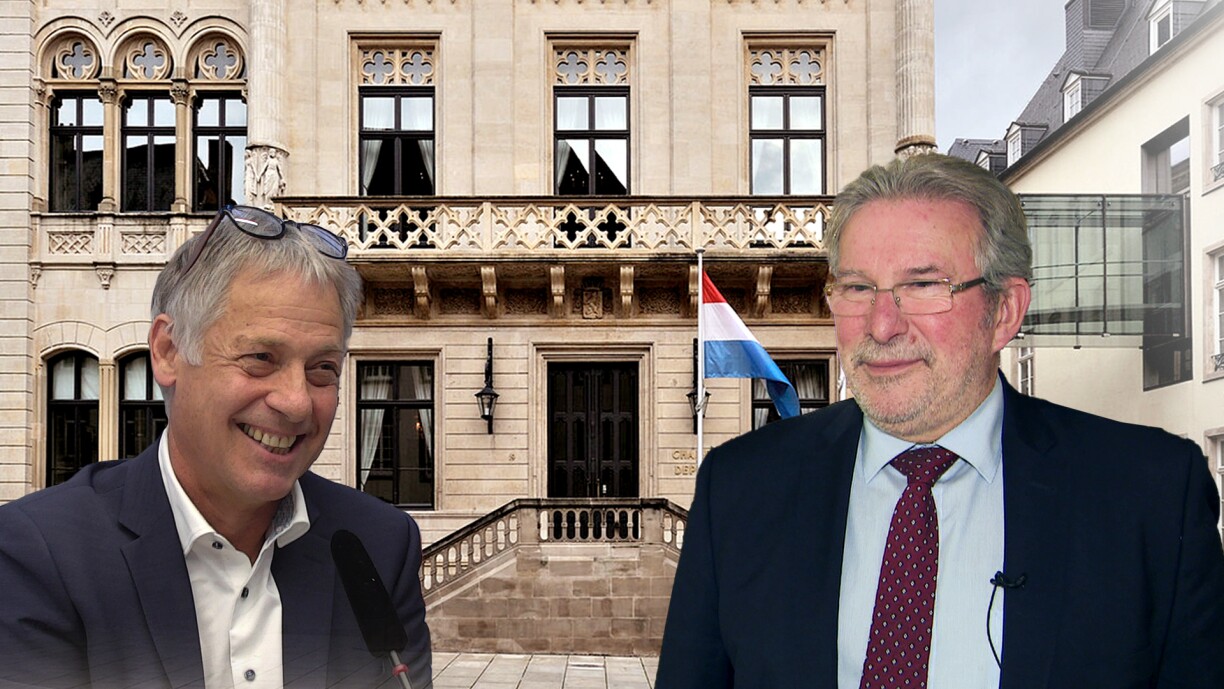
The list of questions in the Minister's response to the parliamentary question by MP Mars Di Bartolomeo from the Luxembourg Socialist Workers' Party (LSAP) "expresses that there are a whole range of issues in housing on which the Ministry would like to have better data and research." However, "due to limited resources, this has not been possible to this extent until now."
Despite the fact that the research of the Housing Observatory has substantially improved the data situation on housing development in this legislature. This is how Minister Henri Kox reacted to an enquiry by our colleagues from RTL.lu, after the latter were surprised by his answer to the parliamentary question, in which the minister responds with over 30 questions.
Bartolomeo's question to the Minister for Housing was related to people who moved from Luxembourg to the border region: What are the reasons, what are the advantages or disadvantages of such a decision? In his initial response, the Minister told the MP that he had no other data beyond what was accessible on the website of the National Institute of Statistics and Economic Studies (STATEC).
Because he could not find anything more concrete on this website, Bartolomeo decided to follow up, noting that STATEC only has data on people living in Luxembourg. For this reason, he asked the Minister another question: does the migration of people from Luxembourg towards the border regions not warrant further analysis?
The Minister for Housing's answer to this question consists of more than 30 other questions interspersed with sub-questions. While the whole statement is written in the context of housing, it does not really constitute a response from the minister in charge.
The issues raised in the questions range from affordable housing, the impact of new housing on global warming, the average living space per inhabitant, to the effects of a mobilisation tax on vacant land in the perimeter to get it on the market etc.
When asked by RTL about the unusual nature of the response, di Bartolomeo showed himself surprised yet amused and assured that he will be honoured to help the Minister search for answers to each of the questions.
- How can we ensure that the private real estate sector develops more housing that meet the financing capacity of middle-income households in Luxembourg?
- What is the share of land rent in the development of property prices in Luxembourg over the last twenty years?
- What is the evolution of the socio-economic characteristics of first-time buyers in Luxembourg over the last twenty years?
- How can the impact of new housing development on global warming be minimised?
- How can we ensure that people live together in densely populated urban areas?
- What is the average living space per capita according to regions and age or socio-economic age or socio-economic status categories in Luxembourg? How do these averages compare with the averages in neighbouring countries?
- How much living space per capita would be useful and necessary to meet the challenges of sustainable development?
- What is the ideal form of affordable housing preferred by the young, the 60+, the families?
- How has this ideal evolved since the 1980s? Does the country's housing offer correspond to this ideal?
- How can residential potential be mobilised to make better use of the available living space in Luxembourg while strengthening the economic resilience of households?
- What impact does a tax on the mobilisation of land potentially have on the willingness of landowners to develop their land? What is the correlation between the level of the tax rate and housing development?
- How can be ensured that the tax on the mobilisation of land does not have a negative impact on the price evolution while simultaneously ensuring that residential development will be in line with the PDAT?- What impact does a tax on unoccupied dwellings have on the willingness of landlords to rent out these properties? What would be the impact of an increased supply of Social Rental Management on the mobilisation of unoccupied housing?
- How to assess the impact of the money supply (M3) on the evolution of housing prices in Europe?
- Why don't the potential beneficiaries of the rent subsidy benefit more from the rental subsidies put in place by the government?
- What is the take-up rate of other individual support measures for home ownership?
- How can the costs of implementing Social Rental Management be more accurately assessed for its actor?
- How to improve the productivity of the construction sector when it is constantly decreasing? How to ensure that the construction sector becomes a forerunner in the use of renewable building materials?
- How to promote the circular economy in construction?
- How can we ensure that municipal politicians are more open to the development of affordable housing in their towns, especially on former industrial sites?
- How can social diversity be defined? Is there such a thing as a "healthy social mix"?
- Are there social diversity criteria to be implemented in urban development?
- What are the psychological, economic, social, and cultural factors that make low-income households vulnerable?
- What are the psychological, economic, social, and cultural factors that make high-income households more vulnerable?
- What are the links between the diversity of the inhabitants of an apartment building and the resilience of living together?
- What kind of support is necessary and useful to ensure that a residential community with great economic, social, and cultural diversity can live together successfully?
- What support is necessary and useful to ensure that a neighbourhood with great economic, social, and cultural diversity can live together successfully?
- What impact does school diversity have on living together in a neighbourhood?
- What is the definition of 'gentrification'? In which neighbourhoods of Luxembourg's major cities can gentrification be observed?
- How to achieve the energy transition in housing in working-class neighbourhoods? How to identify working-class neighbourhoods in Luxembourg?
- What improvements are needed to make the Rent Commissions an effective mediation body before the Justice of the Peace?
- What is the evolution of the size of companies active in housing development?





