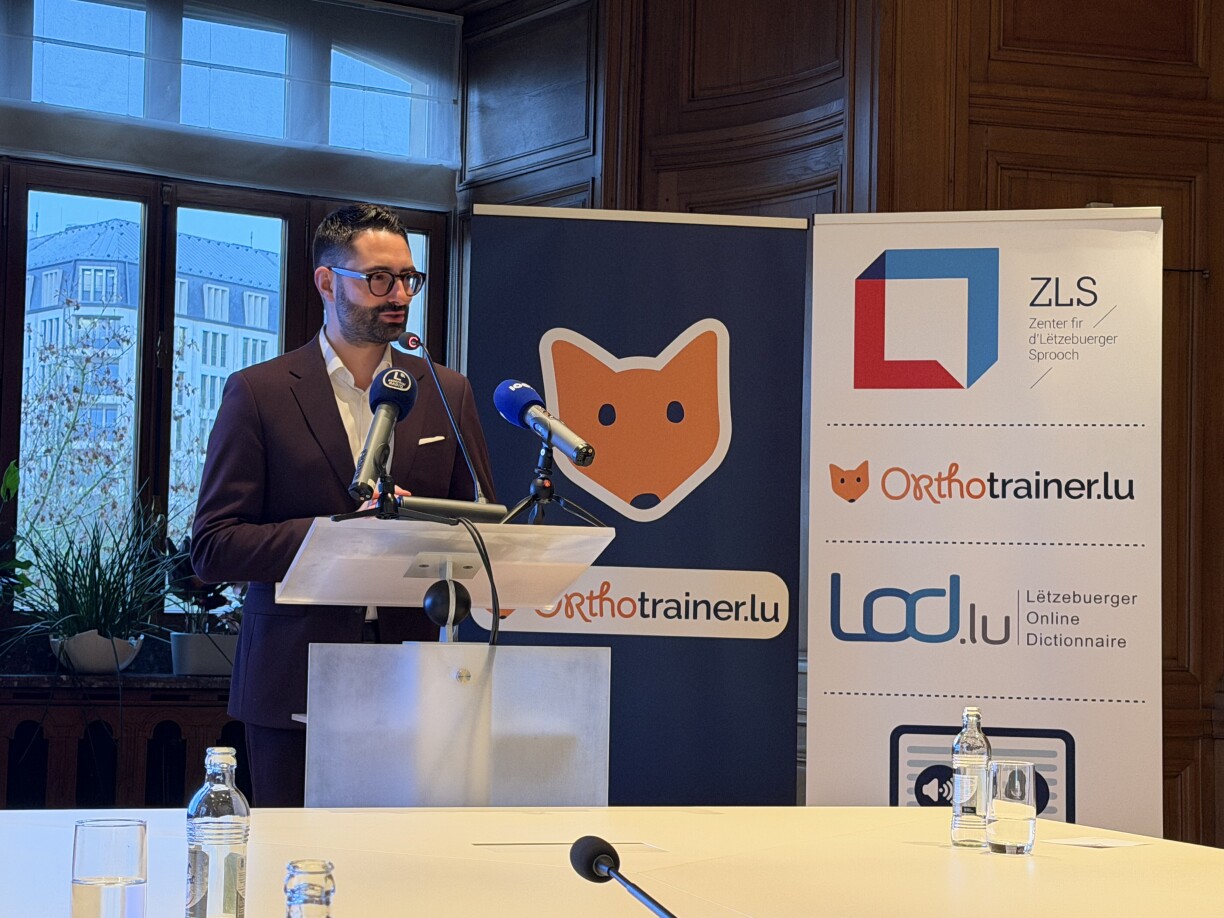
The Ministry of Culture on Monday morning unveiled four new or revised online tools designed to strengthen the presence of Luxembourgish in the digital sphere. According to Minister of Culture Eric Thill, the number of users across the existing platforms continues to grow, and, at the same time, more and more people want to learn Luxembourgish. In response, the Ministry of Culture has expanded and modernised its digital offering to make access easier, he said.
As people increasingly learn and interact online, the government aims to reach them on the platforms they actually use. Thill said the goal is to give Luxembourgish greater visibility in the digital world.
He stressed that the new tools – the redesigned Ortho-Trainer, the new Spellchecker app, the updated 'Sproochmaschinn' (language machine in Luxembourgish), and the Dutch version of the Luxembourgish Online Dictionary (LOD) – allow people to learn Luxembourgish wherever they are, without necessarily signing up for a language course.
The Ortho-Trainer is an online platform dedicated to learning and practising Luxembourgish spelling. It has been revamped to improve accessibility and usability, offering interactive exercises with immediate feedback and clear explanations of spelling rules.
The 'Sproochmaschinn' has also been upgraded. It now consists of two components: one tool that uses AI to convert spoken Luxembourgish into written text, and another that reads written texts aloud.
The system has been trained on twice as much data as before, allowing it to detect errors more accurately. Both programmes also include functions that help users with reading and writing difficulties to better follow and understand texts.
Finally, the LOD, which currently exists in Luxembourgish, German, French, English, Portuguese, and in sign language, will have a Dutch version. This new version required its own separate website, explained Sara Martin from the Centre for the Luxembourgish Language.
She highlighted that these tools remain a collaborative effort: they are developed by volunteers who put in countless hours of work. Every six months the volunteers receive updated files reflecting new entries or changes, giving them time to adjust the content so the platforms can be relaunched regularly. Feedback from Dutch-speaking users is also built into this cycle, which is why maintaining a dedicated Dutch version made sense, Martin stated.






