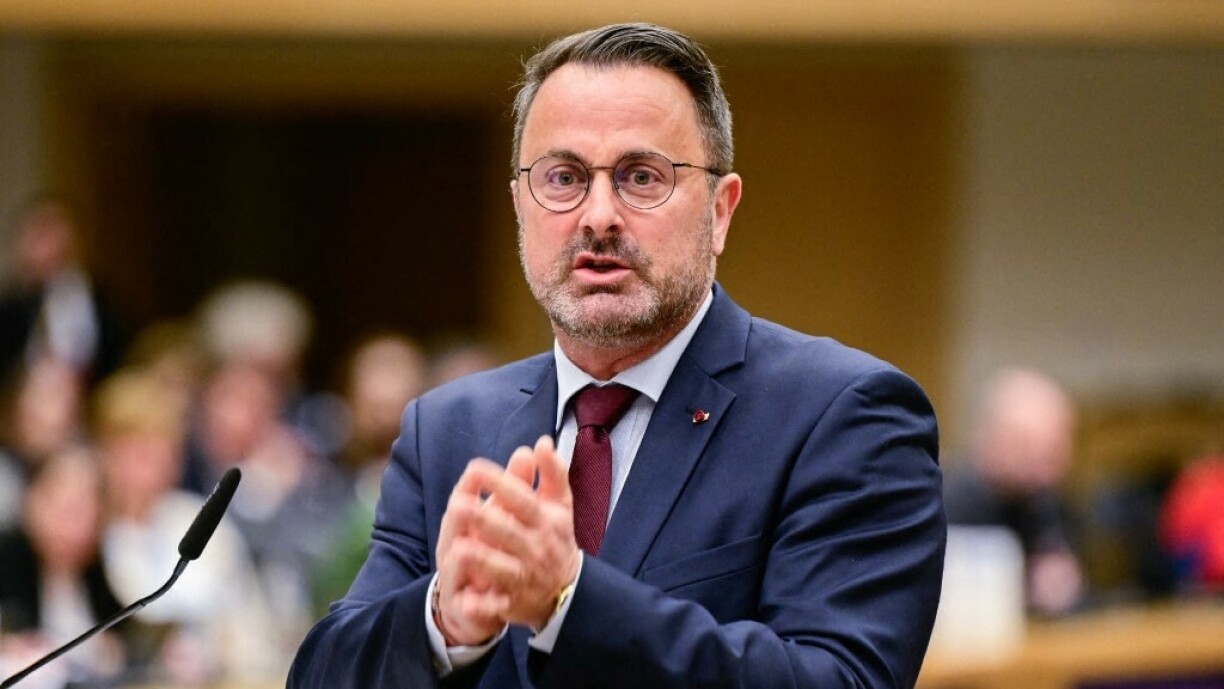
On Wednesday morning, Minister for Foreign Affairs Xavier Bettel addressed the Chamber of Deputies on the state of development cooperation, warning that international law, humanitarian principles, and multilateralism are increasingly under threat.
Bettel highlighted the impact of US President Donald Trump's decision to drastically cut development aid, noting that such moves create financial gaps that are difficult to fill. He emphasised the need for the private sector to play a more significant role in addressing these challenges.
Bettel pointed out that public development aid alone is "by far" insufficient to meet the "enormous" needs of developing countries. In a world marked by "constant polycrises" and shrinking development budgets, he argued for long-term, sustainable funding models that include contributions from the private sector.
While Luxembourg's financial sector could contribute, Bettel sees greater potential in the private sectors of partner countries. Luxembourg's development cooperation policy, he explained, focuses on supporting small- and medium-sized enterprises and small-scale farms in these regions.
The Foreign Minister also linked development policy to foreign policy, stating that Luxembourg intends to more explicitly emphasise democracy and human rights in future bilateral negotiations.
Bettel clarified that the goal is not to impose values but to prevent regressions. "The fact that in Afghanistan, women are no longer able to go to university or to school is unacceptable. The fact that in some countries, people are no longer allowed to practice a religion that was once permitted is unacceptable," he said.
Bettel stressed that Luxembourg is not advocating for specific policies like abortion rights, same-sex marriage, or the construction of religious buildings. However, he insisted that "there shouldn't be any setbacks" in the progress already made toward fundamental rights and freedoms.
In response to shifting geopolitical dynamics, Luxembourg decided to allow its development cooperation agreements with Burkina Faso, Mali, and Niger to expire. The Grand Duchy is now seeking new partner countries, though Bettel stated that no concrete announcements can be made at this stage.
The work of Luxembourg's development cooperation NGOs faced two major challenges in 2024: the Caritas fraud scandal and changes to the funding of educational and awareness-raising initiatives. During his speech in the Chamber of Deputies on Wednesday, Bettel addressed both issues.
Regarding Caritas, he noted that solutions have been found to ensure the continuation of most international projects. For instance, projects in Moldova and Ukraine have been taken over, while agreements with other partners have been secured to at least temporarily manage initiatives in South Sudan and Mali. Bettel also clarified that the ministry supported only one of Caritas' political projects, the continuation of which has been guaranteed.
The restructuring of educational and awareness-raising work by development NGOs, particularly in schools, has drawn criticism from the sector. Bettel explained that the reform is based on an external analysis, which found that an impact study of the sector was "impossible" due to a lack of necessary data. As a result, consultants recommended drafting a reform, which the ministry has initiated. NGOs are currently working on a "common vision" that will lead to the creation of various themed programmes. While the focus will be on implementing shared initiatives, Bettel assured that there will still be space for individual projects. "Every one of them can contribute their perspective, their know-how, and also their particularities [to this vision], creating an engaging offering for the public, schools, teachers, and students," he said.
Bettel announced that 2025 will serve as a transition year, with the framework until 2030 expected to be finalised by 2026. Development NGOs currently account for 15% of Luxembourg's development aid.





