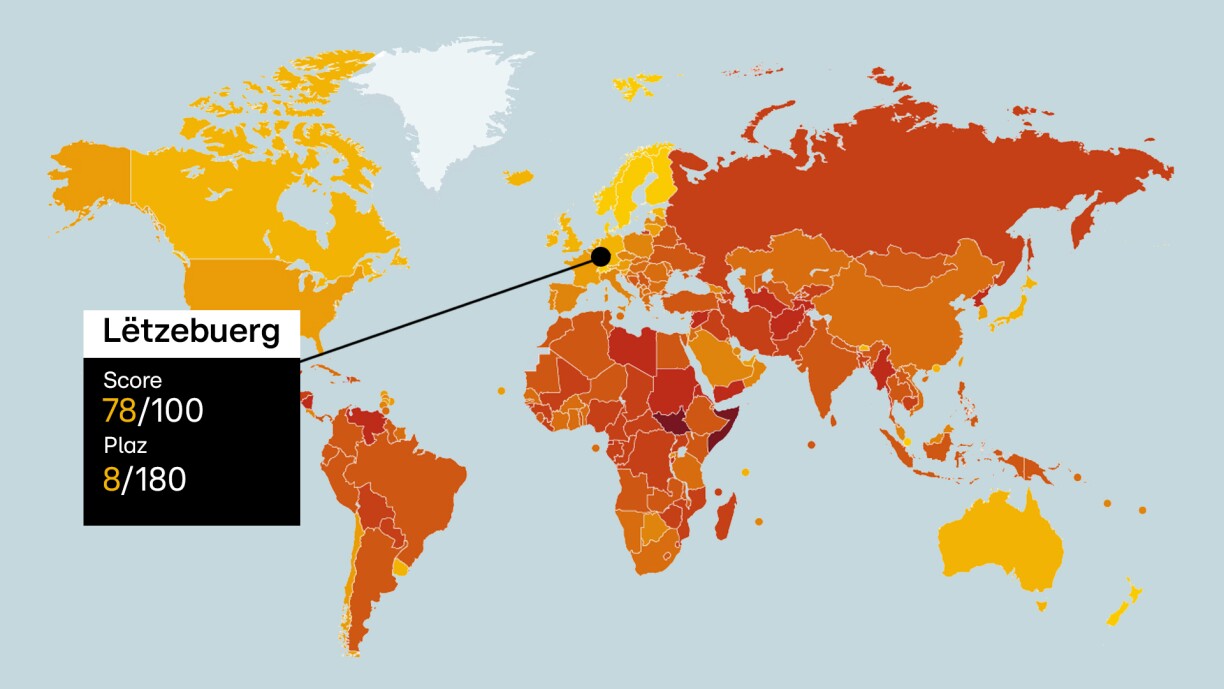
Luxembourg has slipped three positions in Transparency International’s latest Corruption Perceptions Index (CPI), reflecting persistent challenges in governance worldwide.
In the 2025 ranking, the Grand Duchy scored 78 out of 100 points, placing it 8th alongside the Netherlands. This marks a decline from its 5th-place finish in 2024, when it scored 81 points. Luxembourg’s highest-ever CPI score was 85 points in 2015.
Globally, Denmark once again leads the index with 89 points, while South Sudan and Somalia share last place, each scoring 9 points.
Transparency International notes that corruption remains a pervasive challenge across all regions, with limited signs of progress. The organisation links widespread anti-government protests to public frustration over leaders facing few consequences for misconduct and a growing demand for reform.
Although 31 countries have significantly reduced corruption since 2012, many others have not tackled the issue with sufficient resolve. Their scores have either stagnated or worsened over time. The global average now stands at 42 points – the lowest ever recorded.
The report also highlights a troubling trend in established democracies, including the United States, the United Kingdom, and New Zealand, where perceived corruption has increased in recent years. Transparency International warns that a lack of global leadership in anti-corruption efforts is contributing to declining ambition worldwide. It further notes that even countries with low domestic corruption can fuel the problem internationally if they enable the laundering of illicit funds.
Despite the global decline reflected in the index, Transparency International notes isolated progress across nearly every region.
In the Asia-Pacific region, eight countries have improved their scores since 2012. However, the region continues to show stark disparities in corruption levels, often driven by well-connected elites purchasing political influence.
Across the Americas, democratic institutions have weakened as governments have frequently failed to address corruption. This vacuum has allowed organised crime to expand, negatively impacting both security and human rights.
Corruption remains pronounced in Eastern Europe and Central Asia. In sub-Saharan Africa, weak democracies – often exacerbated by armed conflict, insecurity, and social unrest – hinder economic stability and development.
Western Europe hosts nine of the ten least corrupt countries globally. Yet anti-corruption efforts there have largely stagnated in recent years, and the region’s average score has fallen more sharply than that of any other part of the world.





