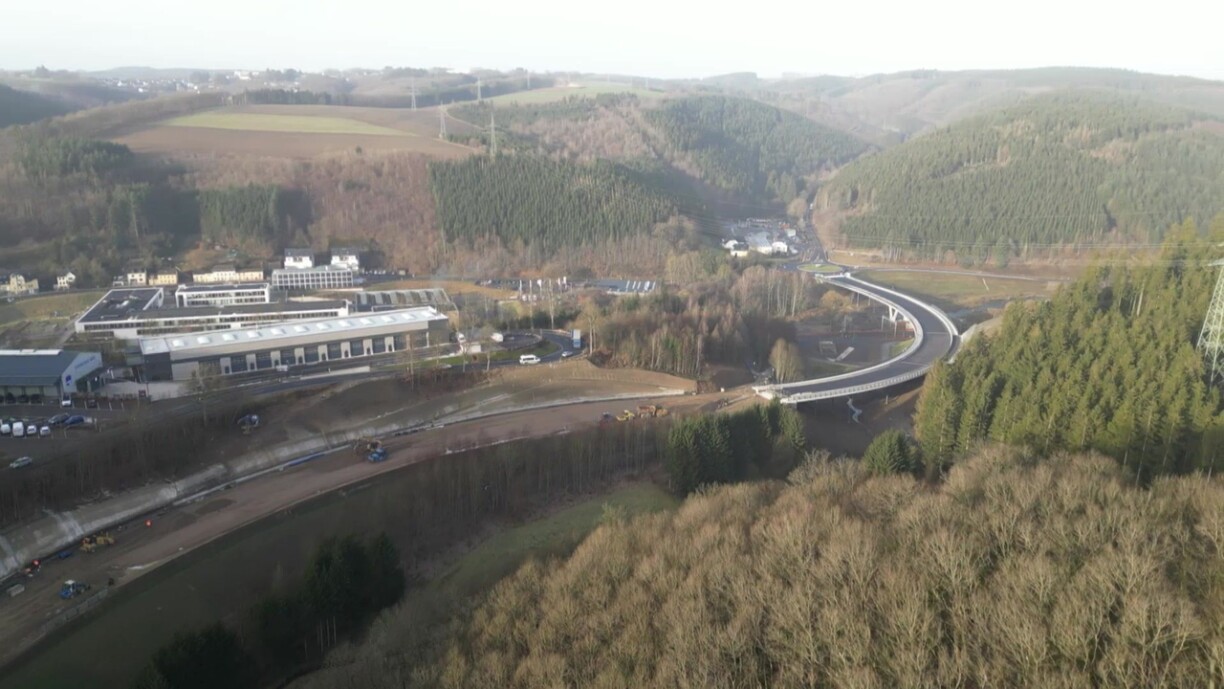
According to Marc Ries, Chief of the Division of Bridges and Roads in Diekirch, the full bypass will be ready by June 2024, despite the wintry conditions only allowing construction to be resumed this past week. Since June 2022, the initial part of the bypass linking the roundabouts in Marnach to the one between Reuler and Urspelt, has been operational. However, with the opening of the 1.7 kilometre stretch between Reuler and the entrance to Clervaux, the traffic in the area is expected to be significantly eased.
"We have now finished linking the N12 from Antoniushof to the N7 in order to have a direct connection from the industrial zone in Lentzweiler. At the moment that area is not connected well. According to our estimates, approximately 10.000 vehicles use that road daily, which will allow Clervaux to be relieved from the excess traffic as well. It will allow the city to develop itself in an entirely different way."
There are several reasons why construction took a decade to complete.
"Once we had a whole year where we weren't allowed to build at all. We had a legal case where the courts had to make a decision, and we had to wait for this decision before the works could resume. These are the type of constraints that projects of this size can encounter. Of course there were also winters where we cannot continue working even if there's no snow. Just the cold alone is not a good climate for the cement. This needs to be accounted for. Then, we also have periods where we need to construct on train tracks when trains are not running. These are arrangements we have to make with train companies."
With a length of 265 metres and an average height of 30 metres, the viaduct Irbich is the largest section of the project. The 85 metre long bridge over the Olegrëndchen and the second 255 metre viaduct over Clervaux are still under construction. The riverbed had to be moved and renaturalised.
The "transversale" will not only make life easier for car drivers but it hopes to ease transits for cyclists as well.
"Here along the PC7b, as we call it, the Transversale reaches Clervaux, where you can then cycle from Marnach all the way down to Clervaux. And here the road connects to the PC21, which was partially open this summer and will be officially opened in its entirety in the summer of 2024. This is the link to the Vennbahn, where you can then get to the Netherlands."
Additionally, a bridge is being built near the roundabout on the N7 in Marnach, which can be used by farmer's vehicles such as tractors but also cyclists, allowing them to avoid crossing the Transversale.
Not far from Clervaux, the Eselborn-Lentzweiler industrial zone attracts a lot of truck traffic. The project will improve access to this area as well.
"We have now built roundabouts at all major intersections on the N18. The only one missing is the one in Lentzweiler to create a link to the industrial zone. We want to improve the situation there, and the construction of a roundabout is planned for next year if everything goes well."
As for the total cost of the bypass, it was initially estimated to be 36 million euros. However, due to the rise in construction prices, the initial sum is no longer enough. A financing law from 2018 allowed the total to be recalculated to 73 million euros, which Marc Ries believes to be sufficient.





