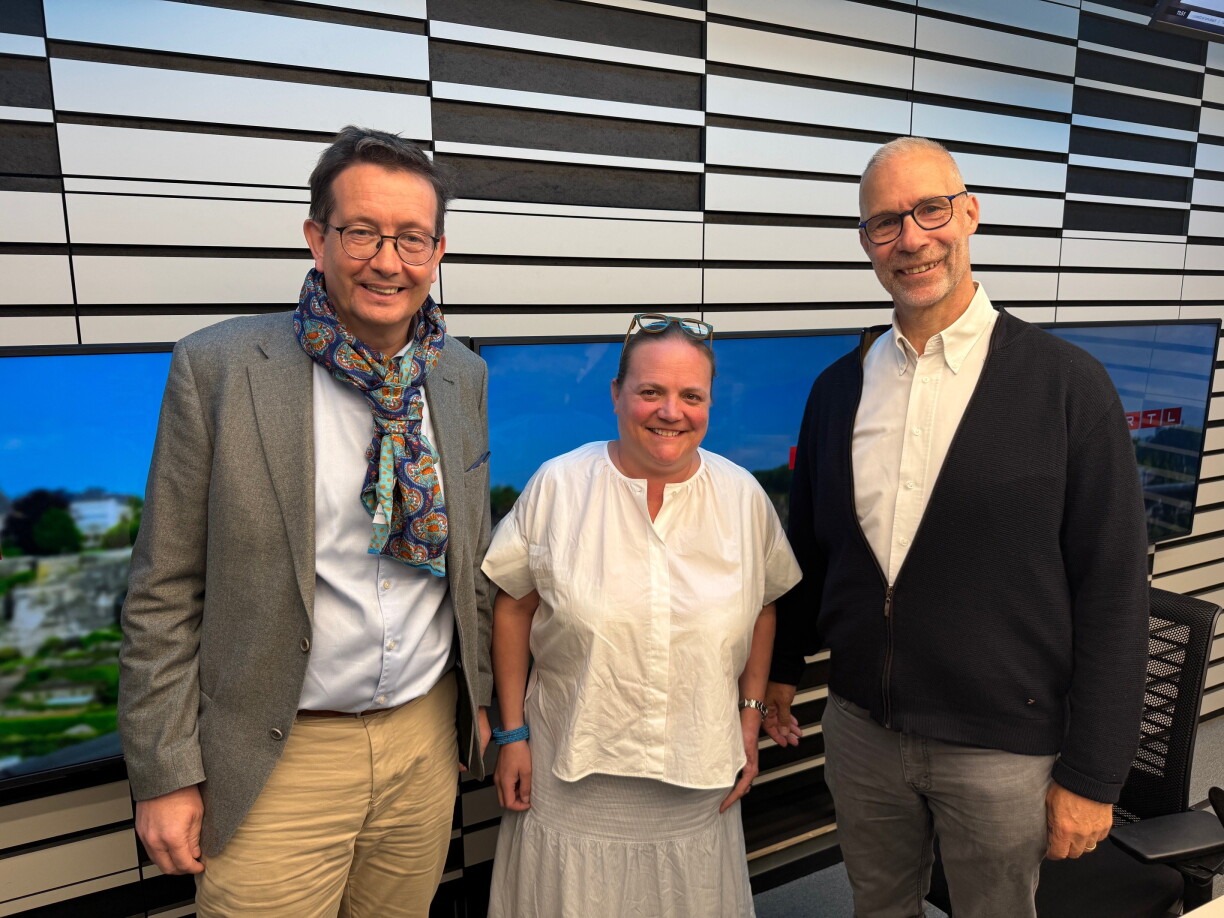
What kind of future does the Gare district have? RTL invited Anne Kaiffer, a businesswoman and Luxembourg City Democratic Party (DP) local councillor who has shut her shop near the station, Maurice Bauer, the Christian Social People's Party (CSV) first alderman responsible for commerce and urban development, and Patrick Reisdorff, who has lived in the Gare district for decades.
Kaiffer said she had closed her butcher's shop for several reasons. The war in Ukraine had forced her to raise her prices, and at the same time a number of other shops in the area had shut their doors. Safety and cleanliness in the district had been a problem for some time as well.
Reisdorff laid much of the blame at the door of politicians. The situation had been allowed to drift for too long, starting with prostitution and then moving on to drug use and homelessness. He compared it to a broken window left unrepaired, which only invites further damage.
Whether the situation around the station has improved or worsened in recent years is open to debate, Bauer said. He has had feedback from many residents who feel that things are gradually getting better, and pointed to a recent uptick in the number of shops as proof.
Kaiffer opened her shop at a time when the situation in the area was particularly difficult. The city, she recalled, had argued with the state to get more police officers stationed at the Gare and had brought in a private security firm. Social measures had also been introduced, such as the "A vos Côtés" service.
Reisdorff countered that the very existence of such a service, set up so that older residents could safely withdraw money from ATMs for instance, was itself an indictment. More police alone would not solve the problem, he argued, if the judiciary did not do its job and follow cases through. While judicial independence was a good thing, the courts also had to be the guarantor of security, and a serious staff shortage may well be part of the issue.
Whether the situation around the station has improved or worsened in recent years is open for debate, Bauer said. He hears from many residents living near the station that things are gradually getting better, a trend he said is also reflected in the recent uptick in the number of shops in the area.
Kaiffer called for citizens to be more closely involved in drawing up a future plan for the station district, ideally working with a professional consultancy. Bauer countered that residents were already being engaged in plenty of different ways, for example through the Apéri'Tour, and was sceptical of the consultancy idea, saying that politicians were ultimately elected to shoulder their responsibilities.
The first alderman also urged people not to lump together the various groups in the district, but to draw clear distinctions, for example between dealers and drug users, who are essentially unwell, and those who simply live on the streets without doing anything illegal.
There was also talk of a certain "social tourism", with more people from neighbouring countries coming to Luxembourg in the hope of more help. Some, it was said, are sent to the Grand Duchy under false promises.
Reisdorff argued that it was time to stop framing this as a Gare issue alone, since it has become a national problem. He also said he could not understand why Home Affairs Minister Léon Gloden and the City of Luxembourg's mayor Lydie Polfer had been criticised for advocating a begging ban in the area. In the end, the measure had achieved little, he said, because people now simply go into shops, buy something to eat and swap it for money shortly afterwards.
DP alderwoman Corinne Cahen, who also runs a shoe shop in the district, was not in the studio but spoke in an interview ahead of the broadcast. She insisted she still believed in the Gare district, which has a young population and is architecturally the most beautiful in the city.
She backed working with local residents to shape its future, and floated the idea of removing the monument in front of Spuerkeess and redeveloping the spot, for example with a terrace. She also said she could understand Kaiffer's view when the latter said she no longer believed in the district's future for her business.
Reisdorff, for his part, said purely urban measures would not be enough to solve the problem, since dealers would simply move their activities a few hundred metres away. On citizen participation, he saw room for improvement, arguing that good ideas come from putting many heads together.
Kaiffer agreed with Cahen that the situation for small and medium-sized businesses was currently bad overall.
One urban measure that could perhaps breathe more life into the station district would be a pedestrian zone, the guests suggested, alongside efforts to attract more traditional shops. On traffic, Reisdorff felt the tram had brought considerable relief, with far fewer buses now running through the district. Kaiffer, however, criticised the large number of one-way streets and the shortage of short-stay parking spots for drivers wanting to drop in briefly.





