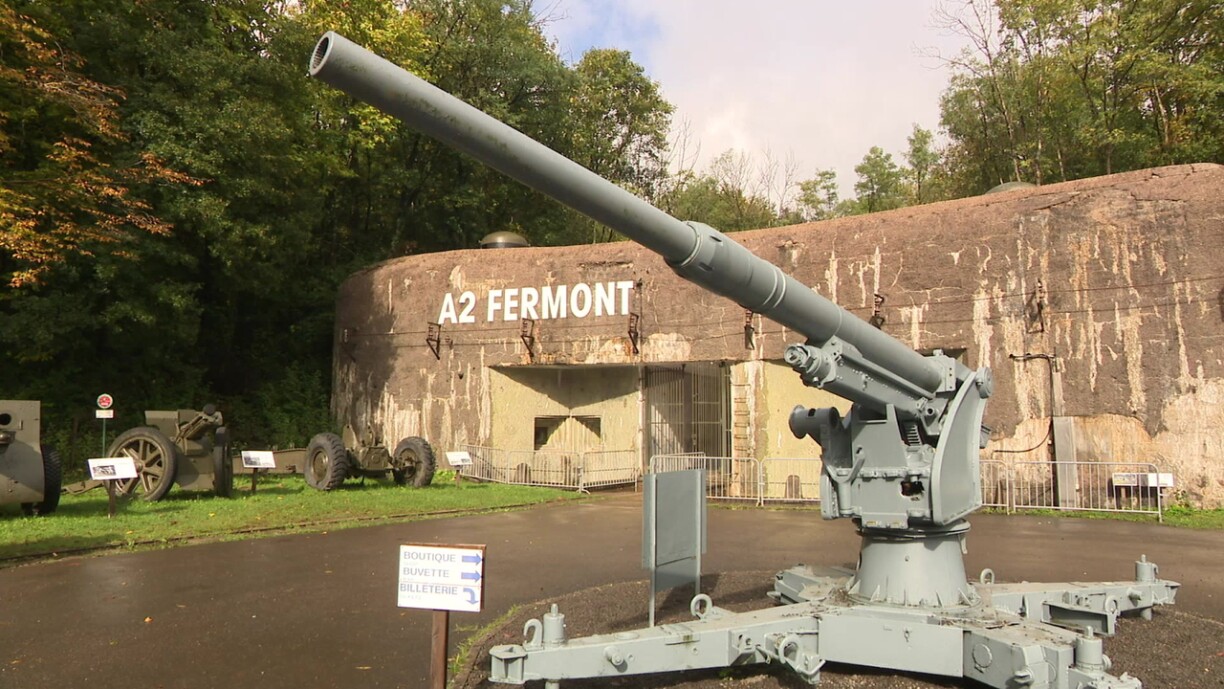
Only about 20 kilometers past the Luxembourgish border lies the French village of Fermont. At the end of this small village, in the forest, there is a “fort,” a primarily underground bunker system that was part of the Maginot Line. This location, which was a battleground during the Second World War, is now open to history enthusiasts. Adjacent to the entrance, there is even a museum to commemorate the French soldiers, including Florian Piton.
Fort de Fermont is not even half an hour away from Luxembourg by car, yet the name remains unfamiliar to many. Built between 1931 and 1935 with the help of regional farmers, it served as a defense against a potential German attack.
Although the fort was never taken by force, the defenders surrendered their keys to the German army after the French capitulation in 1940, which led to four years of occupation. During the battles, the French army sustained only one severe injury and one fatality, that of soldier Florian Piton.
To commemorate him as well as the commitment of the other soldiers, volunteers built the Musée du Combatant in 1940. The museum offers a glimpse into how the fort works. The defence mechanisms were very modern for the time, as well as techniques employed.
Edouard Jacque, the president of the “Association des amis de l’ouvrage du Fort de Fermont et de la Ligne Maginot” explained: “One must imagine the farmers, the miners and the steelworkers who participated in the construction or the 600 military men who did not always have running water in their homes, living in rural France at the beginning of the 20th century. Sometimes even the electricity was out, whereas here, they had everything, except they needed to live 30 meters underground."
Thanks to the museum, visitors can explore the world 30 meters beneath the surface during guided tours. Walking through the long, humid, and dark hallways feels reminiscent of being in a submarine. It is a parallel universe; the 600 soldiers had sleeping quarters, dining halls, guaranteed medical care, and entertainment. Covering the entire grounds on foot would take two days, but there is also a small electric train.
Jacque explains that inside the fort, they cannot use thermal vehicles. If they did, it would immediately create a polluted environment for 600 people. Even with two or three vehicles, that would not work. This is why electricity was chosen; electric trains already existed, as did certain electric cars, scooters, and other vehicles. They also have two loco-tractors, one of which they hope to exhibit in the future train museum in Pétange/Rodange.
Now, all that remains is to see whether the Luxembourgish managers are interested in the train, which they jokingly call TGV, or “Train à Grande Vibration” (Great Vibrations Train). During 1944, the fort was also used by American soldiers as a logistical base during the battles around Bastogne. Today, it partly contributes to environmental protection, as many biodiversity reservoirs have naturally grown around the bunker.





