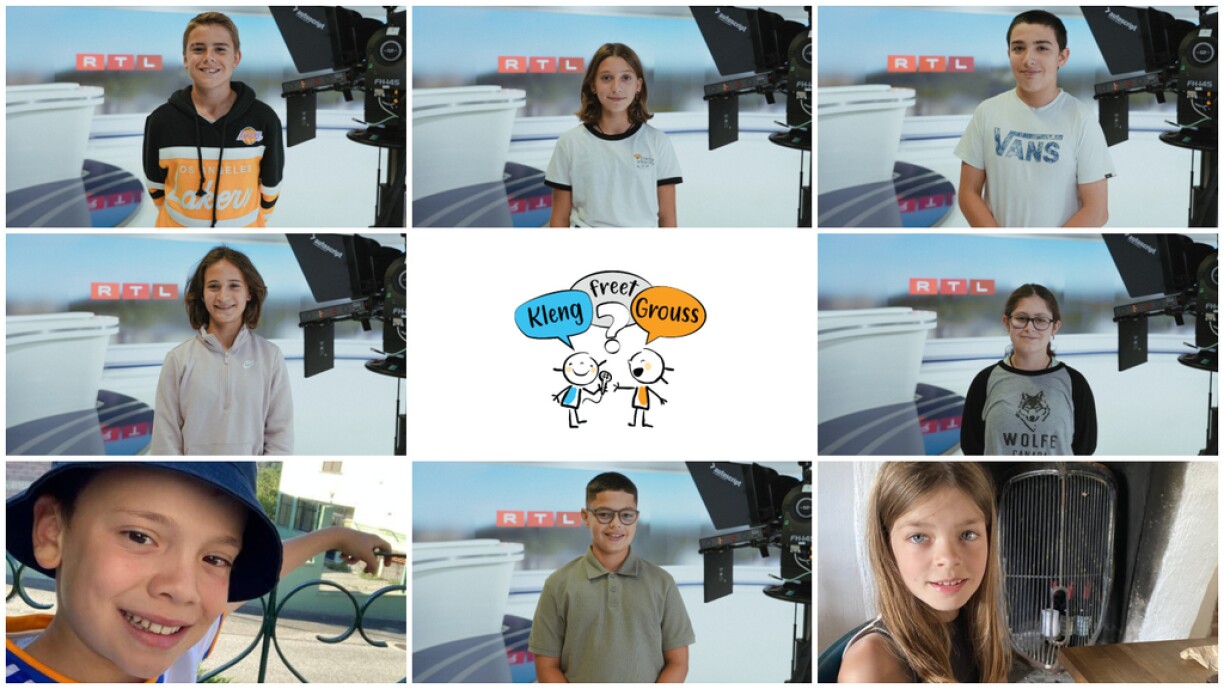
Why isn't English taught until secondary school? Is it difficult to hold multiple ministerial positions? And would Claude Meisch rather be a pupil in 2024, or in the 70s and 80s? RTL's young reporters Zoé and Charel sat down with the minister to find out his thoughts.
The minister revealed he always enjoyed going to school because "there was always something going on", but admitted he went through phases where he was reluctant to study. "I think that's the same with children today," he said. "Fortunately I am still a person who enjoys learning, and I think if you go through life with open ears, open eyes and an open heart, it helps."
When asked what his favourite subject was, Meisch said it was maths, although he acknowledged that this was an unusual selection. "I know a lot of children and young people who have no enthusiasm for maths! I happened to be good at it, but I had more trouble with languages, for example. Every pupil has their own strengths and weaknesses."
"Why don't we learn how to write Luxembourgish in school?" asked Charel. The treatment of Luxembourg in the Grand Duchy has made headlines over the past few years, most recently culminating in a parliamentary debate this week in which it was claimed Luxembourgish was in danger of dying out. Meisch said there was certainly demand for learning the language at school, with many pupils interested in learning more about national culture and literature. As a result, the government recently launched Luxembourgish as a subject in secondary schools, with hour-long weekly lessons to focus on the language.
Zoé asked if English should be introduced at an earlier age, given its global popularity and rising prevalence - currently, students start English classes in their second year of high school. The minister replied that he is frequently asked this question, and that statistically, very few pupils actually struggle with English at school, with the majority of pupils reporting difficulties with German or with French. Many children are already familiar with English before they begin classes, he added, and many students leave secondary school with a high degree of proficiency in the language.
Meisch also covered the upcoming pilot project to scrap the different sections, or streams, in classic secondary education. The young reporters pointed out this would reduce options for pupils to specialise in certain areas, to which Meisch replied that the model would follow the German and European school systems in which pupils take the same classes throughout their secondary education. "We need to see if this model even works at a lycée," he said. "If it does, the government, or even the next government, would have to decide within the Chamber if the plan will be rolled out across all schools."
Further reading: a guide to the International and Luxembourg school systems
What about making craft apprenticeships more attractive to young people? Meisch highlighted projects such as the Chamber of Skilled Trades and Crafts's "Hallo Handwierk" initiative, which sees tradespeople visit schools to share information about their craft and drum up enthusiasm among pupils. The minister said he was considering rolling these visits out to every class in Cycle 4 to help spread awareness.
"As ChatGPT is being used more commonly by pupils now, what role does AI play in the future?", Charel asked. The minister said he'd recently attended a conference in London on artificial intelligence, covering the potential impact of AI on education, and said he was aware that students were already using tools to help with their homework. However he emphasised that teachers could also make use of AI to prepare lessons, but warned that above all, AI should be used sensibly.
The conversation turned to Meisch's work as education minister, as he acknowledged he knew not everyone was satisfied with his efforts. But Meisch told the young reporters he enjoys visiting schools and likes to get children's views on important topics, as well as speaking to staff. "Ministers are responsible for everything, including unpleasant things," he said. "And unpleasant things crop up every single day."
When asked how he balances his responsibilities for education and housing - a role he has held since the new cabinet was announced last autumn - Meisch replied that he needed to be extremely organised, and praised the teams around him for making the roles achievable. The minister pointed to the recent government decisions to reduce tax for investors in new housing, as well as more financial support for buyers and renters. In addition, he said the government would invest 420 million euros in social housing for people on low incomes, something he said would be an important step in achieving a somewhat normal level of affordability for housing in the Grand Duchy.
RTL's young reporting team, made up of youngsters from around the country, shared their reactions to the interview in the "Firwaat?" children's podcast (in Luxembourgish):
Eis RTL-Kannerreporter ënnerhalen sech iwwert d'Schoul an schwätzen iwwert hiren Interview mam Claude Meisch,