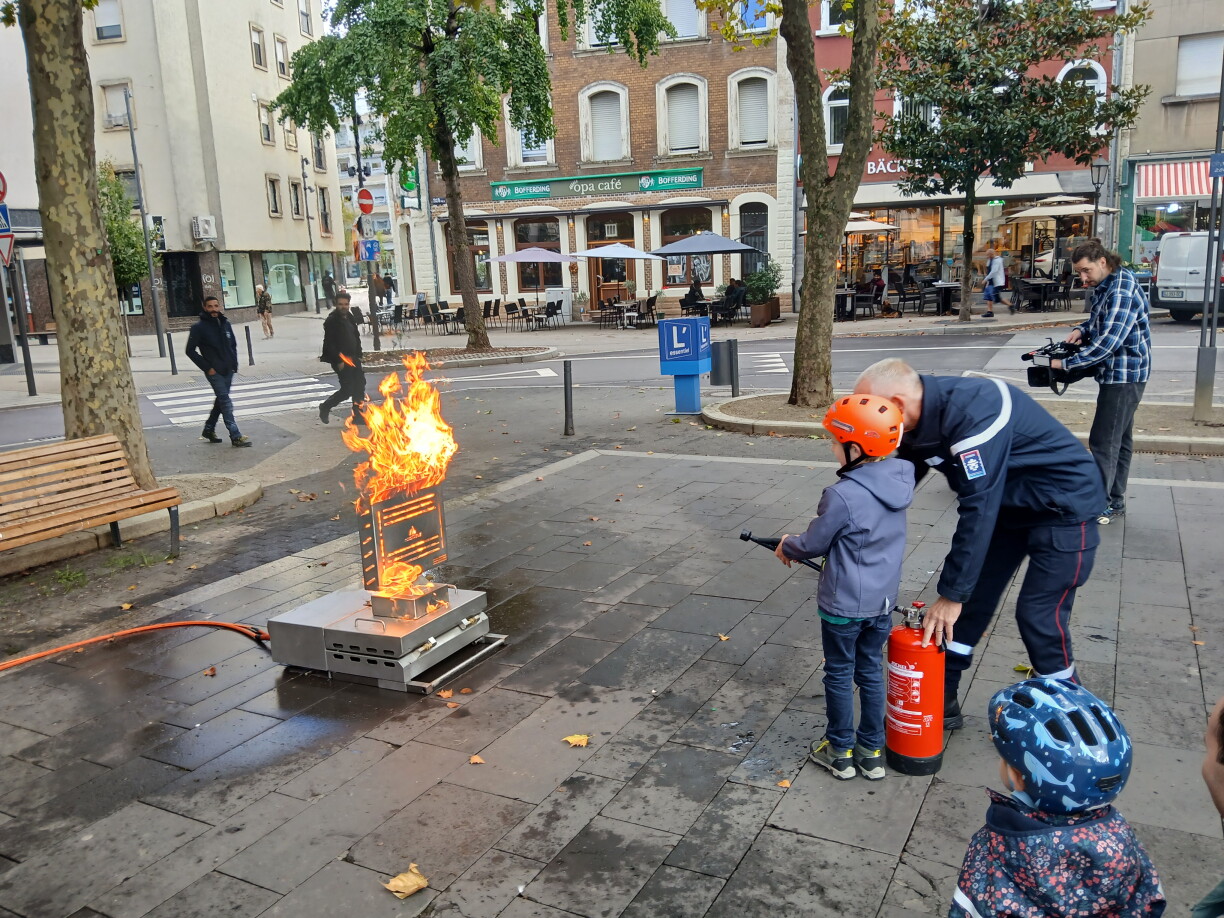
Knowing how to respond in a crisis can save lives, whether it involves a fire or a medical emergency.
On Saturday, the final day of Luxembourg's Resilience Days, firefighters in Dudelange demonstrated how to respond effectively to emergency situations, sharing practical advice and offering hands-on activities for attendees of all ages.
Their goal was to demystify life-saving skills and encourage the public not to hesitate when help is needed.
To illustrate the dangers of building fires and the importance of smoke development, firefighters used a model to safely recreate emergency scenarios. This approach allowed both younger and older visitors to visualise what happens during a fire, without any risk to the town hall.
Visitors were also able to practise using a fire extinguisher, emphasising the value of being prepared at home.


Firefighter Roger Clement from Dudelange highlighted that it is always better to have a foam fire extinguisher at home, regardless of the brand.
The important thing, he noted, is to ensure you know how to use it: every extinguisher comes with instructions and clear symbols indicating its use.
Typically, the process involves pulling a safety tab, giving the extinguisher a firm tap, and then deploying the hose to spray.
Before tackling a fire, participants were advised to test the extinguisher briefly, then approach the flames to within one or two metres and discharge the contents with force for maximum effect.
Another focus of the event was teaching resuscitation techniques for unconscious individuals. Seconds are critical in these situations. Trainee professional firefighter Lilli Gales explained that if a person is not breathing, immediate chest compressions are necessary.
The correct technique involves placing the heel of the hand in the centre of the chest, pressing down five to six centimetres at a rhythm similar to the Bee Gees song Staying Alive.
Thirty compressions should be performed before giving breaths, but if no equipment is available for rescue breaths, continuous compressions are recommended.
Defibrillators, now commonly found in public places, support users by providing step-by-step multilingual instructions, making it possible for anyone to assist in an emergency.
Events like the one in Dudelange aim to increase public understanding of emergency response, according to Home Affairs Minister Léon Gloden. The minister stressed that people should not be afraid to help in an emergency.
The event, held next to the Dudelange town hall, attracted a steady but manageable flow of visitors, without any overcrowding at the stands.
While the term 'resilience' may not be familiar to everyone, initiatives like these are designed to ensure that more people feel confident and ready to act when faced with a crisis.





