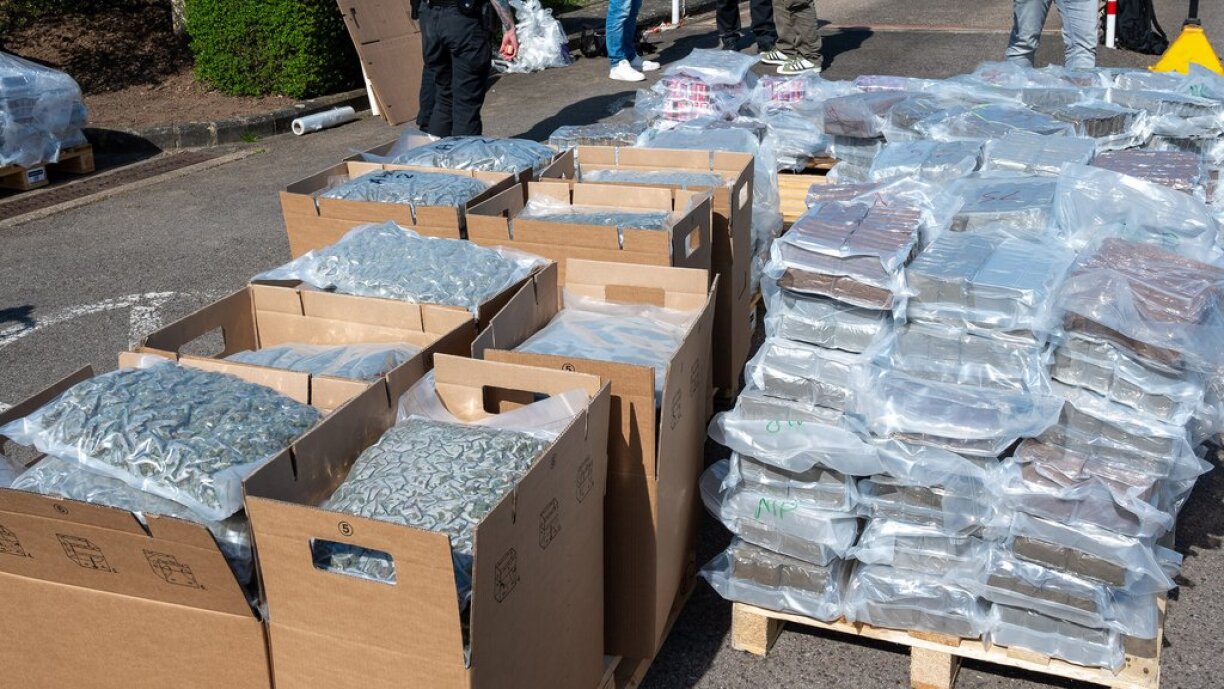
MP Sven Clément of the Pirate Party (Piratepartei) addressed a parliamentary question concerning drug seizures to the Minister of Home Affairs Léon Gloden and to Finance Minister Gilles Roth. The parliamentary question requested information about the amount of drugs seized from 2020 to 2024, where the drugs came from, the measures taken by the government to ensure security in the cargo center, and the danger of drug cartels spreading in Luxembourg.
Regarding drug seizures, the Grand Ducal Police and the Customs and Excise Agency provide data that varies from year to year and from drug to drug. The four narcotics indicated on the answer to the parliamentary question are heroin, cocaine, hash, and marijuana. The amount seized is very low in comparison to the record drug seizures of this year, including the seizure of almost a ton of cocaine in Bilsdorf.
The police and customs seized around a kilogram of heroin and almost a kilogram of cocaine in 2020. In 2021, they seized 2,2kg of heroin and 3,6kg of cocaine. However, in 2022, they seized a lower quantity, namely over a kilogram of heroin and over a kilogram of cocaine.
Marijuana shows a different pattern. In 2022, 168kg of marijuana were seized, making it a record year within the given time frame. Regarding hash, 403kg were seized in 2023, remaining more or less stable throughout the 2020-2024 period.
This low variability is an indicator that there has not been an increase in the amount of drugs transported within Luxembourg.
The answer to the parliamentary question also shows that the police mainly seized heroin and cocaine while customs seized more hash and marijuana on average.
The two ministers also provided answers to the other questions, stating that most drugs seized by the police came from Belgium and the Netherlands. Customs tend to seize drugs transported through air cargo, indicating that the drugs originated from non-EU countries. Furthermore, Luxembourg is said to be a transit country, meaning that the drugs are not destined for the local market.
They also discussed current measures, including cooperation with Europol. Future steps have been outlined such as renewing bilateral agreements with France and Germany and participating in the newly established EU Customs Alliance Borders Expert Team, among others.
Finally, the two ministers emphasised that there is currently no indication of drug cartels established in Luxembourg, deeming the danger of violent gang conflict low, although they do not exclude the possibility of this risk.
D'Parlamentaresch Fro N°2015 an déi entspriechend Äntwert op dës am Detail, fannt Dir hei





