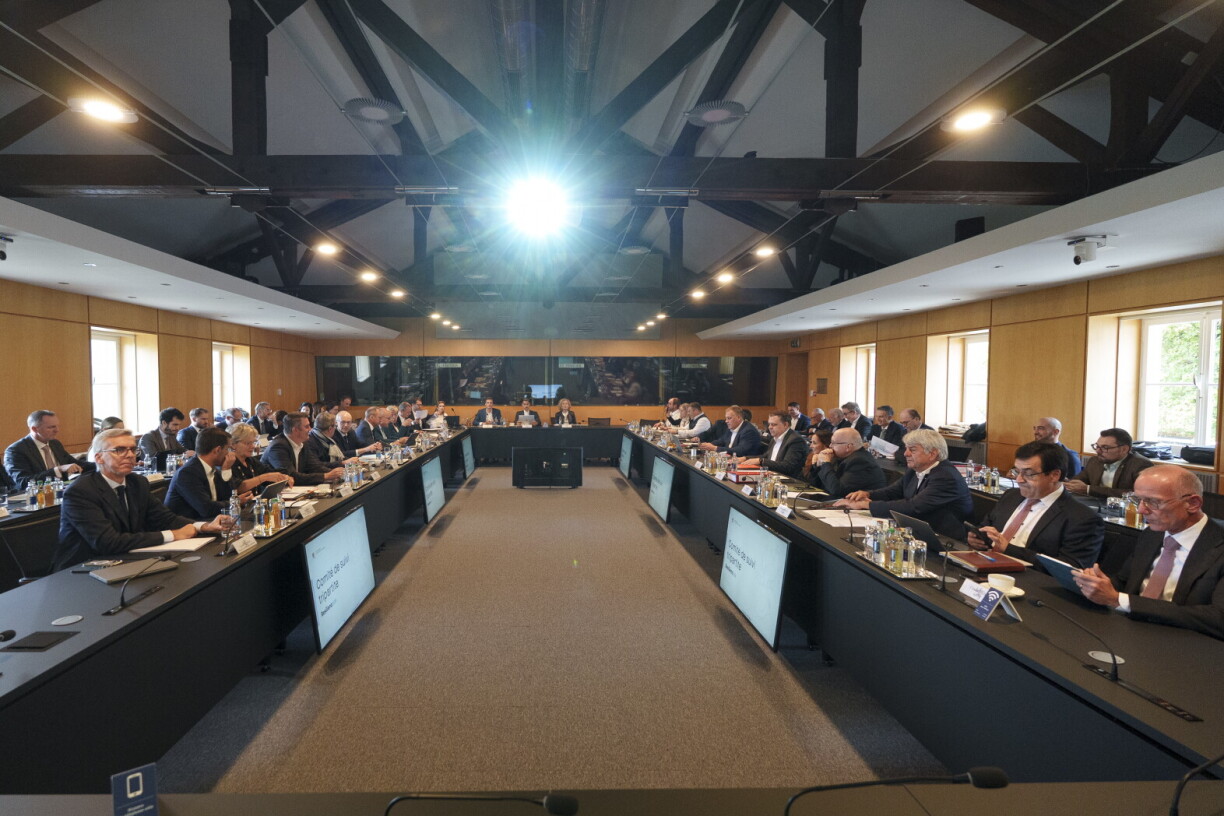
STATEC, the Energy Commissioner, and ADEM presented their findings at the meeting of the Tripartite Monitoring Committee, concluding that while Luxembourg's economy and employment are growing, the rate is slower than in the past.
With this in mind, the government will meet with the unions next Thursday to discuss state subsidies for energy prices and whether they will continue in 2027.
Purchasing power has increased and will continue to so in all income categories between 2024 and 2027, even if spending has also increased significantly, says Statec. The national statistics institute has again used the so-called quintiles to divide people and households into five income categories. Statec was also kind enough to provide us with the absolute figures – the incomes – for the different categories upon request.
In the lowest category are people with a net income of up to €2,800, or households with an income of up to €3,800 per month. For them, expenses have increased by almost €5,000 in the last 3 years, but income has risen by €7,500, so a balance of €2,500.
At the other extreme, for the upper income of over €8,200 per month or €14,100 for a household, expenses have increased by €7,500 per year, but income by 20,000, i.e. an increase of €12,500. In the third quintile, people with €4,800 or households with €7,700 per month, after 3 years, are a little more than €5,000 better off.
There is a clear and significant increase in the upper income category.
The index represents the largest contributor to the increase in disposable income, followed by autonomous increases and then the adjustment of the tax rate to inflation. In absolute terms, the index and adjustment of the rate particularly relieve high incomes.
Fuel tourism and the lower taxes in this country are still attractive. On 12 October, for example, petrol cost €1.88/ litre, compared to €2.21 in Germany and France and €1.98 in Belgium. Heating fuel is also cheaper in Luxembourg than in its neighbouring countries.
Unsurprisingly, fuel consumption has increased more in recent months than in previous years. Diesel and heating fuel consumption has been on the decline – but for diesel this probably reflects the trend of fewer registrations and for heating oil, people have been holding off in the hope that prices will fall.
The Energy Commissioner explicitly warns that attractive prices and state intervention in fuel prices pose a risk to security of the supply. He also warned of a sharp increase in the gas purchase price. In Luxembourg, prices for people are stable thanks to the suppliers' purchasing strategy, but a consequent impact and consequences on electricity prices are to be expected.
The Commissioner concluded that while the system has been resilient to date, structural solutions are needed to strengthen independence for the EU and Luxembourg.
Almost everything points to more targeted measures to stem price increases. It is understandable that the government and the social partners will lean towards 'watering can' policies, because their main goal is to slow down inflation in general, and to avoid two indexation tranches within 12 months.
Everything points to the need to drastically reduce the dependence on fossil energy, not just for the climate, but because they are relatively absent in Europe. The EU is susceptible to blackmail by other world powers and the whims of a few heads of state, and somewhat reliant on Norway, even if it is not a member state.
The main takeaways from the presentation were as follows:
With this in mind, one can only wonder how long there will be growing purchasing power and cheaper fuel prices, or when unpopular measures that risk being unfair will become inevitable.
Almost everything speaks against a tax reform that should relieve everyone and all in order to become more economical.
The social partners will meet for further tripartite discussions next Thursday, expecting results quickly. Subsidies for fuel, gas and electricity are likely to be extended "somehow".


