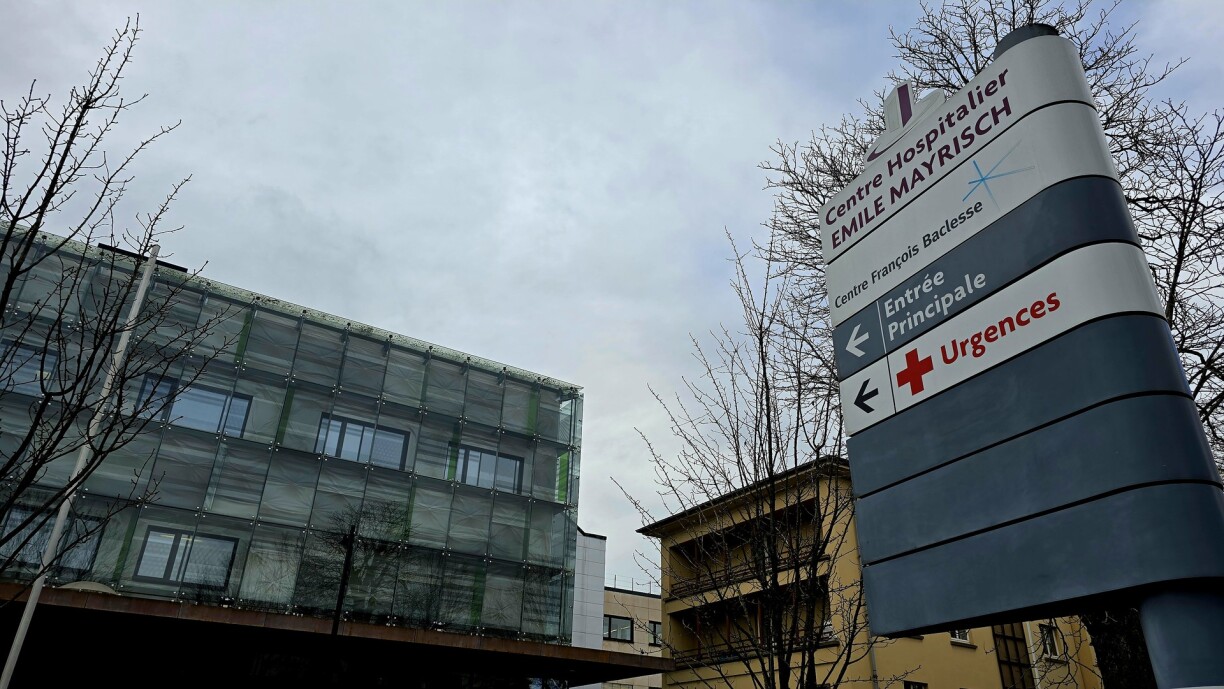
Around three weeks ago, police had to be called to the Hospital Centre Emile Mayrisch (CHEM) after reports of an aggressive and armed individual. Although this ultimately turned out to be a false alarm, such behaviour has increasingly become part of everyday life at the hospital, according to Julien Carpentieri, head of the emergency department. In conversation with RTL, he said that his service in particular faces incidents almost daily.
Lindsay and Stessy, two nurses who agreed to speak on camera, described their own negative experiences, both in the emergency department and in other units. Since staff have also faced harassment online, they preferred not to have their surnames appear in the report.
Lindsay recalled in particular a heavily intoxicated woman who had to be restrained by several members of staff because she became violent and physically aggressive. Lindsay was left with a large bruise on her arm for more than a week following the incident, and the police had to intervene on that occasion as well.
Most cases, however, can be handled internally. Yet even if such aggression has become a daily reality, it should not be considered normal, which is why staff are encouraged to report every incident, explained Stessy. She has worked in the emergency department at CHEM for five years and has also experienced both verbal and physical violence. In critical situations, hospital staff can activate an emergency button, which automatically alerts nearby departments as well as the security team, so they can help defuse the situation. In many cases, this already helps calm things down.
Between January and the end of October this year, this emergency button was pressed 410 times across the entire Esch hospital, not just in the emergency department. In 2023, there were 250 such interventions, and during the pandemic the annual figure was under 100. The situation has therefore significantly worsened, particularly over the past two to three years, according to Carpentieri. Many patients or their relatives have become impatient, he noted. He said that the reasons for escalation vary, as waiting times but also severe pain can trigger aggressive reactions. At night, alcohol and drugs play an even greater role, Carpentieri stated.
Of the 410 alerts triggered this year because staff needed support, 67 incidents had been formally reported as aggression by the end of October. The most serious cases are those in which the staff member is unable to return to work for some time.
Patrizia Ascani, the hospital's head of human resources, stressed that those affected often suffer not only physical injuries but psychological ones too. She recalled a case where a staff member had to be transferred to a different hospital site because they no longer felt safe or comfortable returning to their unit. She added that so far this year, three occupational accidents linked to aggression have been officially recorded, resulting in a total of 175 sick-leave days.
As part of post-incident follow-up, psychological support is offered to all affected staff. In addition to this aftercare, the hospital wants to strengthen its focus on prevention through crisis-management training sessions and simulation exercises that allow teams to practise how to respond effectively in real emergency situations.





