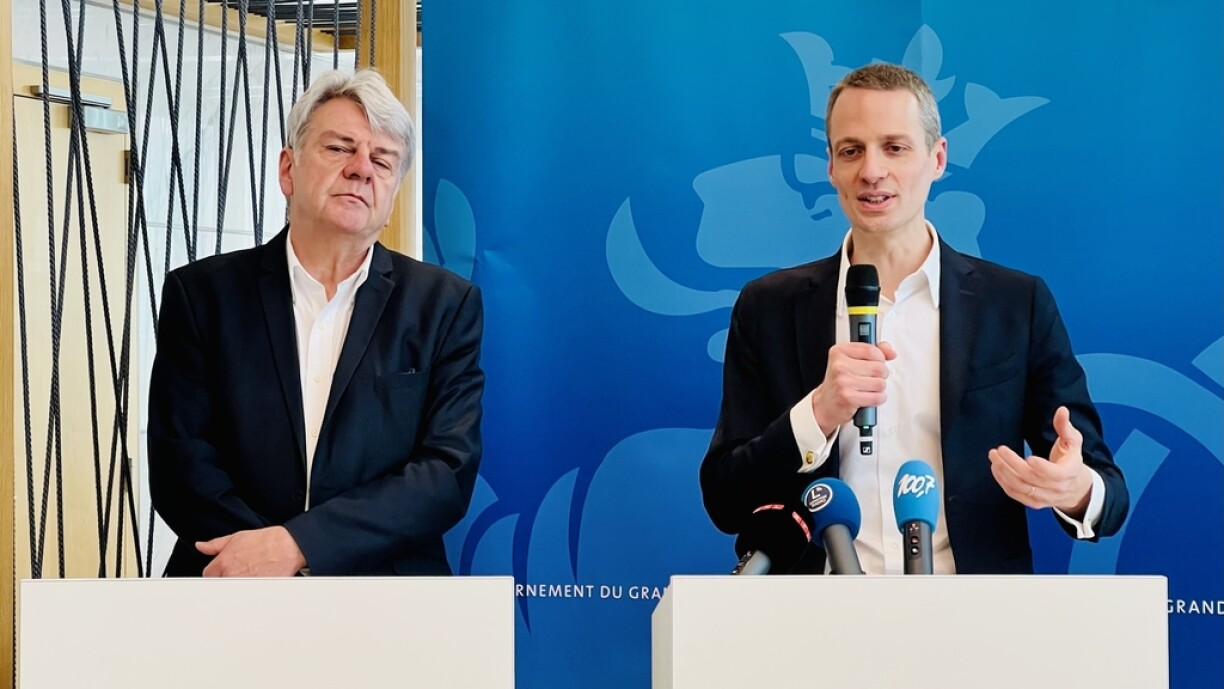
On Wednesday, Minister for the Civil Service Serge Wilmes presented the new salary agreement for the civil service to MPs in the Chamber's relevant commission.
As of 1 January 2025, the point value for public sector salaries will retroactively increase by 2%, with an additional 0.5% hike set for next year. This adjustment will result in a total cost of €195.5 million for the state, which employs approximately 37,500 civil servants.
However, it is expected that around €80 million will be recovered through taxation, explained Wilmes alongside representatives from the General Confederation of Civil Servants (CGFP) during a later press conference on Wednesday.
The salary adjustments will directly impact public sector employees at different career levels. A trainee civil servant in career group C1 (clerical staff) will see a gross salary increase of €98 per month over two years, while a university graduate in career group A1 will receive a monthly raise of €198.
The 2024 public sector wage bill stands at €4.3 billion, within a total national expenditure of €27 billion.


According to government officials, the agreement will also extend to municipal civil servants and adjacent regulated sectors, meaning businesses that are linked to the state but operate independently, though the specific budget allocation for the latter remains under negotiation. Wilmes emphasised that discussions with CGFP's sectoral subgroups will continue throughout the agreement’s duration.
Despite welcoming the agreement, CGFP President Romain Wolff acknowledged that the union had hoped for a larger increase in the point value. However, he noted that the deal is part of a broader package that includes full compensation for teachers' overtime.
Additionally, head teachers will receive a flat-rate payment of €1,750 per year. In a further initiative, a new daycare centre operated by the CGFP is planned for Belval.
Beyond the linear salary increase, the agreement also aims to reinforce the principle of responsibility within the public sector, Wilmes emphasised. Employees in leadership positions, such as department heads, will thus see their point value increase by seven points.
Another significant change concerns mortgage rate subsidies for state employees. Currently, the government subsidises interest on mortgage loans of up to €150,000 with a repayment period of 15 years. Under the new agreement, this threshold will rise to €400,000, with an extended repayment period of 25 years.
"We naturally would have wished for it to be a bit higher. We are well aware of today’s realities", Wolff commented.
Additionally, the agreement introduces an improved 'unpaid leave for professional reasons', allowing civil servants to transition into different career paths more easily.
According to Wilmes, the point value increase serves as a recognition of employees' work results and aligns with economic growth. He also emphasised that negotiations factored in the private sector's perspective, ensuring a balanced approach given the current economic climate.
However, Wolff noted that the 2.5% index adjustment would come later and still fall short of fully compensating for inflation.
He also pointed to criticism from high-ranking private sector representatives, some of whom questioned the merit of increasing the point value. "Sometimes it's better to say nothing when a microphone is put in front of you", Wolff remarked.





