Since the end of July, companies that purchase electric vehicles benefit from higher incentives. While some companies see the transition to electromobility as a major challenge, others see it as an opportunity and a foundation for their business model. Our colleagues from RTL.lu asked various stakeholders about this.
It is a key issue for owners of electric cars and a major challenge for service station operators. In order to remain competitive, the members of the Luxembourg Energy and Mobility Group, formerly the Petroleum Group, are focusing on ultra-fast charging stations.
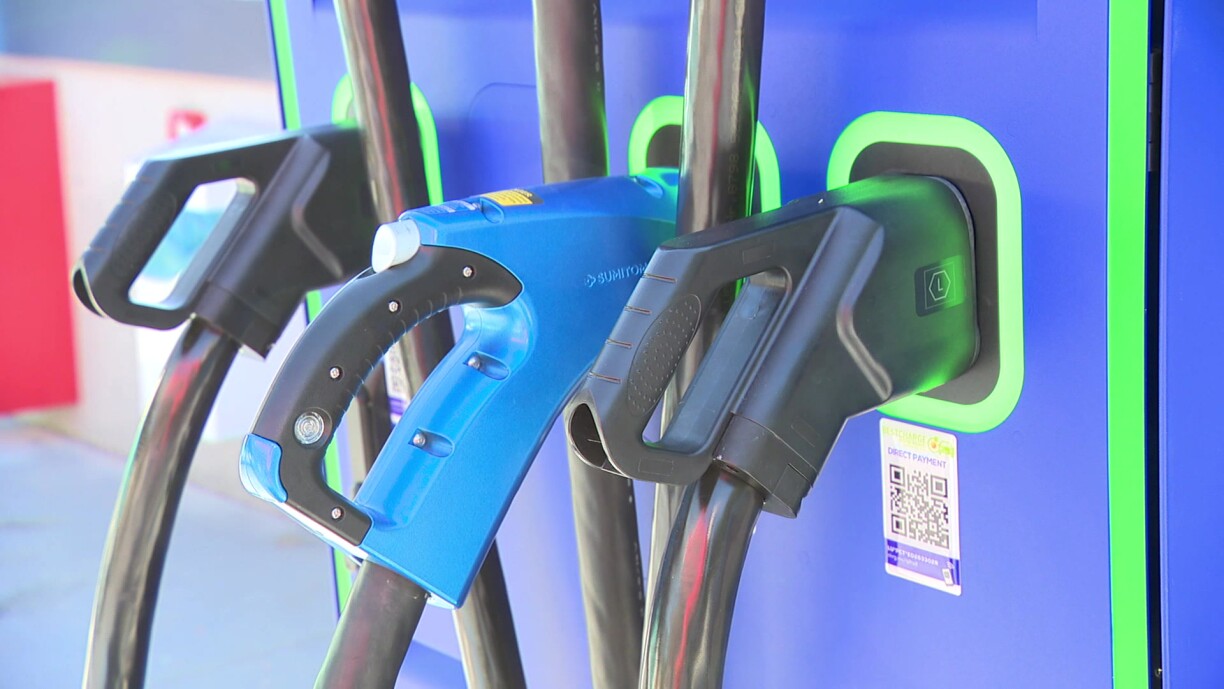
Since June, a station in Senningerberg has been equipped with three superchargers, with a total capacity of 300 kilowatts for six vehicles. This investment was made without government subsidy.
Paul Kaiser, vice-chairman of the association, thinks that superchargers are "ideal" for service stations because they are so fast. "People don't have to stay too long, it usually takes between ten and 20 minutes," Kaiser explains. On the other hand, slower chargers, such as the AC chargers still seen in villages, are expensive for service stations and sometimes require people to wait "for hours". For Kaiser, these types of chargers "don't make sense" in petrol stations.
Being able to charge your vehicle efficiently at a petrol station is especially important for people who live in a residence without electric charging points. But it should also be possible to charge your vehicle outside the stations. The Luxembourg Motoring Association (ACL) wants to increase the charging capacity of its site in Bertrange. There are now three charging stations, with up to 40 expected following the conversion. But aside from the €500,000 cost, to which the state will contribute up to €100,000, there is another challenge.
ACL Director Jean-Claude Juchem stresses that organisations like the ACL need people who can advise them on projects like these. "Do you need fast chargers, how many charging points do you need to charge during the day and how many to charge at night? Do you give access to neighbours or the public so that they can benefit from it? These are questions that need to be answered by specialists," Juchem argues.
Providing answers to these kinds of questions is part of the business model of start-up Moovee, which has its headquartes at the Paul Wurth InCub. In addition to advising companies on the installation and maintenance of charging stations, the start-up also offers a sharing system. Employees can rent a car from the company for a certain period of time using an app, even in their free time, so that vehicles are not kept in the parking lot late at night or on weekends. Each company sets its own prices. Most of the vehicles are electric, but they are not suitable for all customers.
Moovee's managing director, Sébastien Berthelot, explains that even if the start-up "promotes electric mobility," 22% of its vehicle fleet is not electric. The reason is that some organisations, for example the University of Luxembourg, have car parks that are not currently equipped with charging stations. "We provide them with shared vehicles, but they are thermal because there are no charging outlets," Berthelot states.
As a result, there is still some work to be done before everyone can charge their electric car at work.