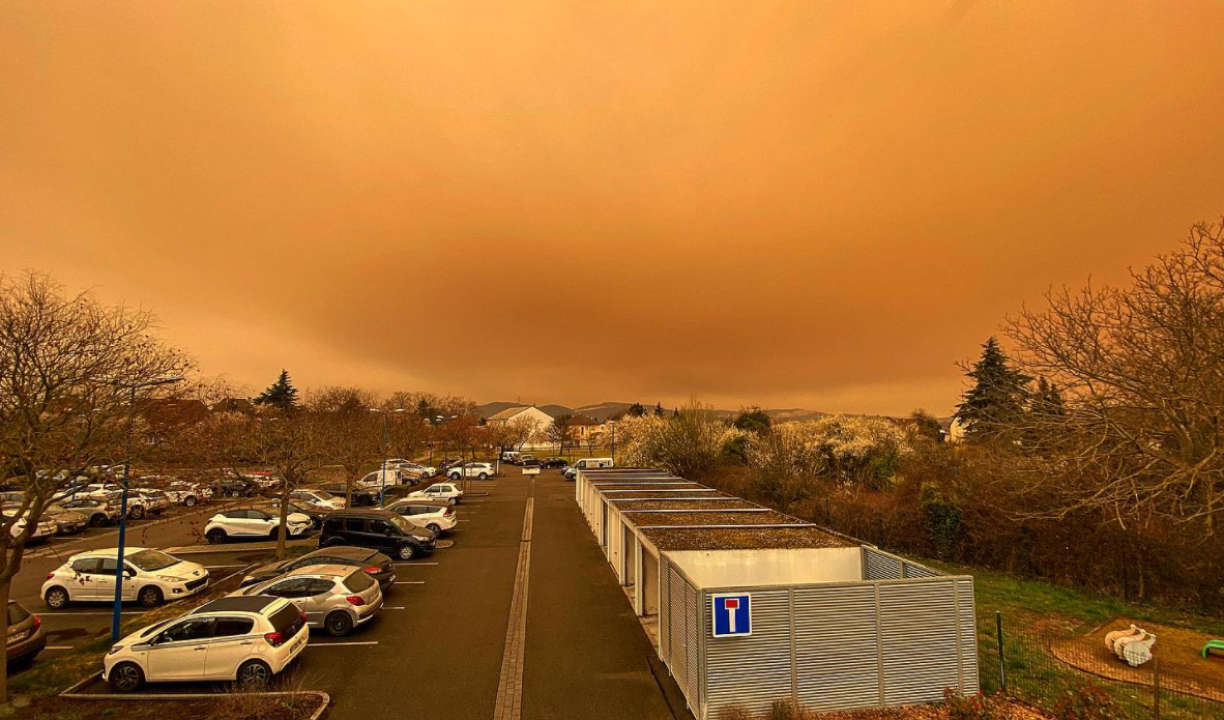
Numerous people already experienced the weather phenomenon on Wednesday morning, even before its arrival in the Grand Duchy. The vast majority of the cars of cross-border workers from France were more or less covered in a layer of sand-coloured dust. In fact, the sand dust came all the way from the Sahara desert.
The French regional newspaper L'Est Républicain published an impressive series of photos that were taken across the Grand Est region on Tuesday. On social networks, various pictures are circulating showing cars covered in dust.
The Sahara dust is expected to arrive in Luxembourg on Wednesday and Thursday. "The current animation of the satellite image shows a large cloud field with a ripped surface (caused by the Sahara dust), which will soon reach Luxembourg from the southwest. The sky may then gradually take on a brownish hue", Meteolux warned in a tweet on Wednesday morning.
High concentrations of Saharan dust in the air could even darken the sky, a phenomenon experienced in various places in France yesterday.
Luxembourg's national weather service had already announced on Tuesday that "a higher concentration of Saharan dust" would reach Luxembourg on Wednesday, but "mainly in the upper layers of the atmosphere".
On Wednesday morning, Météo France announced that the sky will remain cloudy in many places across France on Wednesday due to the concentration of desert dust in the atmosphere. The weather phenomenon could also lead to maximum temperatures that are "a little lower than expected", according to Météo France.
The thin layer of sand from the Sahara fell on Madrid and a large part of Spain on Monday night, before moving up towards France.
Crossing the Pyrenees, the dust mainly passed over the west of France on Tuesday and should fade until Thursday, the French weather service said. This is not an exceptional phenomenon, but "more significant because of its geographical extent and its duration of several days".
In Spain, many people used hoses to wash down the dust in the centre of the capital where a brown film covered windows in apartment buildings.
Haze created by the hot air is driven across the Mediterranean Sea by powerful winds called 'la calima'. The phenomenon is common in Spain, and especially the Canary Islands, off Morocco.





