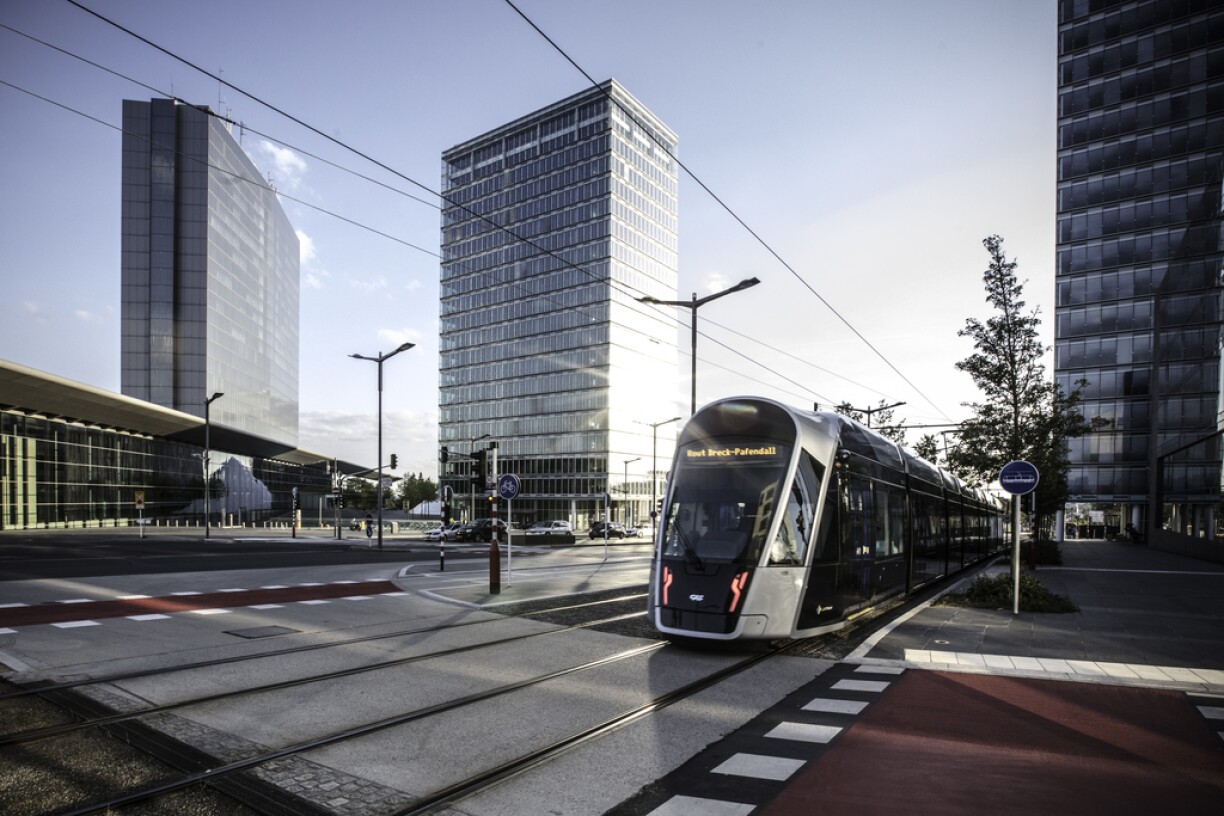
The Luxembourg City tram exclusively uses electricity to run and consequently does not pollute the air. Over the long term, the tram's role is to replace a significant amount of the RGTR buses. These buses, Bausch explained, run at a high capacity and connect the capital's busiest thoroughfares, going from the Central Station through to the Hamilius and to Kirchberg.
The minister added that every phase extending the tram's route sees the RGTR bus network undergo restructuring. The tram began operating between Luxexpo and Pfaffenthal-Kirchberg in December 2017, a move which was accompanied by a 23% reduction of RGTR bus lines connecting the Luxexpo and the city centre.
The July 2018 extension towards Place de l'Etoile saw further bus lines be reduced. Consequently, the introduction of the tram has reduced busses by 37%, which has naturally had a positive environmental impact.
The use of the tram means that those bus journeys emitting greenhouse gases do not occur. A 2017 Luxtram study calculated that, with 20,000 daily passengers, the first stretch of the tram route would avoid 3,400 tonnes of CO2 emissions. As it happens, trams currently have an average of 22,000 daily passengers, which demonstrates the proof of Luxtram's calculations.
Once the complete line is in operation, totalling 16 kilometres from the Cloche d'Or to the airport in Findel, the tram's impact will see a staggering 54,000 tonnes of CO2 emissions avoided. Already, the tram has had a significant impact on improving Luxembourg's air quality and that trend is due to continue once the line is fully operational.
Bausch also provided some details concerning the modernisation of bus fleets and the resulting impact on the air quality. He stated that annual averages of nitrogen dioxide emissions had dropped from 45 pg/m3 in 2017 to 40 pg/m3 in 2018, which in turn 'demonstrates the success resulting from the authorities' efforts in modernising RGTR and Luxembourg City bus fleets'.





