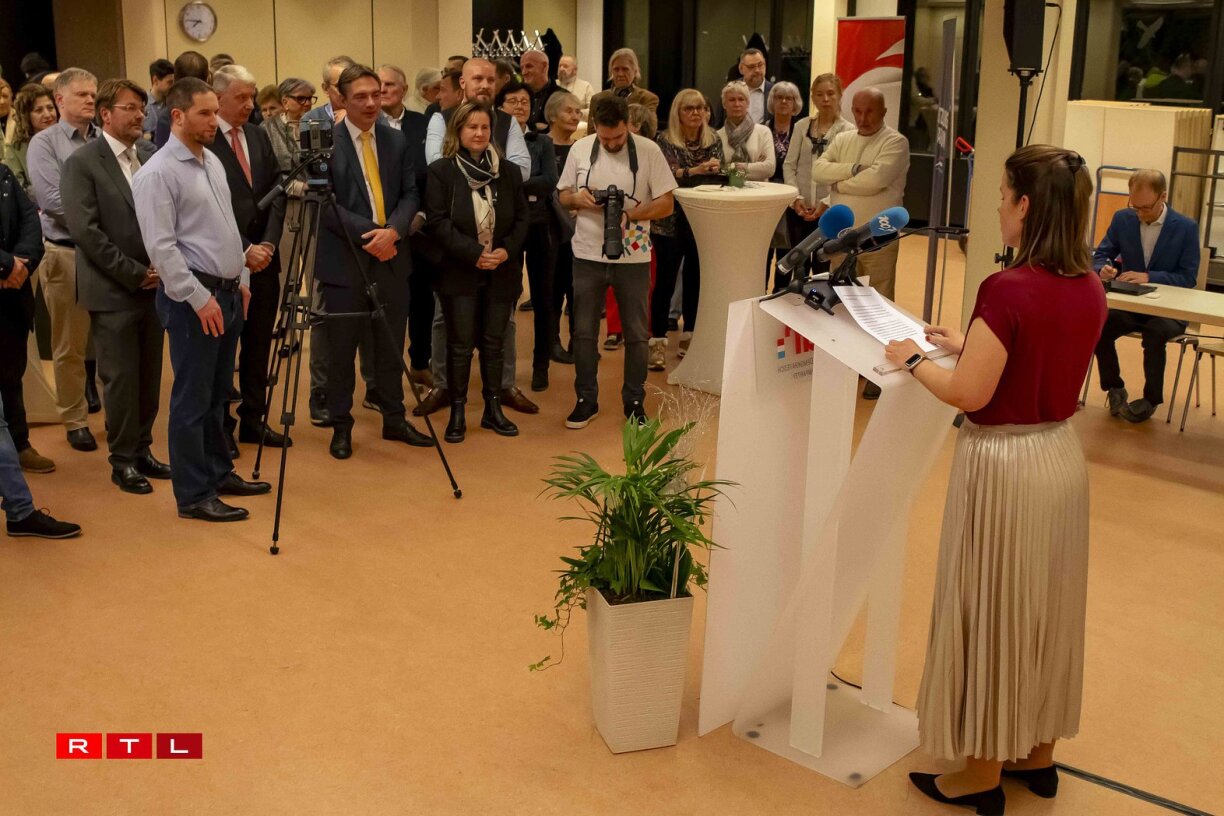
The Alternative Democratic Reform Party (ADR) was the first of Luxembourg's major parties to hold its New Year's reception, with all five MPs, one MEP, party leadership, and 60–70 members and sympathisers convening in the 'Black House' in Cents on Monday evening. The slogan of the event was 'Lëtzebuerg gär hunn', which can be translated to either 'loving' or 'liking Luxembourg', a slogan repurposed from their 2023 election campaigns.
The ADR's self-proclaimed mission statement for the year is to strengthen democracy and bring political exchanges closer to the people, with transparency and co-determination rights to be more than just empty words.
The ADR will hold its annual national congress on 30 March.
According to ADR president Alexandra Schoos, 2024 was a "very good year" for the party, with a first seat gained in the European Parliament and a second one on the State Council. She acknowledged that the European elections required a lot of focus from them and their competitors, but believes that the government coalition needs to increase their efforts in 2025.
Schoos expressed frustrations over the fact that the Covid-19 pandemic still has not been properly reevaluated, with no expert group tasked to analyse measures and the administration "vehemently opposed" to any steps. The ADR also still rejects the French literacy programme in primary schools, arguing that the initiative risks creating a "parallel society".
On a more positive note, Schoos praised the government for recent tax reliefs and the adjustment of the tax scale, noting that ADR members are determined to offer constructive feedback. "I think as a party we are trusting, we have our ideology, and we keep to our election programme", she observed.
The ADR sees the pension reform as one of their central tasks, with Schoos vowing to present possible solutions, even if the "press has to be patient". While the "world has been created in seven days", it will "take longer to carry out a pension reform or systematic improvement".
Aside from this significant challenge, the ADR also has its eyes set on what Schoos labelled the construction and housing crises.
In terms of international geopolitics, the ADR sees the situation as "unstable", but believes there to be a chance for a clean slate. Schoos did however express concerns about wide-ranging issues of finding coalition agreements observed in several countries, including Austria, France, and Germany.
The ADR has recently been at the centre of a controversy after MEP Fernand Kartheiser gave a contentious interview with a Russian newspaper, in which he allegedly voiced positions considered friendly vis-à-vis Putin, and which even dismayed his own party colleagues. Nevertheless, Schoos rejected the notion that the ADR is at risk of being banned from the European Conservatives and Reformists (ECR), a group to which they have belonged since 2009 and which they firmly intend to continue supporting.
Schoos also vowed to upholding the ADR's position that Ukraine deserves humanitarian support in its fight against the Russian invasion, which the ADR continues to condemn. The ADR is further committed to peace negotiations, arguing that military options do not represent viable solutions in terms of diplomacy.





