A strong El Niño event has led to a quiet start to the 2026 Atlantic hurricane season. But on social media, posts are ignoring the natural cycle, lauding controversial bills that ban weather modification for the lack of storms in Florida. Scientists have repeatedly said technology capable of creating or steering hurricanes does not exist and the National Oceanic and Atmospheric Administration told AFP that the slow season resulted from meteorological factors forecast months ahead.
"Florida bans cloud seeding. Florida stops getting hurricanes," a September 13 post on X says , resharing news coverage of the lack of hurricanes forming in the Atlantic basin so far in 2026.
Others -- including White House accounts -- gave credit to US President Donald Trump for the lack of hurricanes.
"Cloud seeding in the USA was defunded under trump and now (e) don't get hurricanes in the south," a September 15 post said .
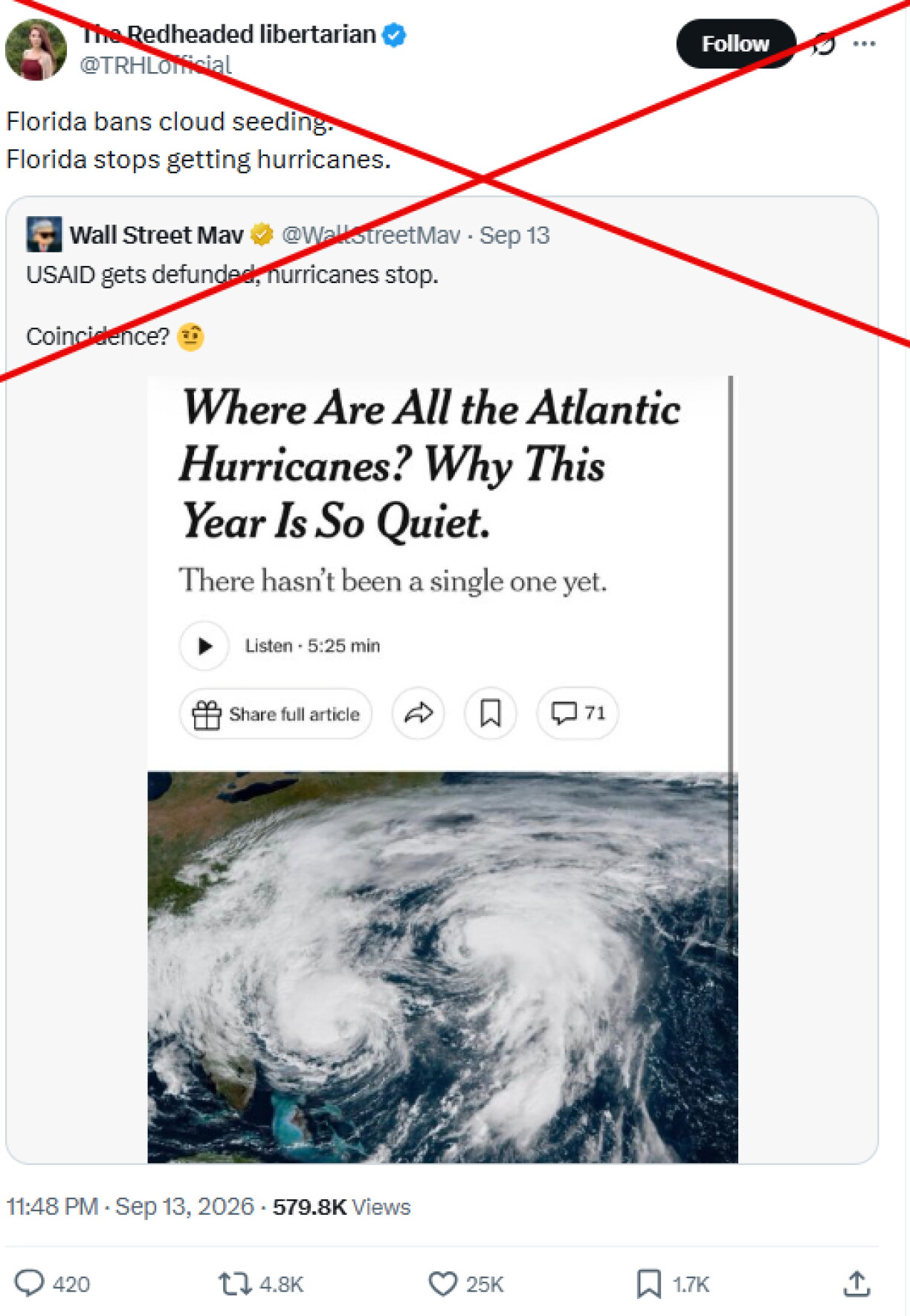
Additional posts shared a decades-old patent -- which AFP previously showed was abandoned -- as they celebrated the cloud seeding "bans" for their alleged impact on hurricanes.
In the past two years, state legislatures -- including in Florida -- did pass controversial bills to block all geoengineering and local weather research programs.
Legislation targeted, among other programs, cloud seeding -- a technique that introduces tiny particles into the sky to induce rain over small geographical areas (archived here ) -- despite a lack of evidence that these efforts impact atmospheric conditions at a large scale.
Additionally, tropical storms start forming far away from actual coastlines (archived here ).
"None of the bills passed or agencies defunded have caused the dearth of hurricanes this year," said Kristen Corbosiero , a University at Albany atmospheric science professor (archived here ).
An extremely strong El Niño event and its known effects on the Atlantic Ocean -- strong vertical wind shear, dry air, and sinking air -- hampered storm formation and intensification in the region, she told AFP in a September 16 email.
El Niño is the warming phase of a natural cycle in the tropical Pacific known as the El Niño-Southern Oscillation (ENSO). It comes along every two to seven years (archived here ).
ENSO promotes hurricane formation in the tropical Pacific while decreasing their likelihood in the Atlantic (archived here ).
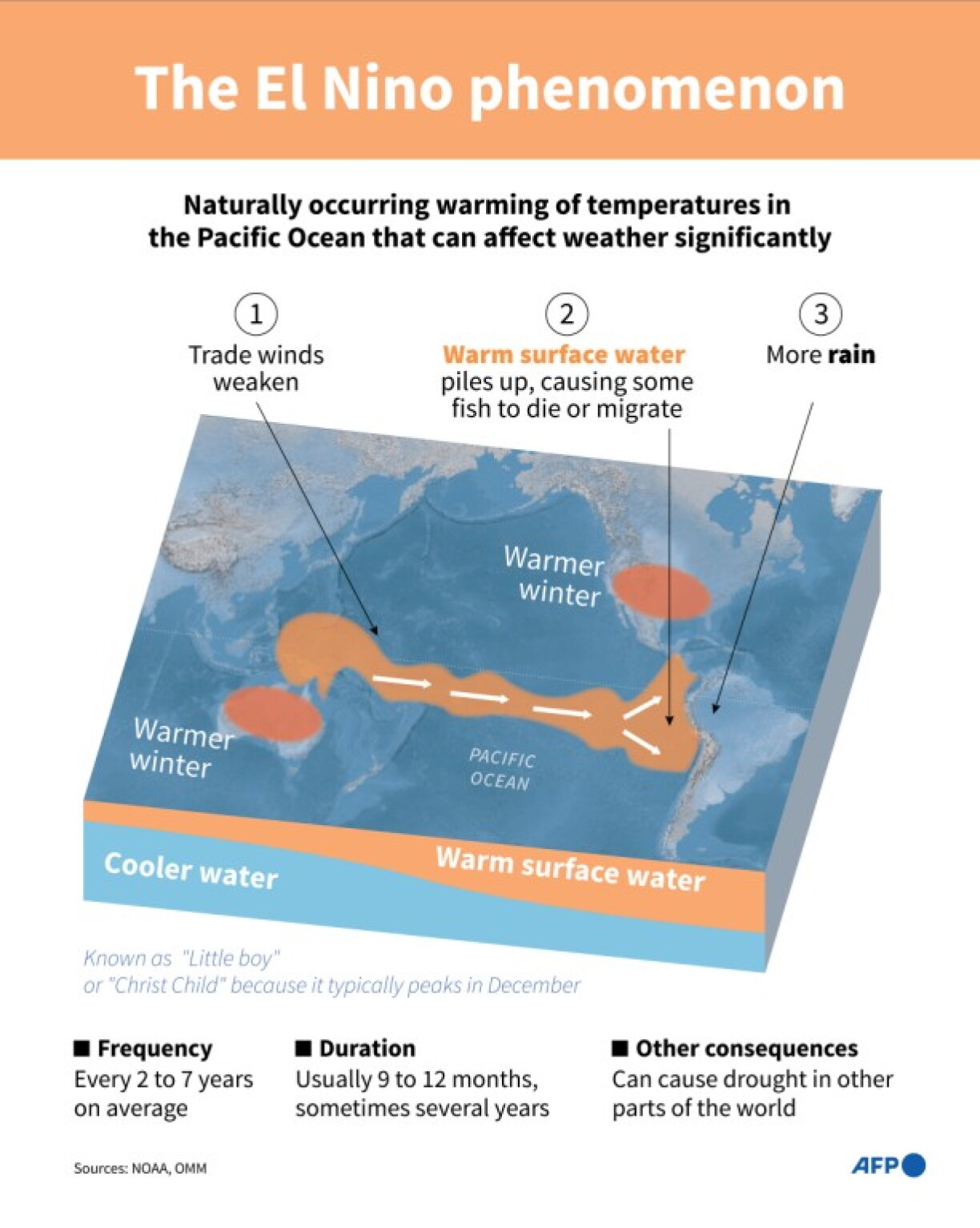
This is precisely what has been happening in 2026, with a series of storms hitting the Pacific Ocean and a quiet Atlantic season, contradicting posts claiming the reasons for the low number of storm remained unknown.
https://www.soest.hawaii.edu/soestwp/about/directory/david-ho/ Matt Rosencrans , a meteorologist at the National Oceanic and Atmospheric Administration's (NOAA) Center for Weather and Climate Prediction, echoed this explanation for the record-low Atlantic hurricane season (archived here ).
"The reason for the slow start to the Atlantic hurricane season is the strengthening El Niño pattern in the Equatorial Pacific Ocean," he told AFP in a September 16 email.
"So far this season, the North Atlantic has produced five named storms (all tropical storms) and no hurricanes. This all aligns with being in an El Niño state, and a robust one at that," he said.
Michael Mann , p residential distinguished professor of Earth and environmental science at the University of Pennsylvania, pointed to the season's forecast in a September 16 email (archived here and here ). He said conditions remain on target to see "only 8 named storms (with an uncertainty of +/- 3)."
urn:newsml:afp.com:20260917:b8a1c31a-21c0-499b-9818-23321e813263
The natural cycles, and not purported influences of weather modification, impact the number of storms, scientists told AFP.
David Ho , professor of oceanography at the University of Hawai'i at Mānoa (archived here ), said that no technology "exists to either cause, prevent, or steer hurricanes."
Rather, El Niño in the Atlantic "chops off the heads of hurricanes," he told AFP in a September 16 email.
AFP has repeatedly reported on inaccurate discourse surrounding cloud seeding , weather modification programs and their alleged influence on climate trends and tropical storm formations in the United States.
Cloud seeding has been documented and studied for decades ( archived here and here ).
The first experiment was conducted in 1946 (archived here ). It involved silver iodide -- a compound that, in large amounts, can constitute an environmental hazard, according to the National Institutes of Health (archived here ).
"There was no conclusive evidence from cloud seeding experiments done half a century ago that the process could affect storm intensity and, as such, the experiments were abandoned," said Corbosiero of the University at Albany.
"Cloud seeding does not make thunderstorms form -- Florida has had lots of those this year -- and cannot form a hurricane," she said.
https://www.soest.hawaii.edu/soestwp/about/directory/david-ho/ Di Yang , an assistant professor of geography at the University of Florida (archived here ), also previously told AFP that cloud seeding methods are highly localized and can only coax marginally more precipitation out of existing cloud s.
Find AFP's full list of climate debunks, here .





