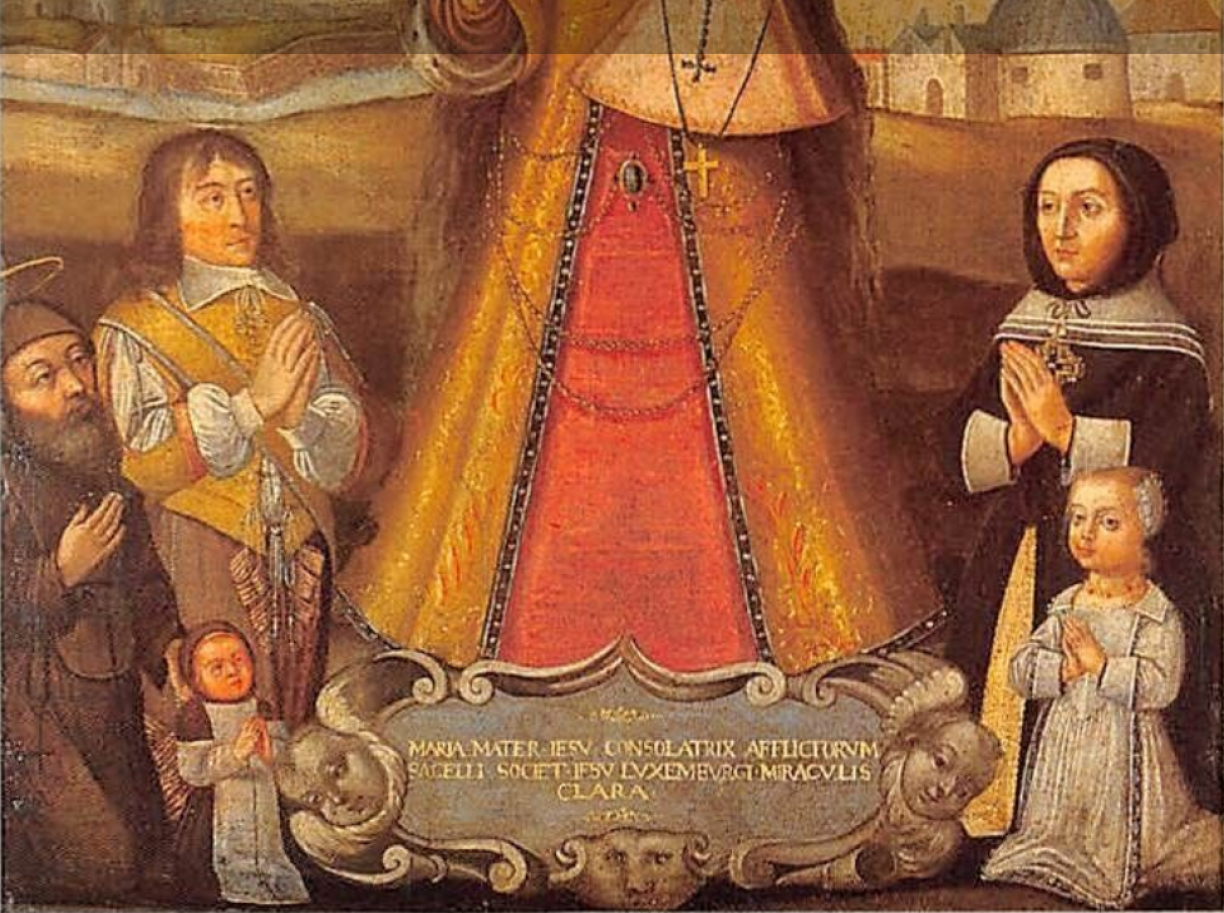
Nestled within the historic presbytery of Notre Dame in Luxembourg, the Maria Mater painting offers a compelling glimpse into the region’s past.
I was fortunate to view this painting, which is cared for by Notre Dame of Luxembourg. Most fittingly, the painting is kept in an impressive building called the presbytery, built in 1690. The Pastoral Assistant was kind enough to give me a tour. After entering the building and ascending a short set of stairs, the high ceilings are most notable and appear to have been refurbished with decorations in the early 18th century, while at the same time respecting the previous century’s designs. The building itself is worth an article in its own right.
The tour continued, and as I entered the main office, I scanned the room. There, above the fireplace, was an excellent painting of the perfect size. It shows the Madonna with her child at the centre, a husband and wife, and two children. Noting that the child with the husband is a boy, and the one with the wife is a girl. It appears to be unsigned, but it was obvious that the artist had developed the skills to render paint into realistic faces with expressions.
The Pastoral Assistant, who has an exceptional amount of knowledge, explained an important difference between older paintings of the Madonna and newer ones. Images of the Madonna of Luxembourg made in the year 1666 and after hold a key to the village in her hand. So, the painting had to be produced before this year. Additionally, the Church of Gacis is also shown in the painting and was not completed until 1629. This gives a production date between 1629-1666.
We can tighten this range. With the understanding that trends spread from region to region and do not occur at the same time. However, the “Dancing Procession of Echternach” by Antoine Stevens demonstrates that middle and upper-class people in Luxembourg were on top of fashions and trends, while the working and lower classes were heavily influenced by the fashions in Flanders and Brabant.
The lady is wearing a fashionable black over-hood, or ober hauben. The black hood was in contrast to previous generations that wore white hoods. Nor is she wearing a ruff that was fashionable during the previous 100 years. Instead, she wears a tappet, which is like a mini-cape with banded lace. Her wrist-cuffs are very simple without lace.
The Spanish Ropa that was fashionable up until the 1620s, as seen in the St. Michel’s painting, has gone out of fashion. Instead, she is wearing a gown called a tabbaard. It is a gown where the bodice and the skirt are separate pieces.
If you look closely, at the top of her bodice (where it touches the white collar), you can see a vertical black line. It is likely black lace. It is a detail common to bodices of this era. These bodices were so popular that I found them among the 17th-century probate inventories as far away as New York. Like New York, those tabbaards were black too.
Black dye was very expensive. Some dyes produced very dark brown or very dark blue, but not black. True black-dyed fabric was popular among the middle class and upper class.
She wears a golden yellow petticoat underneath her gown, called an “underste rock”. A yellow-coloured petticoat could be woollen, but this one is likely silk. When the painting is viewed in person, the design on the fabric can be seen. It seems to be watered silk or a brocade.
Similar gowns are found in paintings in the Netherlands. In the painting of Abraham del Court and his wife Maria de Kaersgieter, 1654, we can see his silk jacket has the same open sleeves as the man in the Maria Mater painting. Both husbands and wives also have the same-sized collars. Both wives wore a mid-waist length bodice. However, Maria de Kaersgieter’s bodice has an extension down the centre front. As a side note, the yellowish jacket of the husband is closed with string or lace, not buttons. It is possibly made of leather like a buff coat. He is likely part of the military.
It may be tempting to point and say that they are wearing Louis XIV-style gowns. However, Louis XIV wasn’t born until 1638 and didn’t turn 18 until 1661. This is the style that belonged to his parents’ generation. A fashion that Louis XIV recycled and revived at his court in the 1680s. Instead, Luxembourg is likely mimicking the noble classes of the Spanish Netherlands and the Electors of Prussia.
In the 1630s, the waistline of the tabbaard was very high, like an Empire seamed. Then the waistline shifted downward to the lower ribs in the 1640s. It was at a natural waist by the 1650s and elongated in the 1660s. This also helps date the painting.
However, it is one garment in this painting that lets us date it to a specific decade. Marieke de Winkle describes trends in colours and handkerchiefs in her 2006 book, Fashion and Fancy: Dress and Meaning in Rembrandt's Paintings. Men started wearing large fallen collars in the Spanish Netherlands after the 1620s. In the 1630s, men’s fallen collars were wide, spreading out to the shoulder seams of their jackets. Then in the 1650s, men’s collars became smaller and narrower, like the one in the painting. We can safely say that this painting was produced between the 1640s-1650s, and most likely in the 1650s.
Even if we say that Luxembourg “must” have been behind in fashion, we know that the painting had to be produced before the year 1666. So, if Luxembourg is behind in fashion, it is only by 5-10 years.
Discovering Luxembourg’s fashions, we can see that most surviving images of people show the fashions of the middle class, upper class, and nobility. Due to this, we have a solid collection of evidence showing what middle, upper, and noble people looked like from the 1540s to the 1650s.
Additionally, the 1606 Dancing Procession and the 1620s St. Michel’s paintings give us an understanding of what the working class dressed like. When combining these two paintings with the sketches by Abbot Bertels from the late 1590s, we can see that they were keeping up with trends, such as the cut, style, and colour of their jackets. Additionally, colours such as black, red, yellow, and green were important to people in Luxembourg. Finally, the working class in Luxembourg had a distinctly Spanish Netherlands appearance with heavy influence from Flanders.
As we continue to explore what textiles and clothing were worn in Luxembourg during the Silver Age, we will begin to explore the probate inventory of Dorothea Putz. Putz’s inventory shows us how a lady on a budget can do more with less.
Tara Mancini is an author with Buffalo Raising Journal. Articles have covered topic categories such as culture, charitable fundraisers, and city and State infrastructure since 2016. Mancini’s hobbies includes reading and collecting data from 17th century documents, then inputing the data into a database using spreadsheets for use in her articles.





