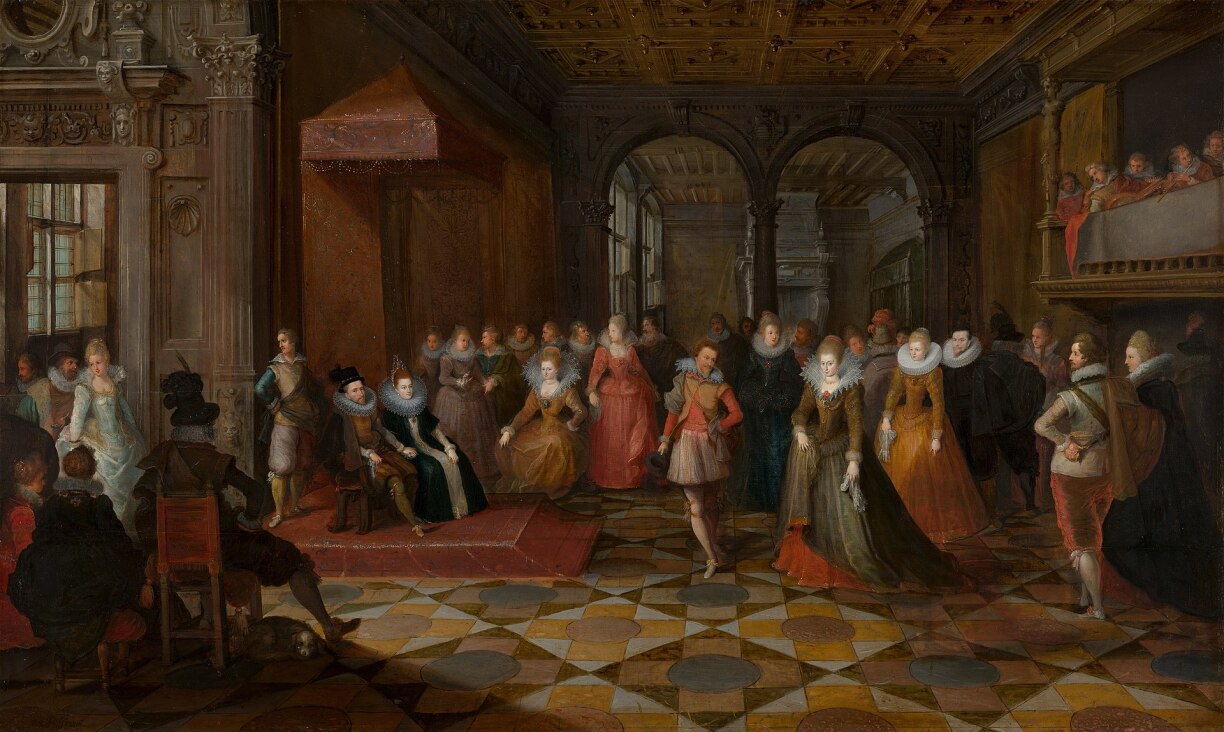
I could stand so close to the oil painting that if I wanted to… I could touch it. No alarms or guards were present to protect the artifact. After I got past the notion that someone could easily take this painting off the wall and walk out the door with it… I noticed the lady in red at the centre.
She is kneeling, with her back to the viewer. She has a white cap on her head and simple brown leather-soled shoes. Her garment is a bright scarlet, which was an expensive fabric at this time. Her garment has a waist seam. She may be wearing a scarlet waistcoat and scarlet petticoat (called a rock). However, it is more likely she wears a garment called an over-gown, which is the top outer layer of clothing. While it may appear to be a simple over-gown, it was worn by people of all classes.
Also, if you look closely you will see several short lines drawn onto the shoulder wings. This could be a simple shoulder wing with strips of ribbon decoration. Or the wing is made of strips of fabric made in loops called tabs, and set side-by-side. It is a fashion popular in the Benelux region worn between the 1580s to the 1620s.
To the right-hand side of the viewer, a male and female figure are wearing fancy clothes. Her hair is pulled up high, and if you look closely you can see at the back of her head is a grey-black headband.
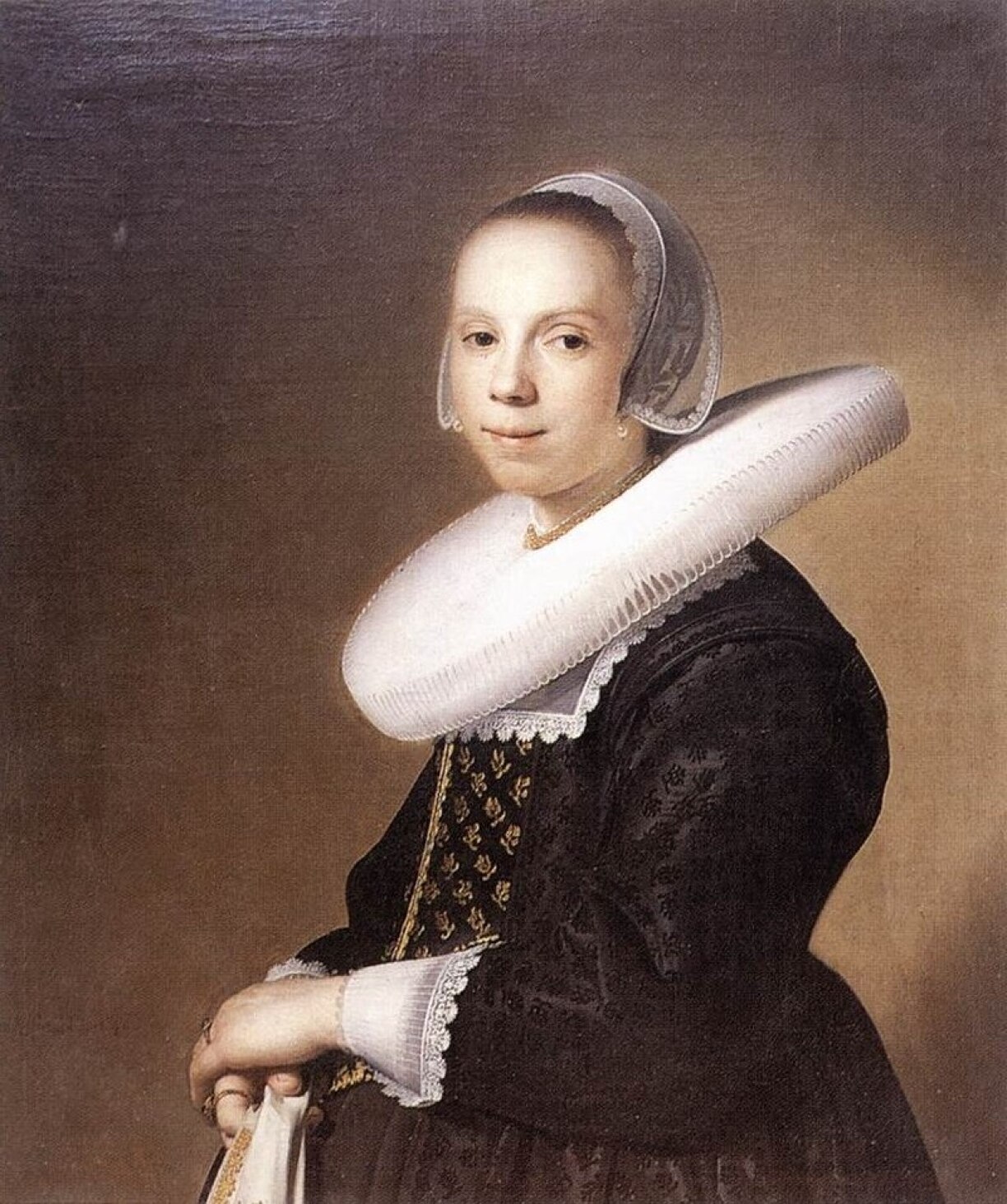
Around her neck is a ruff. From about the 1550s-1560s, linen neck ruffs were very short, roughly 1-4cm. About the 1560s wealthy people started wearing ruffs about 4cm or more. By the 1580s, the wide ruff had become popular with the middle class. Very wide cartwheel ruffs that were as wide as a person’s shoulders appeared in the 1630s and 40s.
Of course, fashions spread from one region to another. So, dating a particular painting on clothing gives a range of time rather than a specific year. The medium-sized ruff with lace in the St. Michel’s painting first appears in the 1580s and continues into the 1620s. We know that this painting was probably not painted after the 1620s because men stopped wearing ruffs. Instead, they wore wide flat collars that lay like a napkin on their shoulders.
Her clothing tells us that styles from the Court at Brussels were popular at this time. Of particular note is her golden bodice and his doublet. The centre front of her bodice is elongated downward. The centre front of the man’s doublet is wide and is paired with knee breaches.
She is wearing a black over-gown that falls down her back to her feet and opens in the front. If you look closely, there are several vertical lines drawn onto the black robe to indicate pleated fabric. This makes knowing which gown it is easy; it’s a Ropa in Spanish also called a vlieger in Netherlandish. Ropas were popular in Spain from the 1550s-1650s and spread to the court in Brussels.
In this painting the Archdukes Albert and Isabel are seated in their court at Brussels. They are entertaining guests that include Philip Willem of Oranje-Nassau (1554-1618) and Eleonore de Bourbon (1587-1619). The Dutches Isabel who had inherited the Duchy of Luxembourg from her father the King of Spain is wearing a Ropa.
What is important to note here is that this painting shows the Duchess Isabella following one style popular in Spain, Italy, and Brussels, while Eleonore de Bourbon and her entourage happen to be following a different style. See the full painting here.
This was a face-off of fashions. While Eleonore de Bourbon presented herself with one vision of what a female in power might look like, Duchess Isabel presented herself with the “whatever” nonchalance that a person with her exceptional education, resources, and power could wield. It’s no wonder that women both high-born and working class tried to emulate her as best they could.
There is a 400 year old Ropa, made of Italian silk, kept at the V&A museum in England. A surviving bodice like the one in St. Michel’s painting can be viewed in the Hessische Landesmuseum Darmstadt Museum video below. Another similar bodice can be found in a painting by the Flemish painter Peter Paul Rubens (1577-1640) worn by his wife here.
Now we shall turn our attention to this painting that hangs precariously within a child’s touch. According to Hemecht, Luxembourg, 1994-46(1): 103-116:
“The construction and decoration of the Jesuit Kollegiumskirche in the city of Luxembourg between 1613 and 1621 marked the start of a new period of religious art. Its paintings, dispersed after the order’s dissolution in 1773, exemplified key iconographic themes of Catholic baroque art.”
Over the last five years, I have only been able to locate three oil paintings with Luxembourgish provenance that included images of ordinary people. This painting in St. Michael’s church is one of the three. Making these paintings exceedingly rare. Additionally, paintings provide evidence that the Luxembourgish people followed fashions and styles specific to the Benelux region.
Unfortunately, the St. Michel’s painting is threatened. It is not only easily stolen but candle soot discolours the surface and flames under it threatening fire damage. The other two paintings include the “Dancing Procession of Echternach” by Antoine Stevens, 1606, and Notre Dame’s Maria Mater painting which dates from about the 1640s. The “Dancing Procession of Echternach” is set back in an alcove away from probing fingers, with a table separating it from the viewers. It is also just too large to be picked up and taken out the back door.
The Notre Dame’s Maria Mater painting is probably one of the most difficult paintings to track down. I learned about it due to stumbling across an old postcard. I suspect someone must have understood its importance and then stashed it away to keep it safe.
When the three oil paintings are combined with fashion plates found in books, we can begin to piece together what a market or street scene looked like in the 16th and 17th centuries. This is particularly important when a museum produces images of street and market scenes for visitors. Images for education should reflect those found in Luxembourgish paintings, sketches, statues, and other native artifacts.
… and who knows, maybe one day they may be needed for a documentary on Luxembourg.
Tara Mancini is an author with Buffalo Raising Journal. Articles have covered topic categories such as culture, charitable fundraisers, and city and State infrastructure since 2016. Mancini’s hobbies includes reading and collecting data from 17th century documents, then inputing the data into a database using spreadsheets for use in her articles.





