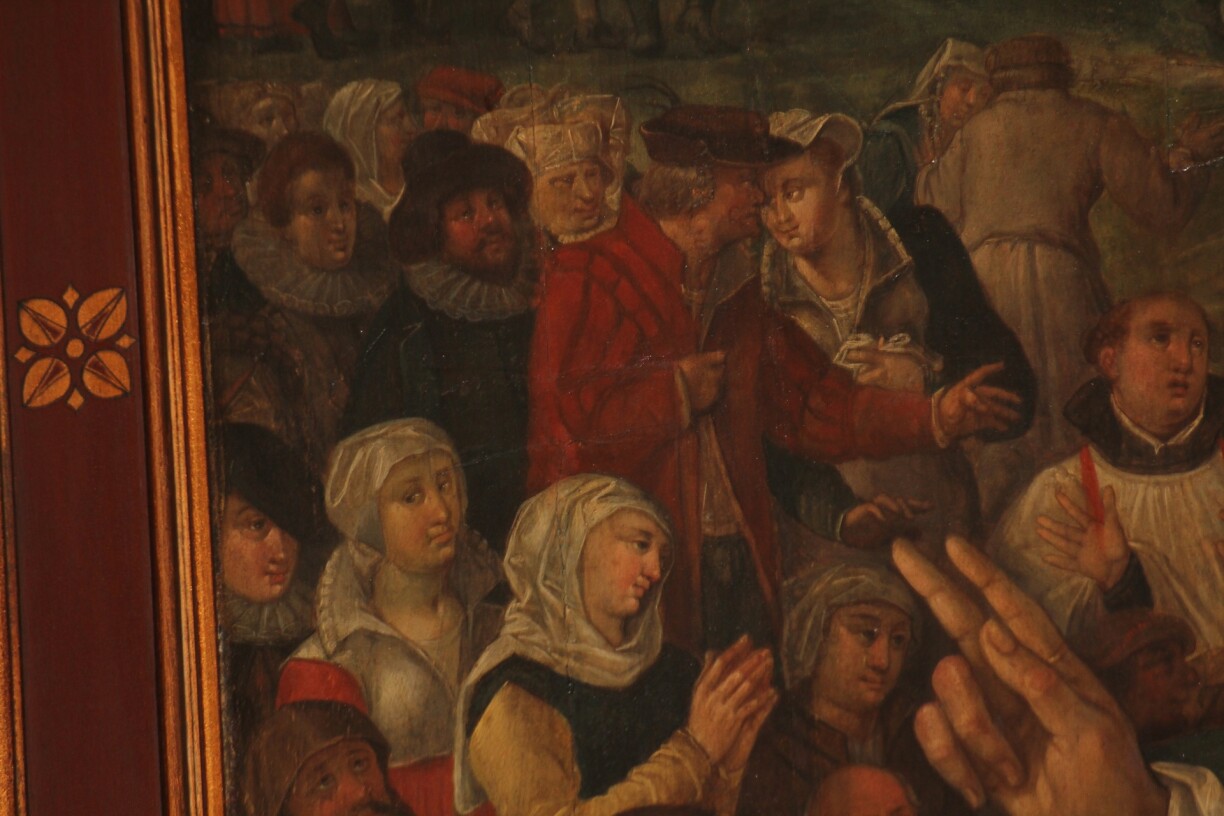
She stood in the procession; a mantle was pulled up over her head, and under her white cap covered her hair. This particular cap is called a Diadem, and is made with a fine thin linen, and shaped like a halo. In her case, it is a double halo. It makes one look bright and light. At her neck, she wears a noticeably white ruff. The linen cap and ruff offer softness and are at odds with her very structured suit of clothes.
Her tailor-made jacket, called a doublet, is fitted tight against her body. At the shoulders of her doublet are two rows of small loops that circle the arm. Her suit of clothes is painted in dark reddish brown.
In the same painting, there is another female with a similar suit of clothing. However, her back is turned to the viewer. She also wears a neck ruff, and her hair is bound up on the back of her head in a wide bun typical of this time. She also wears a doublet with a single row of loops. It may be tempting to say she is wearing an upper skirt and an under skirt, but based on 17th century probate inventory records from Luxembourg it is an “ober rock” and an “underste rock”. It had become fashionable for ladies to turn up the back of their over-gowns and show off a bright red or other bright colour.
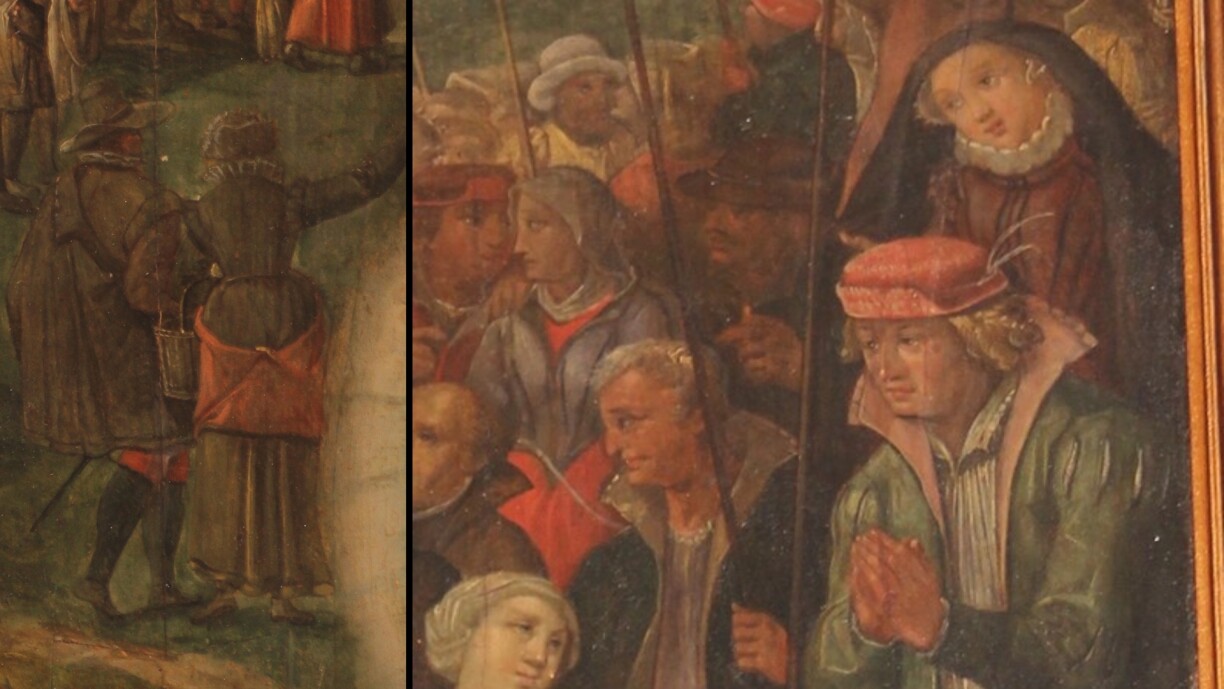
Did you ever notice how styles repeat? It happens to be popular right now for men to wear their sweaters with the sleeves wrapped over one shoulder and under the other arm. Just like the men in this painting. A quaint point of interest, the man and woman each have a handle for the shared basket.
The 1606 painting of the “Dancing Procession of Echternach”, by Antoine Stevens, portrayed all classes of people from Luxembourg. It’s an exceedingly important painting when it comes to understanding the material culture of Luxembourg. It shows the types of clothing, textile colours, and styles. It even gives us a sense of the proportion of how many people were in each class. When a museum needs a reference for images of Luxembourgish people, this is a primary source.
We can use the images in Hans Weigel’s 1577 book of fashions to determine the class of these people. The fashion plates of Burgundian (Spanish Netherlands) nobility and middle-class women from Flanders are very similar to the images in the painting.
Mary of Burgundy inherited the estates of Luxembourg, Brabant, Flanders, and Holland in January of 1477. These “princely estates” passed onto Maximilian I of Burgundy in 1519. Then the estates came under the rule of the House of Habsburgs’ King Philip of Spain and then his child Isabella Clara Eugenia. At the time of this painting, Isabella had been the governor of Luxembourg since May 6th, 1598.
She would continue to rule Luxembourg from Brussels until September 17th, 1665. So, it should not be surprising that Luxembourg had people following fashions from the Court in Brussels. Nor that these fashions overlapped heavily with Flanders, Brabant, and Holland. Additionally, as we will see, fashions from Spain, Italy, and Germanic regions also are present.
On the viewer’s left, there is a lady who is wearing the highest level of fashion. A fashion from the courts in Italy and Spain. Her hair is not covered, which is typical of nobility during this time. Her neck ruff is much wider which was a new trend. She has shoulder wings with two layers of little loops as compared to the single layer of loops the other two women wore. And if you look closely at her sleeve, you’ll notice that it is slit open. This is because they are hanging sleeves.
Though it is difficult to see due to soot from candle flames and dim lights, the male next to her has a blue waistcoat and a matching blue overcoat with a lapel. Interestingly, he has shaped his beard and moustache like those in Italy.
There are a few noticeable garments that are not specific to Brussels, Flanders, and Brabant. There is a young man who sports a small pink hat with the visor flipped up. His jacket in green silk has the collar flipped up also and is lined in pink. The newest fashion from Germany were doublets with slashed sleeves. Another doublet with slashed sleeves in red is found in the same painting.
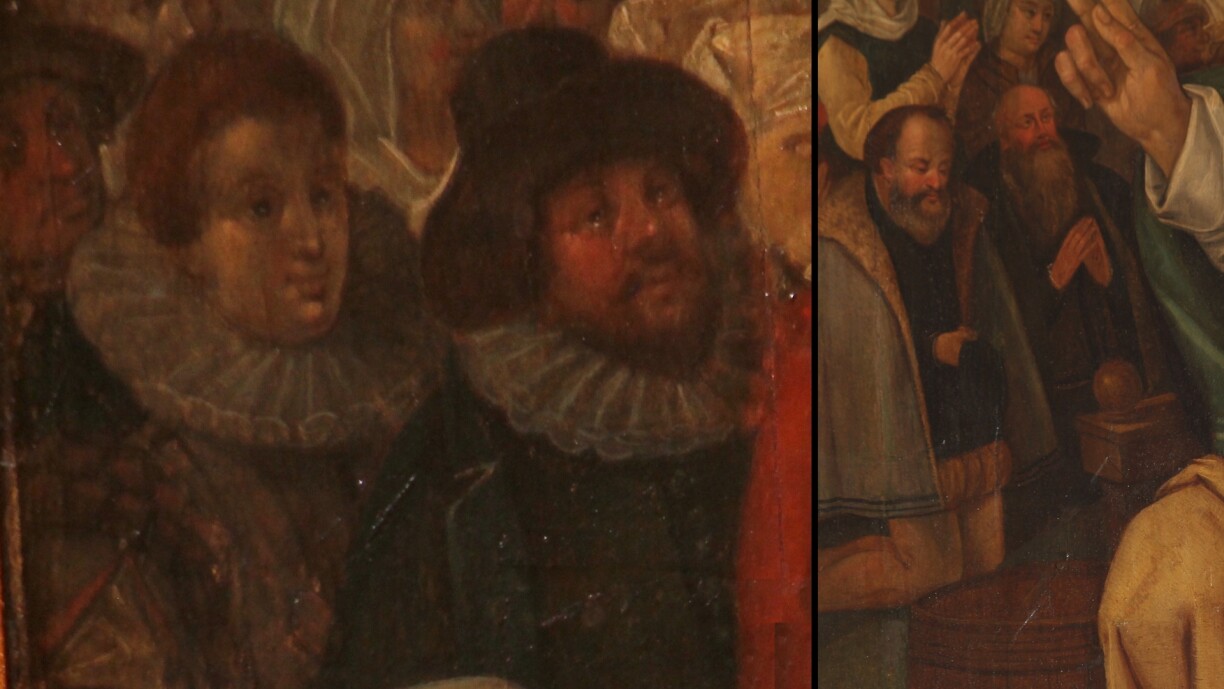
This painting clearly shows that there is a time lapse in fashion between working class, middle class, and upper-class persons. Nevertheless, we see doublets made from woollens dyed in the colours: red, yellow, blue, and black. One working class person is even wearing a yellow doublet with pink lining.
Paintings like these provide evidence that Luxembourg was a colourful place and that the working class could afford more expensively dyed fabrics. Cheaper woollens were the colour of natural sheep’s wool that is undyed. Red, yellow, and black waistcoats or doublets are hallmarks of the Netherlands and Flanders.
During the 16th century, waistcoats were common for the working and sometimes middle class too. Sleeves were attachable with strings, called points. This allowed the person to wear sleeves that were different colours. The doublet had the sleeves sewn on and were not changeable.
The headdresses worn by the females in the painting are also found in sketches. The Abbot of Echternach, Abbott Johannes Bertelius (also Jean Bertels, 1544–1607) travelled around the region sketching the people of various towns.
In the painting, there is a one-time appearance of a headdress that looks like a woman has a large flower-shaped handkerchief on her head. Another one of these flower-shaped headdresses is seen in a sketch by Bertel’s of the town of Mondrich, Luxembourg. This is not a nun or a mistake. This is a 16th century fashion more commonly found in Flemish paintings such as those by Pieter Bruegel (1525–1569).
The most common headdress in the painting is a simple head wrap. It is tempting to point and claim that the head wraps must be an allegory to Mother Mary. However, the head wrap style is also found in 16th century Flemish paintings of people at work. The painting also shows what is called in Pre-modern Luxembourgish an “underste hauben”, or an under hood. For example, one inventory had, “Sech underste hauben”.
An under hood is made of linen, while an over hood might be made of coarse linen or wool making it more durable. These hoods are commonly found in Jean Bertels’s sketches. They are also found in 17th century Luxembourg probate inventories.
Historians call the 17th century the Pre-Modern Era. So, words from the 17th century documents have been dubbed Pre-Modern Luxembourgish. For example, the authors of the documents do not call a table by the German term Tisch. They call it a “disch”. Modern Luxembourgish calls it a Dësch.
Luxembourg had both exposure and access to the latest fashions. The “Dancing Procession of Echternach”, by Antoine Stevens, 1606, is one of three surviving Silver Age paintings with Luxembourgish provenance that include people in 17th century clothing. The styles seen in the painting are supported by the style seen in the silhouettes in Bertel’s sketches.
As we continue our tour, we will move forward in time to the second of three important paintings of Luxembourgish people. Unfortunately, this painting is at risk of being damaged or stolen as it is unprotected and unguarded.
It hangs within grasp, at eye level, above lit candles, in a local church.
Tara Mancini is an author with Buffalo Raising Journal. Articles have covered topic categories such as culture, charitable fundraisers, and city and State infrastructure since 2016. Mancini’s hobbies includes reading and collecting data from 17th century documents, then inputing the data into a database using spreadsheets for use in her articles.





