Only a short drive or train ride away from Luxembourg, the oldest city in Germany, known for its shops and restaurants, is filled with ancient Roman history. It’s the perfect destination for a daytrip during the summer break.
Further reading: Roman Luxembourg
Initially, the Trier area was inhabited by the Celts, specifically by the tribe of the Treveri, from whom the later city got its name. During the Gallic wars, Julius Caesar fought between 58 and 50 BC, the region and the Treveri were conquered. Following their military success, the Romans founded the city now known as Trier in c.17 BC, naming it Augusta Treverorum after their emperor. The city prospered and expanded quickly, becoming the capital of the province Gallia Belgica (which also included Luxembourg), and was one of the most populated cities in the Western Empire. It was also acknowledged by emperors, such as Constantine the Great, who benefitted used it as imperial residence in the western part of the Empire. Many of the ancient Roman structures are still intact or remain in good condition today and were declared UNESCO world heritage sites in 1986. Here are some that are worth a visit.
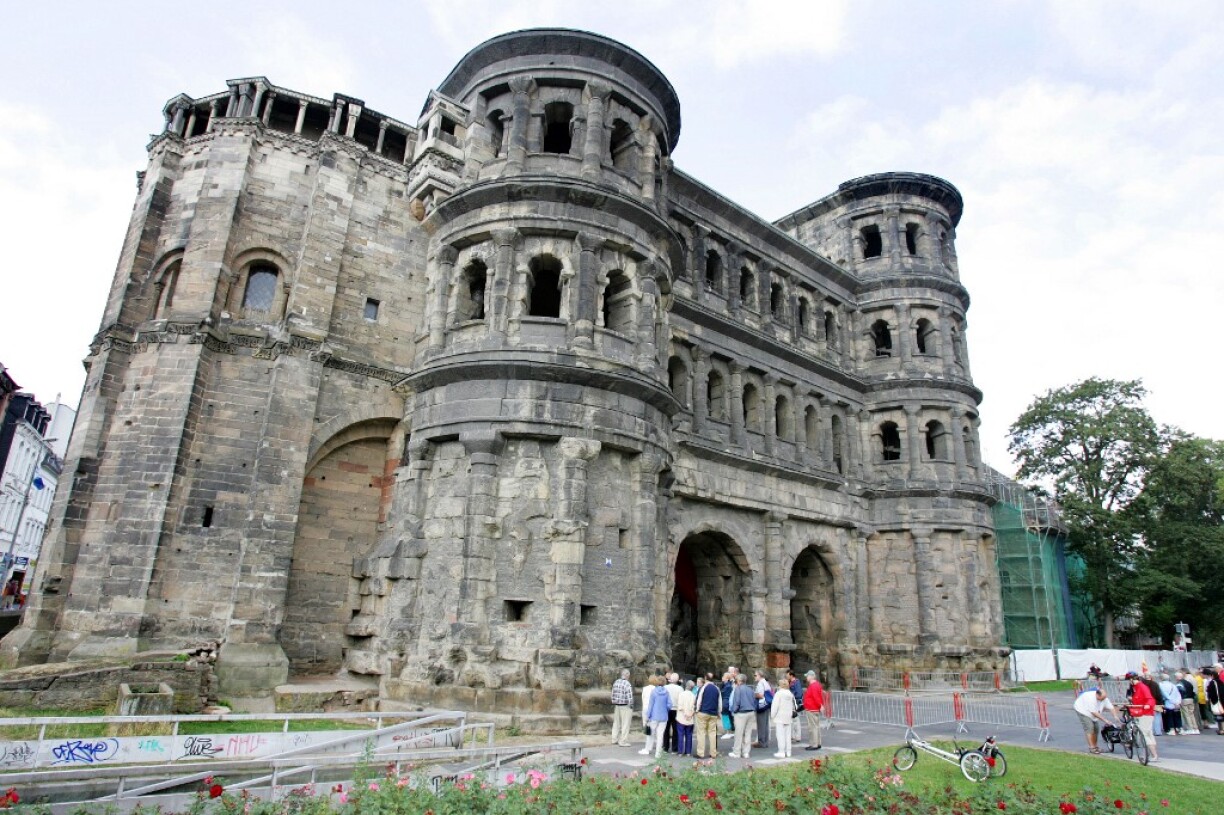
The Porta Nigra, literally meaning Black Gate, is probably Trier’s best-known landmark. Built in the 2nd century AD, he construction used to be a Roman city gate and was built out of 7,200 massive sandstone blocks weighing about 6 tons each that are being held together by iron clasps. Still located by one of the main roads in Trier, the Porta Nigra is the only surviving gate out of four and the largest surviving gate north of the Alps.
After the downfall of the Roman Empire, the Porta Nigra was no longer used as a city gate. In the Middle Ages, some of its sandstone blocks were reused to construct other buildings. However, in the 11th century, the Porta Nigra became the home of a monk called Simeon, who lived there as a hermit. To honour him after his death, the gate was converted into a church which is one of the main reasons why it survives to this day. The gate’s current name also dates back to the Middle Ages and stems from the blackened appearance of the sandstone. In 1803, Napoleon dissolved the church and ordered the Porta Nigra to be reverted back to its former state. Since then, maintenance and reconstruction efforts have continued.
The gate can be visited all year; more information about ticket prices and opening times can be found here.
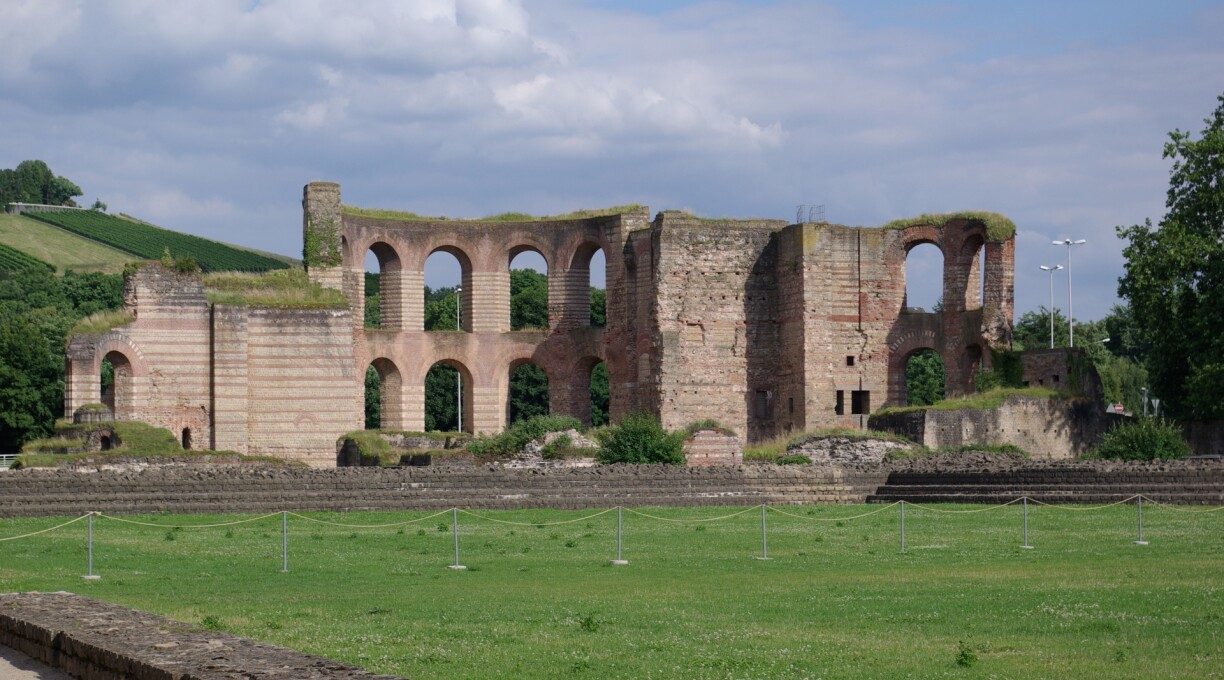
The imperial baths were constructed in the 4th century AD under Constantin the Great, who planned to expand the imperial district. The baths were supposed to be a gift to the population and were used recreationally; visitors could sit in 40-degree water, play ball games with friends, or be massaged. The baths have an underground passageway that staff (often slaves) used to get discretely from one place to the next. Even though the baths’ construction was never finished, they are now among the largest preserved baths outside of Rome.
After the fall of the Empire, the baths, just like the Porta Nigra, were used for a different purpose. Over the centuries, the baths were transformed into a castle, served as a monastery, and even as a city wall. In 1984, parts of the baths were reconstructed, and new archaeological discoveries still continue to be made.
The baths, including the underground passageways and parts of the sewage systems, can be visited all year; more information about ticket prices and opening times can be found here.
Not far from the imperial baths, you can find the ancient amphitheatre, which was built in the 2nd century AD. At its peak, it could welcome 22,000 spectators who gathered to watch gladiator fights, animal baiting, or executions. The tiered seats were up to 22m high, and the amphitheatre used to be integrated into the city walls. Underneath the theatre, you can find a basement where prisoners and animals were being kept.
During the Middle Ages, monks used the grounds as a storage space and re-used some of the building materials. Today gladiator fights are still simulated in the amphitheatre.
More information about ticket prices and opening times can be found here.
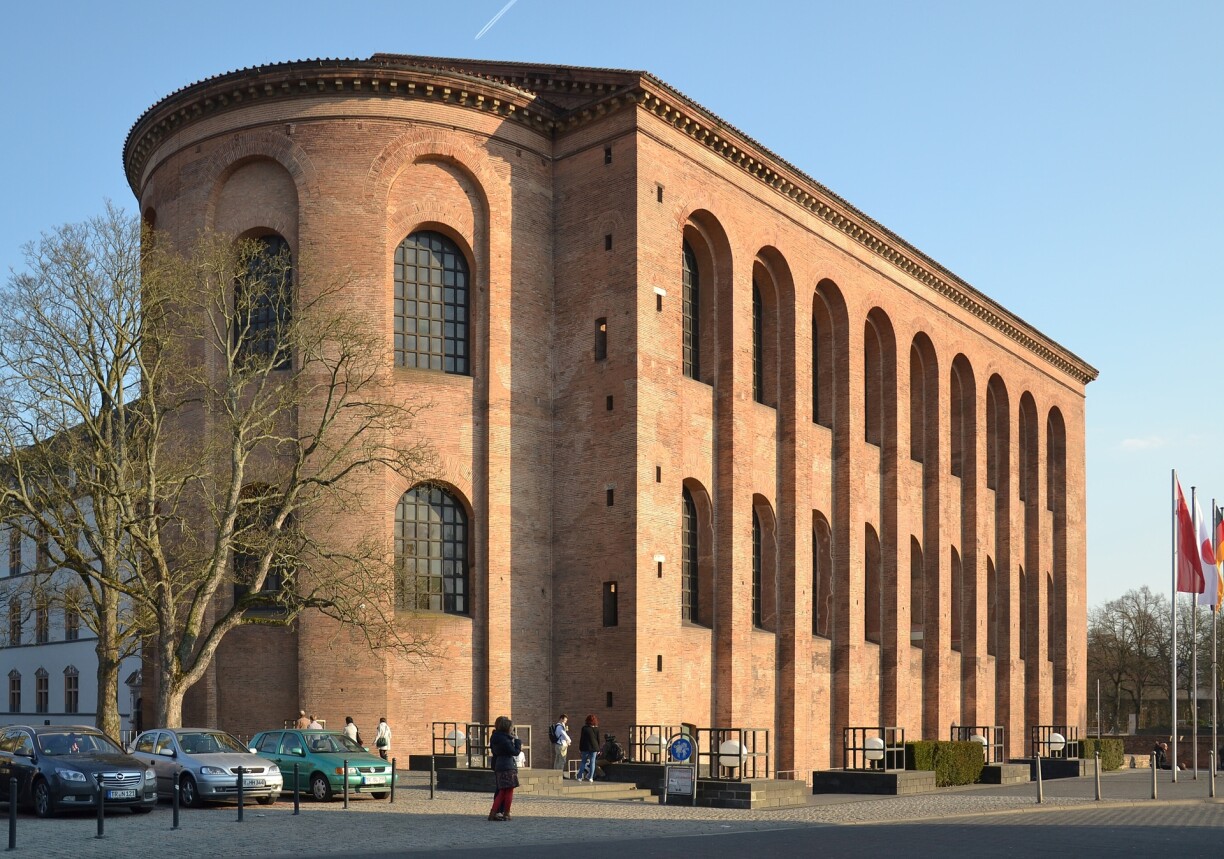
The Aula Palatina, also known as Basilica of Constantine, was built around 310 AD. The basilica was part of a palace complex and served as a throne and reception room. Now a free-standing building, it initially had several smaller buildings attached to it. Its hall is pillarless, has elegant black and white marble flooring and used to have a heating system. The basilica has the largest surviving hall from antiquity.
During the Middle Ages, it was partially redesigned and served as the residence of the bishop of Trier. During WWII, Aula Palatina was destroyed but later reconstructed. Since 1856, the basilica has been a protestant church and is now known as the ‘Church of the Redeemer’.
The basilica is free to visit outside of service times. Regularly, concerts are also being held in the church hall, and if booked in advance, groups can tour the basement of the basilica to see the Roman foundations.
Dating back to the 2nd century, the Roman Bridge in Trier is the oldest bridge in Germany and the oldest north of the Alps. The bridge was built to connect 2 Roman trading routes, which helped the city prosper. Similar to the Porta Nigra, the bridge was built with massive whinstone blocks from the Eifel region that are held together with iron clamps. In Roman times, throwing a coin off the bridge was thought to bring good luck. The upper part was destroyed twice during wars in the 12th and 18th centuries and then subsequently rebuilt.
The bridge is freely accessible at all times of the day.
If you’re looking after an indoor activity, the Rhineland Federal State Museum is the place to go. The archaeological museum contains artefacts, such as coins and mosaics, found at the previously mentioned sites. Moreover, the museum does not only focus on Roman history but, in total, covers a time span of 200000 years, from the Ice Age to the 18th century.
Opening times can be found here.
Trier offers a discounted entry price under a scheme called Antikencard, which allows you to visit several sites while only paying once for the card.





