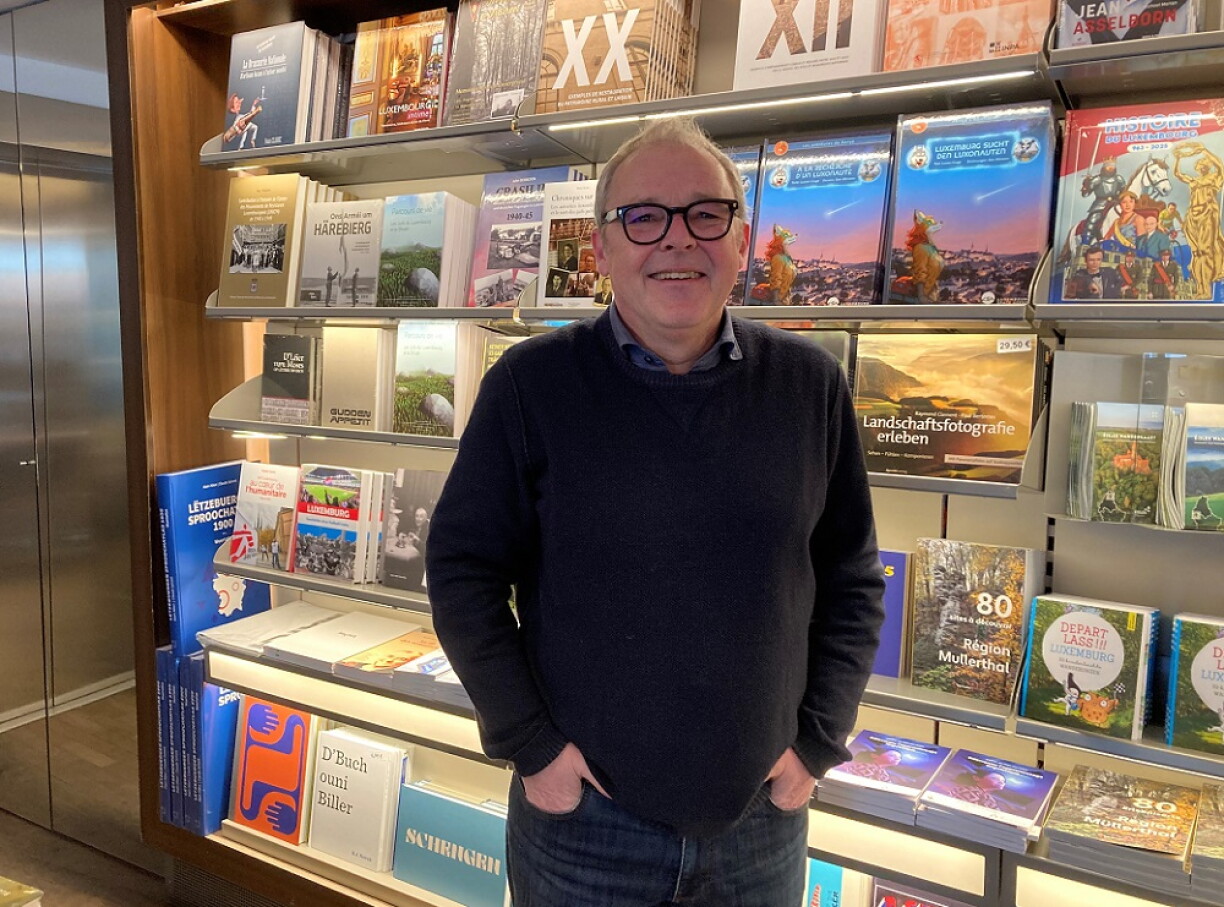
The start of the school year is just around the corner, and for the first time in decades, Jean-Claude Henkes is not to be found in a bookshop selling schoolbooks. He does miss the buzz of a fresh start a little, but he is also making the most of his retirement, which he took on 1 January 2026.
Working in a bookshop had been a childhood dream for Henkes. That dream came true on 1 August 1981, when he began working at the Ernster bookshop on Rue du Fossé in Luxembourg City.
Henkes explained that booksellers receive a huge volume of information from publishers, which means that they are often told four, five or six months in advance what a given publisher intends to release, well before the titles reach Luxembourg, Germany or France, so that shops can prepare themselves for a literary season. Publishers, in effect, tell them in advance what is coming down the line. He and his colleagues also read an enormous amount of book reviews every day, since it is impossible to read every book from cover to cover. What matters, he said, is knowing what is being published. Booksellers then decide for themselves what they will order, since they also know their public and their clientele.
Henkes pointed out that at the shop in the capital, some twelve people work side by side, each with their own area of responsibility. One colleague looks after French literature, another after German literature, others are in charge of children's books or non-fiction, from gardening to cookbooks. He himself, for the past fifteen years or so, has focused above all on Luxembourgish literature.
Over those 40 years, Henkes said, he has watched Luxembourgish literature evolve, and seen which publishers have come into the fold and which have dropped out. In the 1980s, the conversation revolved largely around a handful of Luxembourgish authors, whether Rewenig, Manderscheid or Helminger. Over the past two decades, however, Luxembourgish fiction has "exploded". A great deal is now being published, much of it very fine work, he said, adding that in Luxembourgish non-fiction as well, the quality on the market has reached an impressive level.
Books have always been Henkes's passion, and yet in 1996 he decided to do something entirely different. He had started at Ernster in 1981, and after fifteen years he decided to stop and move on. That was when he made up his mind to cycle across West Africa. He bought himself a decent bike and, at first, thought about cycling across the entire African continent, before quickly realising just how vast that undertaking would be.
He ended up spending three years travelling around West Africa, by bike. It was an incredibly enriching experience, he said, in which he met a great many people, and did so alone. Precisely because he was travelling by himself, he crossed paths with some genuinely warm and interesting characters. It felt, he added, a little like going to school. When you spend three years on another continent, on your own, everyday life is completely different from working in a bookshop here from morning to night.
He also met a great many people along the way, including two very well-known writers. One particularly striking encounter, Henkes said, took place in Tangier, where he met Paul Bowles. He spent an entire day at Bowles's flat, was able to put a great many questions to him and shared a meal with him. In a small aside, Henkes noted that Bowles was the author of "The Sheltering Sky", which was later adapted for the screen by Bernardo Bertolucci.
Also in Tangier, he met Mohamed Choukri, whose acclaimed novel "For Bread Alone" has been translated into some 40 or 50 languages. Throughout the three years, Henkes said, he met people every single week. He also spent a great deal of that time sleeping at other people's homes rather than in hotels. On a bike, he pointed out, you travel very differently and do not have the budget to spend every night in a hotel, which is why staying with local people was such a rich part of the whole experience.
RTL editorial note: Paul Bowles's novel inspired Sting to write the song "Tea in the Sahara" for The Police's 1983 album "Synchronicity".
Unlike today, Henkes did not carry a mobile phone with him at the time, and he only called home at most once or twice a month. It was a trip made on a tight budget, and hotels were a rare exception.
Most of his nights, Henkes said, were spent with perfectly ordinary families. He would arrive in a village by bike in the late afternoon, and, as tends to happen when a white person shows up on a bike, a group of children would quickly gather round him. He would then often ask where he might be able to spend the night, and, more often than not, all the children wanted him to stay at their family's house. He would end up spending a night with one family, or sometimes two or three nights with the same household.
When he pushed on to the next village on his bike, the family he had just left would often tell him, on arrival, to look for a particular person, whether a young cousin or some other relative. That was how it tended to work. It is remarkable, he added, that for three years he essentially operated in that way, always staying with families he did not know at all, and, when he did get to know them, only ever for a very short spell.


Henkes's journey began in North Africa, in Morocco, where he spent close to a whole year. From there he moved on to Western Sahara for a few months, then to Mauritania for six months, then Senegal for another six months, before cycling on to Mali, where he stayed for a further six months. By that point, his bank account in Luxembourg was running rather low, and the decision to head home came together relatively quickly. Three years, he said, had been enough. He briefly toyed with the idea of pushing on to Burkina Faso or Ghana, but ultimately felt he had had his fill.
When he returned to Luxembourg, Henkes said, it was clear he would need to slot back into professional life. Even then, it was not immediately obvious what that would look like. The question of whether he would return to the bookshop, and to his boss Fernand, or do something completely different, did not resolve itself straight away. He briefly considered working in development cooperation, given that he had just spent three years on African soil and knew the situation there reasonably well.
In the end, Fernand got in touch and the two met up in the capital. Fernand told him he was about to open a new point of sale at the City Concorde and asked whether Henkes might not want to lend a hand in recruiting and training staff. Henkes said it was a generous offer, though he was not entirely sure whether he wanted to go back into the bookshop world. In the end, he agreed to give it three or six months and to see how things went. As it turned out, those months stretched into another 25 years, he laughed.
Can Henkes really leave the world of books behind that easily? Not at all, he readily admitted. It is not straightforward, he said, to spend so many years working in a profession with your heart and soul, only to stop from one day to the next. He would not do that. He intends to keep one foot in the bookshop and to help out with external events alongside his former colleagues, whether setting up book stalls, being on hand when the Pierre Werner Institute invites authors, when the National Literature Centre of Luxembourg (CNL) organises round tables in Mersch, or when the National Library hosts a conference. The Walferdange Book Days, as he had already mentioned, remain something he genuinely looks forward to, and he said he would gladly take part in one, two or three of them in the years to come.





