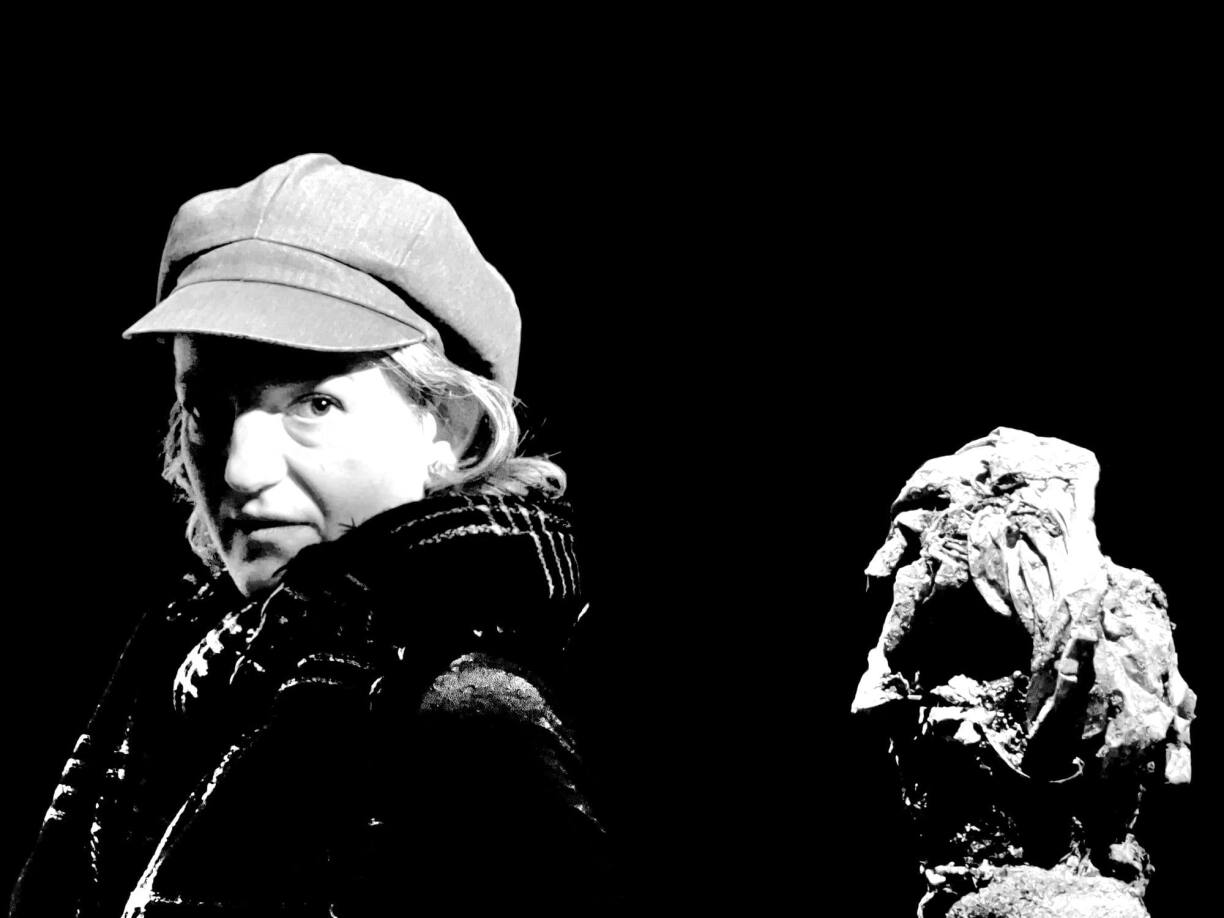
The idea for this project came during the Visite modèle, that provided an introduction to the exhibition Theatre of Cruelty, an exhibition inspired by the works of Antonin Artaud, at the Casino. While walking through the exhibition , I imagined a person who was “lost”, moving through space.
The exhibition itself was already dark, which enhanced this impression. I envisioned a psychiatric patient, speaking to himself, subtly disturbing the exhibition environment, and the public. At the same time, the curator told that Antonin Artaud had a psychiatric illness and had written beautiful texts.
This moment sparked the idea to work with his writings. I was inspired. I imagined this figure speaking Artaud’s words from memory, reciting them spontaneously throughout the exhibition space.
This idea developed in my mind and I asked the director if I could work it out.
Both the curator and the director of Casino were very enthusiastic and gave me full artistic freedom. What I find especially important is that the institution recognized this work not as mediation, but as art: I was paid as an artist rather than as a guide. This openness to rethinking what art can be is, to me, an important part of the project.
The structure followed a theatrical logic, yet subverted it. Artaud believed that theatre should not be confined to the stage, but should happen amongst people, directly engaging them. I selected texts by Antonin Artaud that resonated with the exhibition. At the end of the performance, my collaborator Hulbert Wellenstein initiated applause. This caused the audience to start applauding automatically.
The gesture was intentional: it questioned why we applaud, how easily we follow collective behaviour, and how rarely we reflect on such automatic responses.Through this performance, I also wanted to encourage people to interact more with each other in society.
Today, we are often fixed in who we think we are, and we automatically exclude others who do not fit into that image. This kind of exclusion happens unconsciously – it is an automatic behaviour, much like applause.
At the end of the performance, people began applauding even though I was no longer present. Someone started clapping, and the rest followed, without questioning why.
In the same way, society trains us to look away from what is considered 'negative': old age, illness, trauma, depression and death. We behave as if these things do not exist, even though they are an inevitable part of life.
By ignoring them, or avoiding them in conversation, we turn away from a part of reality and in doing so, we create a society that is fragile and disconnected. At least, this is how I see it. The point of this performance is precisely this: to wake people up.
People often play given roles without questioning them. They wake up, go to work, ignore their surroundings, and continue their routines without reflection.
Another central theme of the project is society’s tendency to hide or exclude what it finds uncomfortable, such as mental illness, suffering, and those who exist outside social norms.
Antonin Artaud himself lived outside these norms. He suffered from meningitis at a young age, underwent electroshock treatments, and was institutionalized for long periods, yet he created extraordinarily powerful texts. His life and writings reveal themes of exclusion, madness, and society’s deep discomfort with what it prefers not to see.
This performance aims to bring such figures and such realities back into visibility.
This project is important to me because it marks my first recognized performance work. While I have previously experimented with alternative guided tours and philosophical approaches to mediation, this was the first time my work was officially acknowledged as art.
On a personal level, the project revolves around a recurring question: Who am I? I believe this is a question people should ask themselves more often and one they should not be afraid to answer differently over time.
Identity is not fixed. Just as I moved from philosophy teacher to journalist to guide to artist, people should allow themselves to change and develop.
Through this performance, I, Anne Havik, invite the audience to come face-to-face with what is usually looked away from, and, in doing so, to reconsider their own position as observers, participants, and social subjects.
This project represents openness: to transformation, to questioning, and to redefining roles both in art and in life.
Written by Margaryta Aleksandrova
ROUX Student Magazine is a student club at the University of Luxembourg. Everything in the magazine is 100% made by students for students and now for you :). The article you just read was featured in our Issue 27. You can find all issues digitally or grab the newest one for free physically in our monthly publication events. Contact us on instagram: @roux.magazine or email us on paper.roux@gmail.com.


