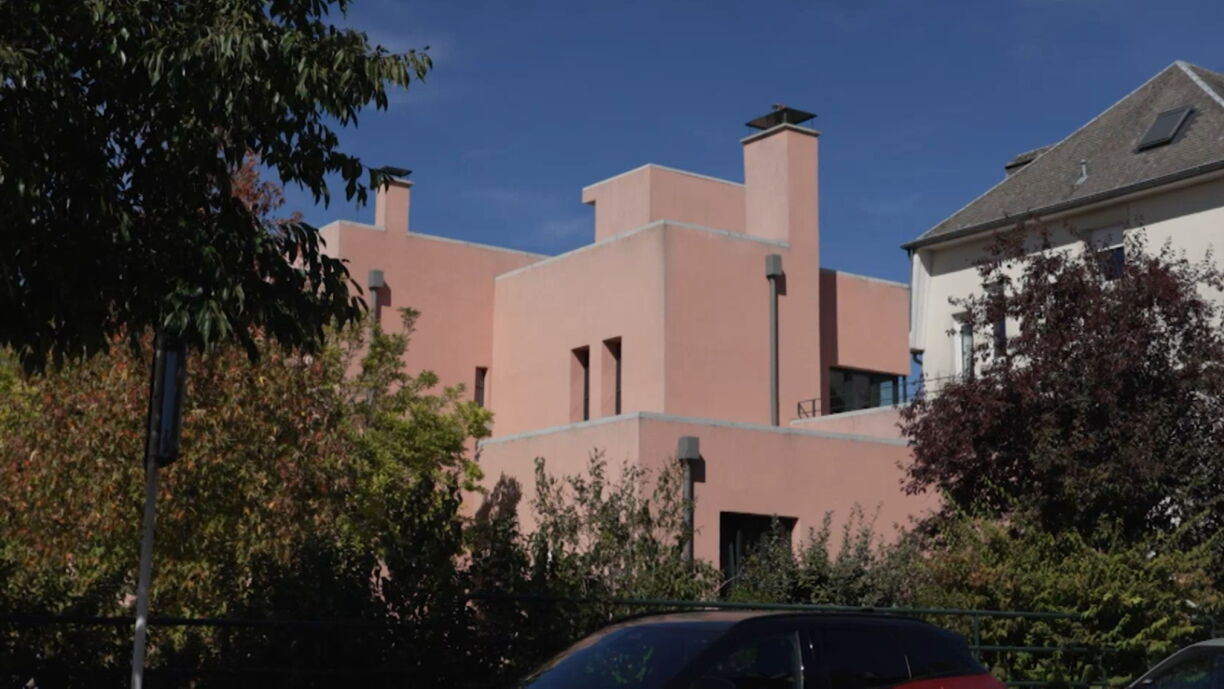
At first glance, Villa Kutter is striking for its unusual colour, but a closer look reveals other distinctive features that set it apart from neighbouring houses in Limpertsberg.
With its clear straight lines, elongated narrow windows, and absence of a traditional roof, the house stands as a rare example of a specific architectural style in Luxembourg.
These elements were restored to prominence nearly 80 years after its construction, thanks to the efforts of a Luxembourg architect.
Villa Kutter owes its name to one of its first residents, the Luxembourg painter Joseph Kutter. Born in 1894 in Luxembourg City, Kutter played a significant role in the history of Luxembourg art, building a career that saw the influence of German expressionism reflected in both his brushwork and subject matter.
In 1928, Kutter commissioned the architect Hubert Schumacher to design a house. Schumacher, inspired by Kutter's ideas, produced a blueprint in what was then considered 'modern architecture'.
The Bauhaus movement originated in 1919, when architect Walter Gropius founded an art school whose name would come to define a distinct approach to architecture and design.
"Bauhaus" has since become synonymous with a style marked by simplicity and functionality.
Key features of the Bauhaus, or, as art historians would call it, the 'classical modern' style, include cubic shapes, large windows, flat roofs, and the use of materials such as concrete, steel, or glass.
Villa Kutter was among the first modernist houses to be built in Luxembourg. However, during the years Joseph Kutter and his family lived there, a series of modifications by different architects gradually undermined the house's original, distinctive style.
When architect Diane Heirend took on the renovation of Villa Kutter in 2019, she set out to recapture the spirit of the original artist's residence.
Her goal was to restore and repair the house, transforming it into a modern home while respecting its historical significance.
Heirend focused on recovering key elements of the Bauhaus style, such as the large glass façade, to preserve the architectural integrity of the building.
Today, Villa Kutter remains a symbol of architectural transition in Luxembourg. Even as contemporary architecture tends to favour cubist forms, Villa Kutter continues to stand out for its unique character.
The house both highlights the importance of preserving historic buildings and demonstrates how such structures can be modernised without losing their original identity.


