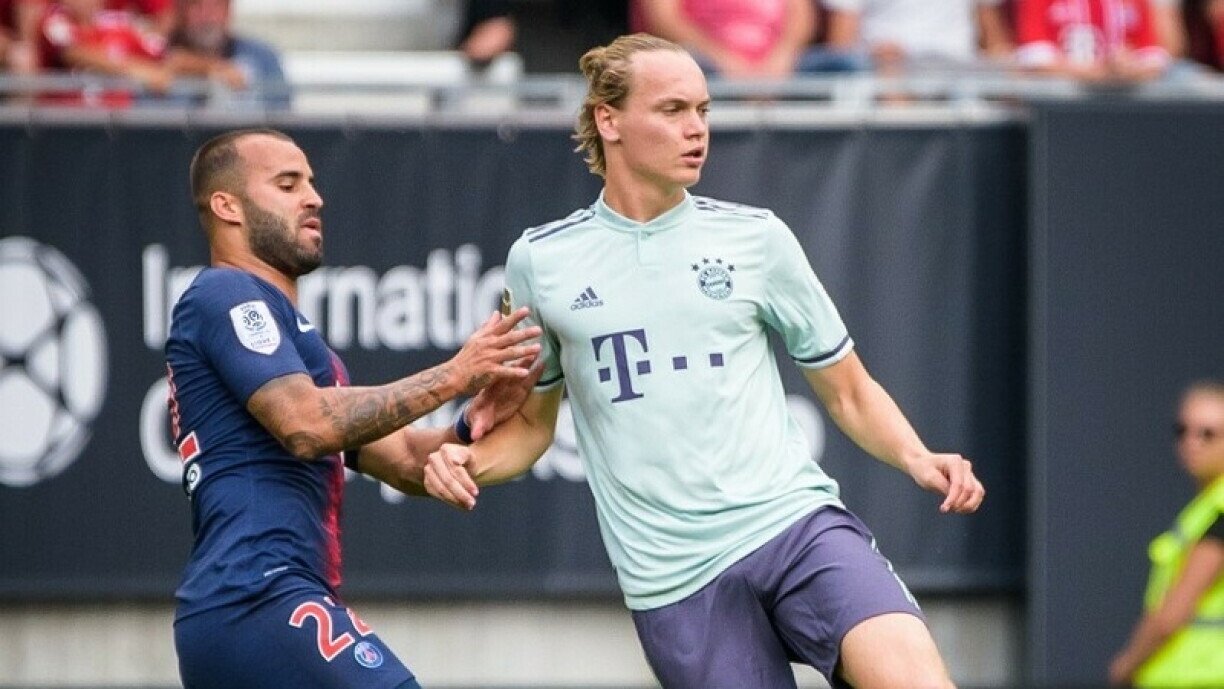
A journeyman at the ripe old age of 25, Ryan Johansson has already had an eventful start to his professional career. Born and raised in Luxembourg, he began at Bayern Munich before spells with Sevilla, Fortuna Sittard, SC Freiburg, Wehen Wiesbaden, and now 3. Bundesliga side Preußen Münster.
While moving between countries and clubs has sometimes made it difficult to feel at home, Johansson believes the experience has been an advantage – exposing him to different cultures, helping him learn six languages (including fluent Luxembourgish), and teaching him how to connect with people from all backgrounds. He says those relationships have also helped him understand coaches and teammates better, both on and off the pitch.
His time at Bayern also gave him the opportunity to learn from some of the biggest names in the game. As a 17-year-old training with the first team, Johansson was particularly struck by the example set by Arjen Robben, who, despite being in the latter stages of his career, would regularly arrive two hours before training and stay long after his teammates had left.
For Johansson, watching Robben's dedication first-hand was as valuable as anything the Dutchman told him.
At just 18 years old he played at the Allianz Arena against Tottenham in a pre-season friendly tournament final, a potential sign that they were looking to integrate him into the first team setup. It was also during that match that he was contacted by other clubs in regards to a move with more first team opportunities.
Having a Swedish father, an Irish mother, and being born in Luxembourg meant Johansson had three countries to choose from when it came to his international future, representing each at youth team level.
At 17, he ultimately chose Ireland, switching from Luxembourg to represent the Boys in Green in the u21 European Championship qualifiers. Ireland had been in regular contact with him, checking in on his progress at club level and making clear from his first friendlies and tournaments that they wanted him to declare for Ireland and believed he could go on to play for the senior team.
For a teenager, the prospect was hugely exciting. "You feel like the only way is up and nothing can slow you down or go bad", Johansson recalls. The support of his parents and family members living in Ireland also played a huge role in his decision.
But making the switch was not straightforward. Johansson had to go through a FIFA clearance process, something he describes as a strange period to experience so early in his career.
"When you're that young playing football and you just want to kind of feel free and play for who you want, it's obviously very tough to kind of go around it", he says, while acknowledging why such regulations exist.
The process was eventually resolved, allowing him to continue his international career with Ireland.
What Johansson and his parents did not fully understand at the time, however, was that choosing Ireland at youth level could make a return to Luxembourg far more complicated. He says he had understood the rules differently, believing that a player could switch back until they had represented a country at senior level.
"Myself and my parents, we didn't know that you weren't allowed to then switch back to the original country", he says. "I always understood that the rule was if you played for the first team, then you couldn't switch back."
It was only later that Johansson realised the implications of the decision he had made at 17. Now 25, and having spent much of his career moving between countries and clubs, he says the possibility of representing Luxembourg has increasingly come back into his thoughts.
"I think Luxembourg's an extremely great option to play for", he says. "I've expressed it to a lot of people and to my family how amazing it would be to go back home to the place where I was born and grew up in and to be able to play national team football for that country."
For Johansson, the connection to Luxembourg has remained strong despite spending years abroad. He still regularly returns, has friends and family here, and describes the country as his "home away from home".
That desire is now far more than a passing thought. Johansson says he has considered the possibility for several years, despite recognising that the current eligibility rules stand in the way of a switch.
And if the eligibility hurdle could somehow be cleared, there would be little hesitation. Asked what he would do if Luxembourg coach Jeff Strasser called to tell him FIFA had approved the switch and invited him into the national team, Johansson's answer was immediate. "I'd be on a plane tomorrow, probably, if they had a match tomorrow."
Unfortunately for Johansson, FIFA's current rules generally allow a player to change international association only once. The exception is where "the player was granted a change of association but was not fielded after the decision", under Article 10(5) of the Regulations Governing the Application of the FIFA Statutes. That does not apply to Johansson, who made five appearances for Ireland's U21s after switching from Luxembourg.
RTL contacted the Luxembourg Football Federation (FLF) about Johansson's case. The federation categorically ruled out the possibility of him representing Luxembourg again under the current rules.
His situation offers an interesting contrast with Brian Madjo. The 17-year-old made three senior appearances for Luxembourg in 2025, but all were friendlies, meaning he remained eligible for England. He subsequently turned down a Luxembourg call-up and was selected for England U17, although he has yet to make an official senior international appearance.
The two cases are different, but they show how important these decisions can be for young players with more than one nationality. Johansson admits that he and his parents did not fully understand the consequences of choosing Ireland at 17.
Madjo has taken a different path, and only time will tell whether that decision ultimately proves to be the right one for his international career. For Johansson, there is no such uncertainty – the decision he made as a teenager is still shaping his international future more than seven years later.





