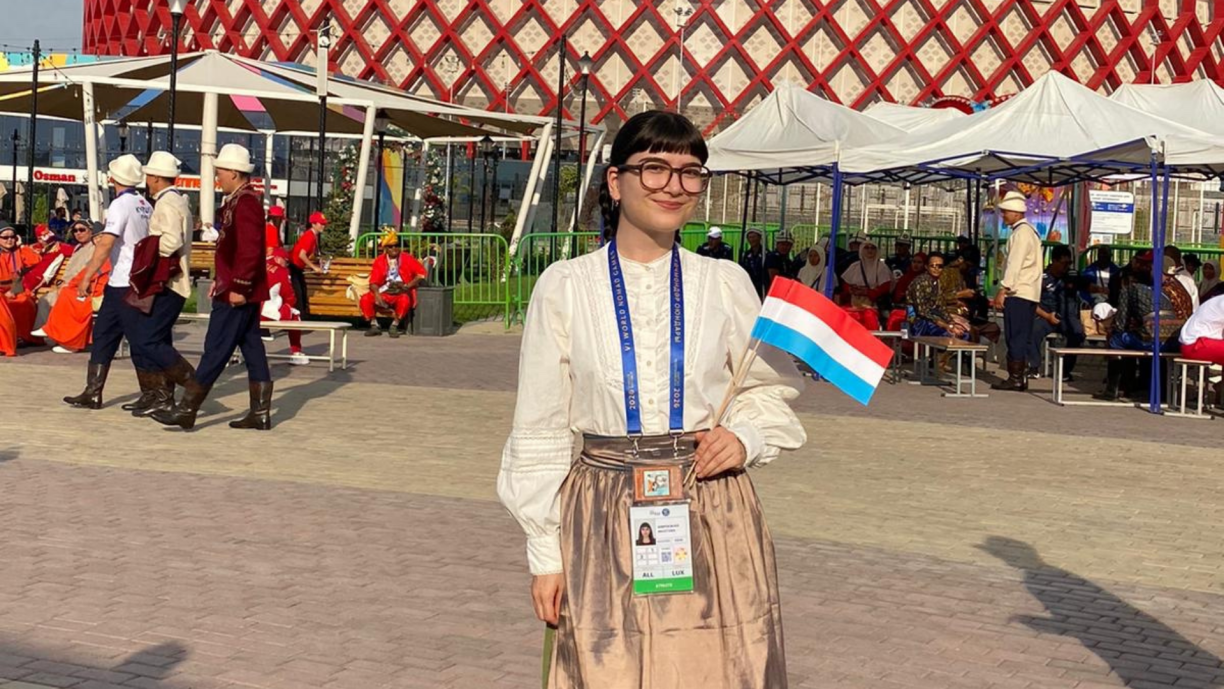
Amidst all the 'stans' lies perhaps the most unknown and, without doubt, one of the hardest to spell: Kyrgyzstan – this year's host of the World Nomad Games. In 2026, the Grand Duchy has one athlete representing them at the games: Luxembourg-born Anastasia Iampolskaia, a social and cultural anthropology master's student at the University of Vienna, who will be participating in Toguz Korgool, a traditional Kyrgyz strategy board game in which players move stones between pits, aiming to capture the most pieces from their opponent.
The question on most people's lips will be: what are the World Nomad Games?
In layman's terms, they are like the Olympics of Central Asia – but instead of athletics and swimming, competitors take part in traditional sports practised by the region's nomadic peoples.
This edition will feature 43 sports, more than 4,000 athletes, and 90 participating countries. Athletes will compete in a host of events, including the best-known, Kok-Boru – essentially polo played with a headless goat carcass – as well as Er Enish, a form of horseback wrestling, and traditional hunting alongside falcons and dogs.
However, sports is not the only aspect of the games, as there will also be scientific and cultural programs, with intellectual games that test competitors' logic, strategic thinking, and memory. An extensive list of all the disciplines can be found here.
The Games opened on Sunday, 31 August at the sold-out Bishkek Arena Stadium in Kyrgyzstan, in front of some of the most powerful people on the planet. The Shanghai Cooperation Organisation summit (SCO), also held in Bishkek, drew a host of world leaders, including Chinese President Xi Jinping, Indian Prime Minister Narendra Modi, President of Turkiye Recep Tayyip Erdoğan, as well as Russian President Vladimir Putin, providing the games with a high-profile international backdrop.
The heightened security checks due to the SCO were there for all the athletes to see, with strict measures in place, and Iampolskaia even stating that she was informed by a credible source that the mayor of Bishkek had informed its residents to leave the city during that period.


Anastasia Iampolskaia carried the Luxembourg flag at the Bishkek Arena and expressed the "surreal" nature of the experience. You can watch Luxembourg's sole representative at the opening ceremony here:
Fundamentally, competing at the highest level of Toguz Korgool is not Iampolskaia's main concern. Instead, she is interested in the anthropological impact of the World Nomad Games. As part of her degree, she is required to take part in a field trip and, this semester, the focus is the anthropology of sport.
"They told us, 'We're not going to just research the Nomad Games, but we're also going to participate'", she says with a wry smile. However, being registered as participants has its perks. They have access to all areas and direct contact with athletes and organisers, allowing them to conduct interviews for their research.
Iampolskaia is part of a group studying the impact of such a large-scale event on spectators, particularly local people. The Kyrgyz State Agency for Tourism Development is expecting more than 100,000 visitors over the six-day event.
Their research was not limited to the event itself. They arrived in Kyrgyzstan a week early to travel around the country and gather ethnographic data, speaking to locals and delving into the culture before participating in the games.
"We lived in yurts and saw how the locals milked horses, to see the nomad lifestyle", explains Iampolskaia. They went on to make kurut, a traditional snack made from fermented milk, which is strained, shaped into salty cheese balls, and then dried in the sun.
Although traversing across the steppes is largely a thing of the past, rural families still practise transhumance, the seasonal movement of livestock between lower and higher pastures, taking horses, sheep, goats, and yaks to high-altitude mountain pastures during the summer months.
The Nomadic Games Luxembourg ASBL and its president Mathieu Schiltz Stoos are very excited to have Iampolskaia representing Luxembourg at the games. "It's not just about sportsmanship, it's also about diplomatic togetherness. It's not just nomadic nations – we were all once nomads – it's a way to show our presence in Eurasia, and not just see it as a buffer zone between China and Russia, through soft power and by showcasing our cultural power", he says.
For Iampolskaia, the World Nomad Games are about far more than the result of a board game. They are an opportunity to immerse herself in a culture she has travelled thousands of kilometres to study, while experiencing it from the perspective of an athlete.
And, as Luxembourg's sole representative among thousands of competitors from around the world, it is an experience she will not forget in a hurry.





