Pinpointing title contenders and ranking the teams based on 90 minutes of play and a few transfers would be a fool’s errand, but the first gameweek has offered us some insight into just how the teams' preparations for the 2026/27 season have been going.
As far as transformations go, Mondorf’s board and supporters can be quite happy with their progress. Since they ensured their qualification for the UEFA Conference League, they stepped up their recruitment, attracting players with European CVs and years of experience at the biggest clubs in the country and beyond.
Despite losing manager Jérémy Deichelbohrer to UNA Strassen, their appointment of Martin Forkel more or less guaranteed a smooth transition. Indeed, the German technician got the club’s season up and running, changing into his preferred system with three defenders, and taking Georgian opponents Dinamo Tbilisi to extra time in their heroic pursuit of a first international win.
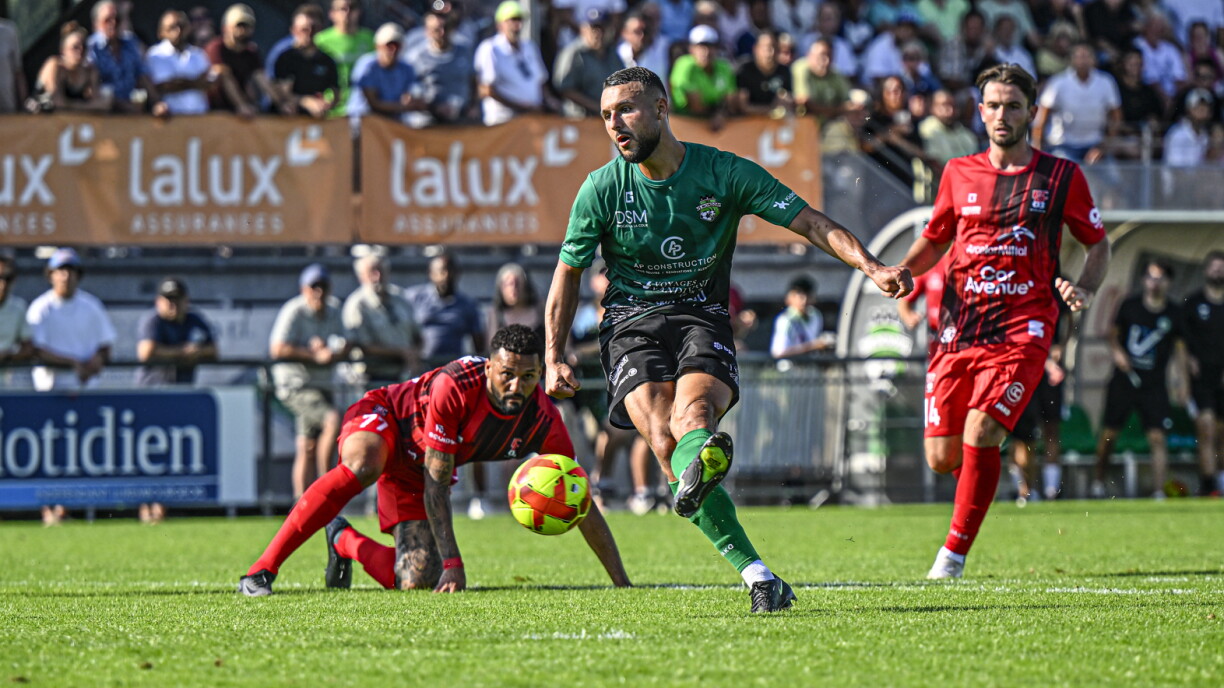
Although that adventure ended in elimination, it served as the perfect dress rehearsal for the BGL Ligue. Facing last season’s cup winners FC Differdange, the Angry Goats knew they would have to wait for their opening. They enjoyed less of the ball than their opponents, but showed no mercy in attack.
For all their attacking woes, it was FCD who opened the scoring after the half-hour mark, when Rafa Pinto jumped the highest to meet Geoffrey Franzoni’s cross. It didn’t take long for the Greens to come up with their answer, when Hatim Far latched onto Mehdi Kirch’s flick-on and watched as veteran goalkeeper Felipe punched the ball into his own net.
The second half then started with a defensive scare as Dwayn Holter, following up on his forgettable showing in Tbilisi last month, took a hard touch and gave the ball away to Rafa Pinto with ease, whose pass found makeshift strike partner Sébastien Thill for a tap-in.
In general, it was Differdange who controlled more of the proceedings throughout the match and crafted more chances. Their lack of an out-and-out centre-forward could cost them dearly over the course of the season, and it bit back with the worst possible timing on Sunday: in the fourth minute of second-half stoppage time, another defensive blunder gifted USM all three points.
Just like Holter, Leandro is another experienced defensive midfielder. Both have been playing in the backline for a relatively short period of time, and their shortcomings have been on display ever since, offering a constant reminder how simply playing players in their natural positions can often be so much more beneficial for a team than simply fielding your 11 most-skilled options.
Leandro’s two fumbles – an awkward slip and a helpless fall as Loris Tinelli sent him flying – brought the hosts back into the game, and eventually turned the game on its head.
Last year, the cracks had already shown on the great Differdange team of the decade. This time, they face serious issues in front of both goals. In contrast, Mondorf look capable to keep punching above their weight – even more so than last season.
For all newly-promoted sides to avoid the loss on the first matchday, the chances were rather low. Wiltz 71 and Etzella Ettelbruck faced each other for a start, meaning only a draw could have saved them both. Walferdange hosted US Hostert on a historic occasion – their first-ever BGL Ligue game. Rumelange had to beat a Swift Hesper side trying to climb back from their 12-point deduction.
Remarkably, they all passed their first test. Etzella’s Simon Yamba Mubeya scored the first goal of the season from a rebound, which was cancelled out in the second half by returning marksman Benjamin Romeyns. Etzella can kick themselves for not scoring another late on at arguably one of the easier match-ups in the fixture list, but ultimately had to settle for a tie.
For all Hesper manager Salem El Foukhari has reiterated ahead of the season about his team’s utter belief and cohesion, individual quality is still running short at Holleschbierg. Rumelange, hardly a powerhouse themselves, came out unscathed thanks to Pedro Mendes’ decider, and secured a vital three points early on.
Hesperange were already facing an uphill battle before the season started, due to a number of important departures and no arrivals, thanks to their international transfer embargo for unpaid salaries over previous years. And, after being docked 12 points, their survival borders on the unthinkable. To lose games like the Rumelange one can quickly damage the mood in the dressing room. The moment the players’ belief evaporates, the club could be in for a rocky season ahead.
Walferdange had similar plans for the transfer market as Rumelange, and decided to largely keep the crop of players that got them to the top-flight in the first place, instead of tinkering with hit-or-miss foreign journeymen on higher salaries. It is a brave approach that has cost teams in the past (think Mamer or Bettembourg), and the final iteration of this squad still looks quite inexperienced at this level.
None of that was on show against Hostert for their historic BGL Ligue debut, though. Playing a fluid 4-3-3 with aggressive midfield positioning and smooth partnerships on the wings, Walfer dared to dream against Marco Martino’s high-octane Hostert side.
Of all teams, Hostert recorded the lowest PPDA (passes per defensive action, a metric measuring how aggressively a team presses back after losing the ball) in the first matchday, marking them out as the most intense and physical team out of possession. While testament to a busy summer and adept coaching, it backfired on Sunday.
When playing a high defensive line, you need defenders that have the recovery speed to get back in position and thwart a counter-attack. It is usually a tactic implemented by big teams with deep squads and skilled centre-backs.
Hostert do not fit either of those categories. As a result, Walferdange’s Patrick Macedo, a striker with zero top-tier experience under his belt, was left to make a run from the halfway line, completely unchallenged, on two different occasions – with no defenders in front of him whatsoever. Prolific as he is, Macedo duly bundled the ball in on both occasions.
Hostert’s aggression and numbers up front worked wonders in attack, on the other hand, with several big chances created. Volkan Ballıçalıoğlu had a dream debut for the team as he scored a four-minute brace on the brink of half-time. First, he finished off a nice run from Keliano Tavares, before nodding in from close range following a Sinan Altun corner.
What Hostert weren't expecting was for Macedo to have another trick up his sleeve. After a dubious penalty call, Walfer’s resident goalscorer dispatched his spot kick to the bottom corner, where Patrício Sancho failed to get a proper handle of it, poking it in instead.
Macedo is now 30 years old, but his prime might still be yet to come. Over the last two years, he netted 47 times in 57 appearances in the second tier. Has he been this good the entire time? In any case, his loyalty paid off as he now scored the first, second and third top-flight goals in his boyhood club’s BGL Ligue history.
Even though the domestic transfer window closed on 15 July, free agents and internationals are still free to sign contracts with Luxembourgish teams until the end of August. Clubs often use this time to make last-minute replacements in case of a key player departing or a long-term injury to a starter.
Upon seeing their first performances out there, some directors of football may still be tempted to make some adjustments before the window is shut. Several teams who avoided relegation with ease last time might be drawn into a dogfight unless they manage to bolster their squads with a true game-winner.
Looking at scorelines alone, Jeunesse Esch losing to Niederkorn by a single goal away from home might not look overly bleak. On further inspection though, they are the team lagging well behind everyone else on important statistical metrics after the first 90 minutes.
Having faced a team who finished behind them last year, Jeunesse’s young and talented XI seemed devoid of ideas with the ball. According to Italian data platform SICS, the Black-and-Whites conjured up only two shots in total – one of them being their only goal, Thibault Maquart’s breath-taking halfway-line lob.
Their two shots accumulated a total of 0.06 expected goals (a statistic measuring the likelihood of each shot ending in a goal based on a variety of factors). They only saw 28% of the ball, once again the least of any team.
Drawing conclusions so early on can be misleading, and it wouldn't be wise to write Jeunesse off. They started last season similarly woefully before getting in their groove and shooting all the way up to sixth place.
However, there are some worrying signs nonetheless. Setting up this passively against a Niederkorn side and relying on solid defending alone (with a rather attack-minded team) signals more of this approach to come. The Wasps might possess a few outstanding players, but aren’t quite up there with the best teams in the division. If manager Reinhold Breu plans to park the bus against upper mid-table opponents, there will be little scope for any attacking firepower.
For two other clubs, the circumstances combined for dreadful scorelines that might be fixed by replacing a cog or two in the system. Käerjéng (having lost 5-1 to Racing FCUL) and Victoria Rosport (conceding four against Strassen) are, in some ways, victims of two heavyweights itching to start their seasons in the best possible way.
Racing were one of the most eye-catching teams in the division under Yannick Kakoko two years ago. His departure brought some turbulent times last season, but hiring Stéphane Masala was an ambitious step to get the team from the City to where they once belonged.
Masala took a page out of Kakoko’s textbook and implemented the same 4-2-4 formation that excited many at Stade Achille Hammerel in 2024/25. Cue destruction.
Dominik Stolz has revitalised himself after last season’s drop in performances, and opened the game with a quick hat-trick, perfectly playing off his attacking partners and getting on the end of every goalscoring opportunity. Ronan Matuvangua also managed to get on the scoresheet, all before the end of the first 45 minutes. Robin Moutschen’s goal after a marauding run on the right flank offered little consolation for Käerjéng.
Less than a minute after play resumed, Ivan Lopes was already picking the ball out of his net again. This time, captain Farid Ikene was the culprit – and it proved to be the end of RFCUL’s havoc for the night. A couple of substitutions ensured everyone got some minutes, and the Sky Blues were more than happy to see out the remainder of the game and finish the day on top.
Käerjéng’s defence was visibly overwhelmed by the sheer number of players their opponents committed in attack. Failing to prepare for that was a mistake from coach David Vandenbroeck, but luckily for them, a four-man attack is not something they will encounter very often, nor is the devastating speed and intensity of Racing’s attacks.
For Rosport, things are looking much gloomier. We are speaking about a club that regularly sold its best assets and gambled on a few signings to make the same impact. For years, it worked. With the smallest squad and on a shoestring budget, Forkel masterminded a solid mid-table season year in, year out.
Last year, the roster regressed even further. Rosport played most of their games without a recognised striker, often relying on wingers upfront in a defence-heavy structure designed to keep opponents at bay and rely on their counter-attacking prowess.
Now Forkel has gone. In his place came Dean Léen, who suffered relegation with Mamer last season (although he technically left before their fate was confirmed). It increasingly seems like this time, there will be no genius standing on the sidelines to cover over all the cracks.
First things first, Léen deserves credit for trying to turn Rosport into a more proactive side. At times, his team appeared to be playing a variation of the old-school total football, with everyone chipping in in attack and defence, and very little coverage at the back.
While always good fun for a neutral, this approach yields little success against physically and technically superior teams in Strassen’s mould. One could only watch in horror as the hosts exploited the 60-yard gaps in-behind Rosport’s wingers ever too often, and tearing apart their two-man defensive structure.
Rosport did what many teams do nowadays, and played a variation of a 2-3-5 in attack. Without the ball, they often aimed to retreat into a 5-4-1 shape. Their transitions were slow and dysfunctional, though. In order to make that system work, the players need to slot into their new positions like clockwork. For Rosport, it seemed all over the place.
Strassen ended the game with four goals, two of them scored by talismanic forward Nicolas Perez. Kino Delorge and Omar Natami both found the net on their domestic debuts.
As the table shapes up in the next weeks, we will be able to see if these teams’ struggles continue. Jeunesse Esch can easily switch to a bolder game plan once they feel confident enough in its results. Käerjéng need numbers at the back, and their new goalkeeper has not impressed so far. As for Rosport, they are craving someone to score goals at a reliable rate, otherwise their radical tactic will bring more scorelines like Tuesday’s.





