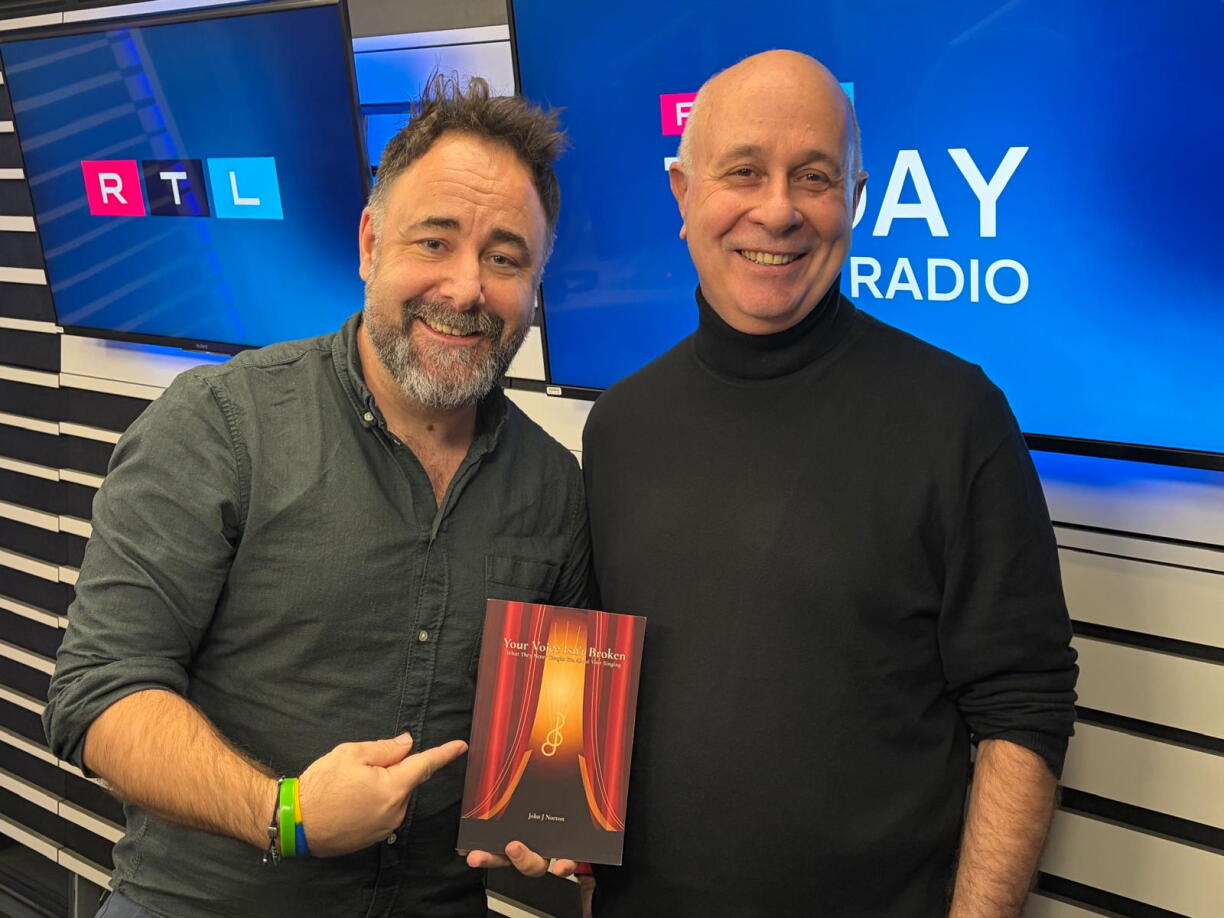
“Most people don't understand how their singing voice works. Once they do, they can get a better picture of what they need to focus on.”
There are people who can sing, people who think they can sing, and those of us who have been politely encouraged to leave the vocals to somebody else.
But according to singer and vocal coach John Norton, the difference between a confident singer and somebody convinced they're hopeless might not be nearly as great as we imagine.
Norton joined The Lunchbox on RTL Today Radio to discuss his new book, Your Voice Isn't Broken: What They Never Taught You About Your Singing, which draws on two decades of professional experience to help people understand how their voices actually work.
And, rather unwisely perhaps, I volunteered to become his latest pupil.
Norton's starting point is straightforward. Millions of people enjoy singing, or would like to, but become discouraged when the results don't match what they're hearing in their heads.
Some have received unhelpful criticism. Others have tried lessons, struggled with technique or simply decided that singing isn't something they're capable of doing.
His book is intended to challenge that assumption.
Rather than burying readers in technical terminology, Norton has attempted to explain the fundamentals in accessible language, whether someone sings in a choir, performs in a band or simply wants to feel more confident.
“I've taken what I've learned as a professional from 20 years, and I've put it down in very basic, no BS terms,” he explained.
For Norton, understanding the physical mechanics of singing is the first step towards improving it.
And that begins with recognising that the voice we hear inside our heads isn't necessarily the one everybody else hears.
Anyone who's ever listened to a recording of their own voice will know the peculiar sensation of wondering who on earth is speaking.
Norton explained that the sound we perceive while singing is influenced by vibrations travelling through our bodies, whereas other people hear the sound travelling through the air.
That difference can make it difficult to judge our own tone and pitch accurately.
It's one reason he believes a good vocal coach can be so useful: they provide an external perspective on what the singer is actually producing.
He also shared a simple trick.
By cupping one hand around an ear, singers may get a different sense of their own voice, helping them monitor pitch and tone.
It isn't a scientifically precise substitute for proper feedback, he readily acknowledged, but it's something he has used throughout his professional career, particularly when performing in challenging acoustic environments.
I suggested it sounded suspiciously similar to the old trick of checking your own breath by breathing into your hand.
Fortunately, he had rather more convincing advice to follow.
When asked for two practical tips to improve singing, Norton didn't begin with pitch, melody or musical ability.
He began with breathing.
He encouraged singers to become more conscious of their breathing patterns and to avoid unnecessary tension around the throat and neck.
His second point was that singing involves considerably more than the vocal cords themselves.
“Singing is physical. It's not a question of cupping your hands, like I used to do in an amateur choir, and hoping and praying.”
Norton believes singers need to engage their breathing and supporting muscles rather than attempting to force everything through the throat.
He describes the body as the power source behind the voice, with the vocal apparatus producing the sound.
It's a distinction that can take time and practice to understand, particularly for beginners who instinctively concentrate all their effort around their neck and throat.
But technique, he argues, is only part of the story.
For all his emphasis on breathing, posture and physical control, Norton believes a performance ultimately succeeds or fails on something far less mechanical.
Emotion.
It doesn't matter whether somebody is singing pop, rock, jazz, blues or classical music. Audiences want to feel something.
“The audience comes to listen because they feel an emotion. Whether you sing in a raw way or whether you sing like me in a cultivated classical way, it doesn't matter.”
That emotional connection, he explained, isn't simply produced by the mouth or vocal cords. It comes from the whole performer.
Which brought us rather neatly to the part of the interview where theory became practice.
Having spent several minutes explaining that Steps couldn't sing, He was invited to prove it.
Norton produced a note and asked Steps to repeat it.
The result wasn't exactly something you'd rush to release as a single, but it did provide an opportunity to demonstrate what he'd been talking about.
He explained that while I had managed to reproduce the pitch, I was relying too heavily on my throat rather than supporting the sound through my body.
“The only difference between you and me is you've heard what I've heard and you've translated that into a sound,” he said.
“With time and a little patience, you can make that adjustment.”
A second attempt revealed another issue: my breathing was rather too shallow.
But there was encouragement, too.
I was on the note.
Which, considering my expectations going into the experiment, felt like a modest triumph.
Norton explained that developing the connection between breathing, body and voice takes practice, but that improvement is possible even for people who have long since written themselves off as singers.
I'm not suggesting a recording contract is imminent.
But at least the diagnosis wasn't terminal.
Your Voice Isn't Broken isn't intended to be read like a novel.
Norton describes it as something readers can dip into, concentrating on the areas where they need the most help.
It's aimed at everyone from complete beginners to experienced performers looking to better understand their technique.
The book is available in paperback and Kindle editions through Amazon.
Naughton also offers further information, free audio and video resources, and opportunities to book coaching sessions through his website, johnjnorton.com.
And while my brief singing lesson didn't immediately reveal a hidden vocal superstar, it did demonstrate the central point of his book rather well.
Perhaps the problem isn't always that we can't sing.
Perhaps it's that nobody has ever properly shown us how.
Listen to the full conversation with Jon Norton on The Lunchbox, RTL Today Radio.


